Why accessibility must be the next strategic requirement for live chat
Public-sector and regulated organisations in the UK are no longer evaluating live chat as a convenience feature. They must treat it as a legal-access channel: meeting the Accessible Information Standard, Equality Act obligations and local procurement rules while maintaining data sovereignty and auditability. GOV.UK updated its guidance on accessible communication formats in June 2026 — accessibility is a current, mandatory design constraint for any service used by councils, police, NHS partners and housing associations. (gov.uk)

Hybrid AI live chat is the only commercially realistic way to deliver consistent, accessible support at scale without offshoring sensitive data. This post explains how to design UK-hosted hybrid systems that: reduce friction for vulnerable users, provide auditable decisions for regulated teams, and stay procurement-ready.
The market context: why hybrid wins in real-world CX
Organisations are experimenting fast with generative AI, but they prefer balance: recent enterprise research shows a strong tilt toward hybrid AI + human models rather than AI-only approaches. 73% of enterprise CX leaders now prefer a hybrid AI/human model for customer service. ()
Adoption is accelerating: AI usage in customer service climbed sharply to a majority in recent years — a statistic support signal that tools are moving from pilot to production. 61% of customer service teams reported using AI in 2025 according to sector research. ()
Design implication: procurement and technical teams must adopt hybrid patterns that prioritise onshore hosting, auditable handovers and accessibility-first content transformation — not monolithic cloud LLMs solved as a one-size-fits-all product.
Define the three tech classes (and why the difference matters)
- Rule‑based chatbots: deterministic scripts and decision trees. Great for simple, high-volume tasks (password resets, opening hours). They’re cheap and predictable but brittle when language varies or when you must comply with accessibility and legal nuance.
- Pure LLM bots: large language models that generate free text. They can sound fluent but produce unpredictable outputs, may hallucinate, and often rely on offshore model hosting or third-party APIs—raising data sovereignty and auditability concerns.
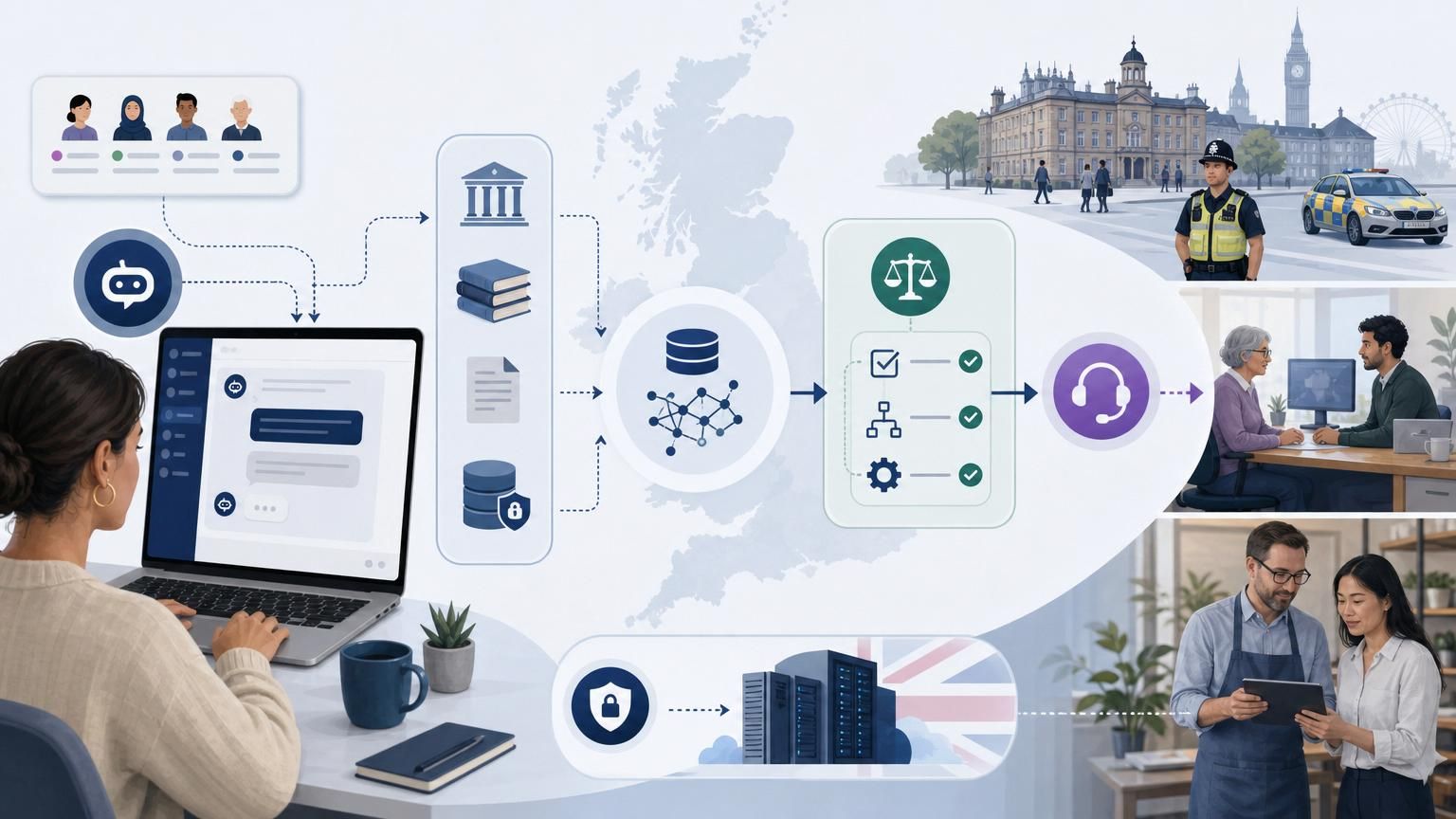
- Hybrid AI live chat: RAG-enabled onshore knowledge retrieval + LLM-assisted drafting + human-in-loop approval and auditable handovers. Hybrid systems combine fast automated triage with strict guardrails and human approval where policy, empathy or legal certainty is required. They are the practical default for UK public services that need both scale and control.
Use the hybrid pattern when your organisation needs to: meet legal accessibility, keep personal or sensitive records onshore, and produce auditable transcripts for regulated decisions.
Accessibility-by-design patterns for hybrid live chat
Delivering accessible chat isn't just about WCAG-compliant widgets. Hybrid AI makes accessibility operational:
- Plain-language automatic rewrites: AI suggests simplified, easy-read summaries of complex guidance and flags when a case needs an easy-read or audio version.
- Alternative-format delivery: on-demand audio output, downloadable easy-read PDFs, and signpost to BSL video content when required.
- Real-time need flags: automatically flag and record an individual’s communication needs (language, reading level, assistive tech) so every subsequent contact is tailored.
- Human escalation with context: when the AI flags a legal or complex case, the chat hands over the conversation with a summary, timestamps and clearly marked decision options for the human agent.
These patterns are aligned with NHS and Government Accessible Information expectations and make compliance demonstrable during audits. (england.nhs.uk)
Knowledge architecture: UK-hosted RAG + controlled updates
Accessible answers demand up-to-date, authoritative source materials (local policies, legislation, council guidance). Use a Retrieval-Augmented Generation (RAG) approach that keeps the knowledge base and retrieval layer on UK infrastructure. That design gives you:
- Data sovereignty: all training indexes and cached context remain under UK jurisdiction.
- Update control: local policy owners can push verified changes to the knowledge index and trigger revalidation workflows.
- Auditability: every RAG retrieval and human amendment is logged for procurement and FOI scrutiny.
IMSupporting provides RAG-based knowledge and hybrid AI chat workflows that are architected for these use cases — see their RAG agent knowledge feature and hybrid workflows for live chat. RAG-based AI agent knowledge · Hybrid AI chat workflows.
Operational rules and guardrails for public-sector deployments
Make these non-negotiable requirements part of your procurement spec:
- UK-hosted service with export control on transcripts and indexes.
- Automatic accessible-format generation (easy-read, audio, high-contrast) for flagged cases.
- Human approvals for any advice that affects legal rights, benefits or enforcement actions.
- Immutable audit logs of all AI suggestions, retrieval hits, and human handovers.
- DPIA and ICO-aligned risk assessment prior to go-live. The ICO’s guidance on AI and data protection remains the baseline for deployments handling personal data. (ico.org.uk)
Measurable benefits for councils, police and regulated teams
When done correctly hybrid AI live chat can:
- Reduce avoidable phone demand and waiting-room times by automating low-risk queries.
- Improve accessibility compliance by automating alternative-format delivery.
- Preserve audit trails for enforcement, complaints and FOI responses.
Statistic-style sentence: organisations choosing hybrid models report faster pilot-to-production cycles and higher stakeholder confidence compared with pure LLM experiments. Gartner found many leaders exploring conversational GenAI pilots in 2025 as the technology matured. ()
Procurement tips — what to ask vendors (and what to refuse)
Ask for:
- Proof of UK hosting and data residency guarantees.
- Demonstrations of easy-read / audio generation workflows using your council content.
- Exportable audit logs in human-readable form for FOI and compliance teams.
- A fail-open human handover that surfaces the AI’s source documents and confidence scores.
Refuse vendors that:
- Hide retrieval sources or refuse onshore indexing.
- Claim "fully automatic" legal advice without human sign-off.
- Cannot show accessible-output examples with your own content.
Quick implementation roadmap (12–16 weeks)
- Discovery: map top 50 chat intents and identify accessibility needs.
- RAG build: ingest authoritative local policies into a UK-hosted index.
- Templates: create easy-read and audio templates for common outcomes.
- Pilot: run a controlled pilot with hybrid handover rules and measure task completion and accessibility compliance.
- Scale: expand channels, train frontline staff on handover flows, codify audit processes.
Where to start today
If you manage support for a council, housing association or regulated team, start with a small legislative or benefits-oriented use case. Use hybrid AI to automate easy-read replies and log every handover. The market is clear: most enterprise CX leaders prefer hybrid AI + human models, and the mandate for accessible, onshore services has become non-negotiable. ()
For a UK-hosted, procurement-ready implementation that combines RAG knowledge, auditable handovers and accessible output generation, review IMSupporting’s platform and features at https://imsupporting.com/ and their RAG and hybrid workflow pages for technical detail. IMSupporting platform · RAG-based AI agent knowledge.
Ready to brief procurement? Book a demo or download the technical brief to see how UK-hosted hybrid AI live chat can make accessible communications measurable, auditable and operationally safe for your organisation. Visit https://imsupporting.com/ to take the next step.