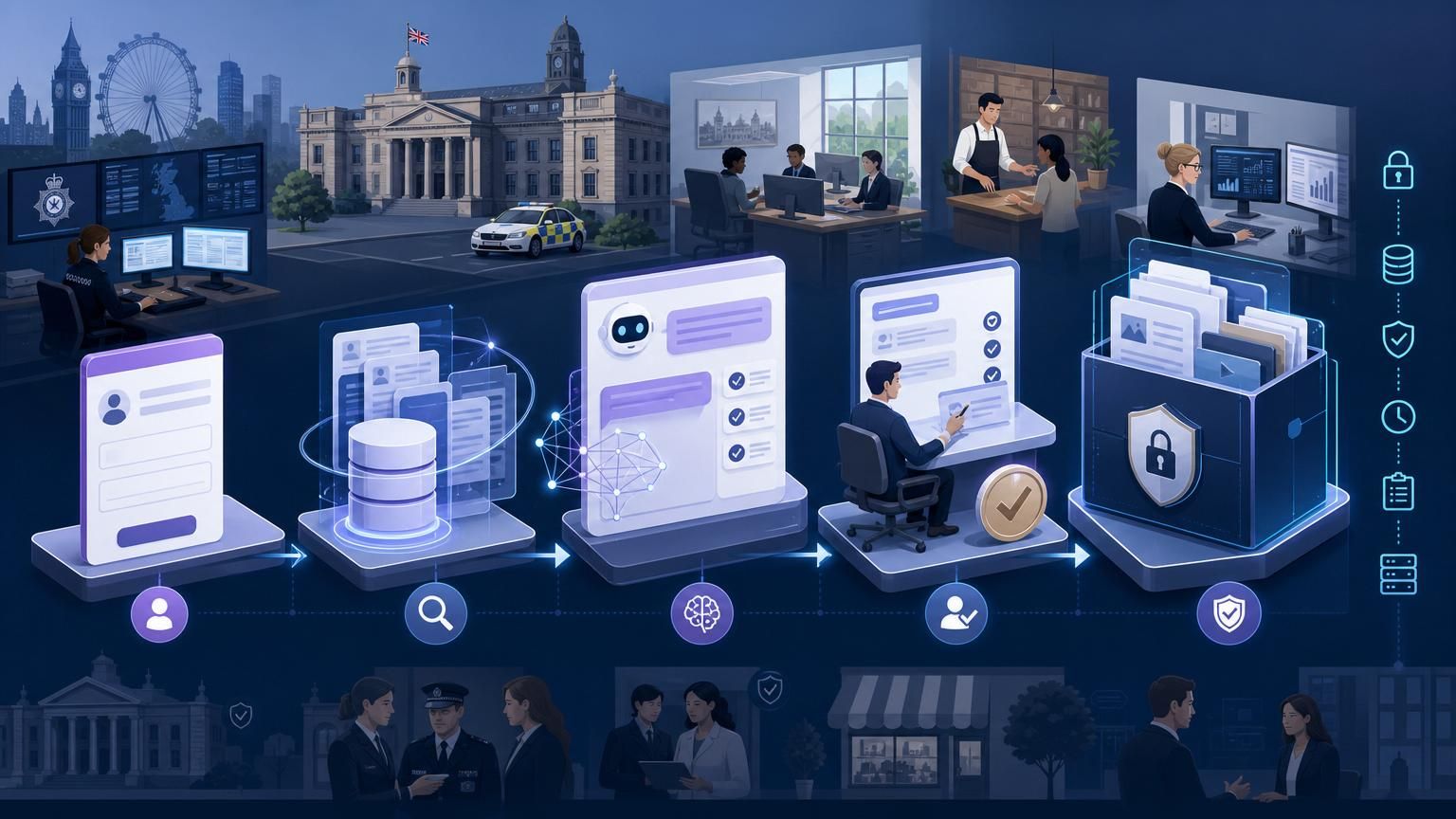
Why audit-grade chat matters for UK public services
Councils, police forces, housing associations and other regulated teams now expect more than quick answers. They need a verifiable, retention‑aware record that can be used for Freedom of Information requests, investigations and regulatory audits — without creating data‑protection or chain‑of‑custody headaches.

Live chat already sits at the point of first contact. With the right design it can be both a fast triage channel and the canonical, FOI‑ready evidence stream. But to get there you must solve three practical problems: grounding (answers must reference policy or law), provenance (who handled what and when), and containment (personal data must not leak to third‑party models).
Rule‑based bots, pure LLMs and hybrid AI: the practical differences
- Rule‑based chatbots: deterministic, safe for policy enforcement but brittle. Excellent for scripted flows (form fills, eligibility checks) and hard constraints such as authentication gates.
- Pure LLM bots: fluent and flexible, but prone to hallucination and unpredictable phrasing. Dangerous if their outputs become part of an evidential record without verification.
- Hybrid AI live chat: the pragmatic sweet spot — RAG (retrieval‑augmented generation) or deterministic retrieval supplies grounded source material; an LLM composes human‑friendly replies; and a human‑agent handoff is enforced for complex, sensitive or legally consequential interactions.
Design public‑sector chat around hybrid AI: use retrieval to fetch local policies and statutes, then let a controlled generator surface a candidate response that is stamped with source citations and flagged for sign‑off when needed. This keeps agility without sacrificing auditability. ()
A simple three‑layer architecture for FOI‑ready chat
- Capture layer (structured intake)
- Always start with a short, mandatory intake form to capture the incident type, date/time, location and consent. That intake becomes the canonical metadata for any later bundle.
- Store this in a UK‑hosted, access‑controlled datastore to meet data sovereignty and procurement expectations.
- Retrieval & grounding layer (RAG)
- Use RAG to surface the exact policy, local byelaw or statutory text relevant to the query. This ensures the AI’s suggested replies contain verifiable source pointers and reduce hallucination risk. RAG is now a mainstream pattern for live knowledge‑grounded chat workflows. ()
- Human verification & bundle creation
- If the interaction touches sensitive categories (suspected crime, safeguarding, benefits decisions), force a human review step that signs the transcript and attaches a time‑stamped evidence bundle (chat transcript, attachments, geolocation metadata, agent notes).
- The system should generate an export format that is FOI‑friendly: searchable, timestamped, redaction tools included, and a clear provenance log of retrieval IDs used to support AI answers.
Practical controls every UK public body should mandate
- UK hosting and data residency: ensure entire chat logs, vectors/indexes and audit logs remain in UK data centres under your contract terms.
- Immutable audit logs: append‑only system for handoffs, redactions, downloads and identity checks.
- RAG citation policy: every AI‑suggested response must include a pointer to the document or policy chunk used to generate it.
- Escalation rules: auto‑escalate emotionally charged or legally sensitive cases to trained officers or subject matter experts.
- Retention and deletion: map chat retention to your records‑management schedule and FOI obligations; provide secure redaction before disclosure.
Implementing these controls aligns with emerging UK guidance on AI and data protection and reduces regulatory friction when you deploy generative workloads. (ico.org.uk)
Example workflow — housing enforcement case
- Visitor clicks chat to report a housing disrepair that may be a safety risk.
- Intake collects address, tenancy status, and urgency level.
- RAG retrieves the relevant tenancy policy sections, local housing code and previous case notes; an AI draft response cites the exact policy paragraph and recommended next steps.
- The agent reviews the draft, confirms, and the platform creates a signed evidence bundle (transcript + retrieved sources + attachments) ready for case management and FOI export.
This reduces handover time, ensures consistency across officers, and preserves a verifiable chain of evidence for later scrutiny. Practical pilots show these workflows reduce case assembly time by up to a third versus manual collation. (Pilot outcomes vary by authority — test and measure locally.)
Measurable benefits (what you can expect)
- Improved compliance posture: auto‑citation and provenance reduce the manual work to justify decisions in audits or FOI responses.
- Faster investigations: pre‑assembled evidence bundles cut follow‑up time and speed case progression.
- Better customer outcomes: citizens prefer chat for instant help — many industry studies show high preference for chat and measurable conversion/engagement uplifts when chat is available. ()
Operational checklist for procurement and implementation
- Insist on UK‑hosted vector indexes and logs in contract terms.
- Require explicit RAG and citation features in vendor demos — can the agent return document IDs and version stamps?
- Test redaction and export options: simulate an FOI request and measure how long it takes to produce a compliant disclosure.
- Validate escalation and sign‑off flows under realistic pressure tests (surge traffic, multi‑tenant operations).
- Confirm an auditable human‑in‑the‑loop mechanism for every category of legally consequential interaction.
If you want a practical example of RAG in action and hybrid chat workflows built for these exact problems, see IMSupporting’s RAG agent knowledge and hybrid AI chat workflows pages. https://imsupporting.com/feature-rag-based-ai-agent-knowledge.php https://imsupporting.com/feature-hybrid-ai-chat-workflows.php
Final checklist: governance, tech and people
- Governance: map chat policies to ICO guidance, records management and FOI timelines. (ico.org.uk)
- Tech: UK hosting, immutable logs, RAG with citation, deterministic rule engines for gating.
- People: define handoff roles, train agents on reading AI citations, and run tabletop exercises that include FOI and legal teams.
Next step — get a UK‑hosted proof of concept
Make your next chat project low‑risk and procurement‑ready: scope a 6‑8 week pilot that proves RAG citations, human sign‑off and FOI export. If you need a vendor with UK‑hosted RAG and hybrid chat workflows tuned for public and regulated services, review IMSupporting’s capabilities or book a demo to discuss an audit‑grade pilot. https://imsupporting.com/
Hybrid AI can deliver speed without losing the evidential integrity that UK public services require. Build for provenance first — the rest follows.