
Why turn live chat into a back‑office accelerator
Most live chat projects stop at first contact: capture the query, create a ticket, and hand it to an overloaded back office. That’s where cost-to-serve stays high and SLAs slip. A different, commercially sharper approach is to make live chat the place where work actually gets done — not just where it’s recorded.
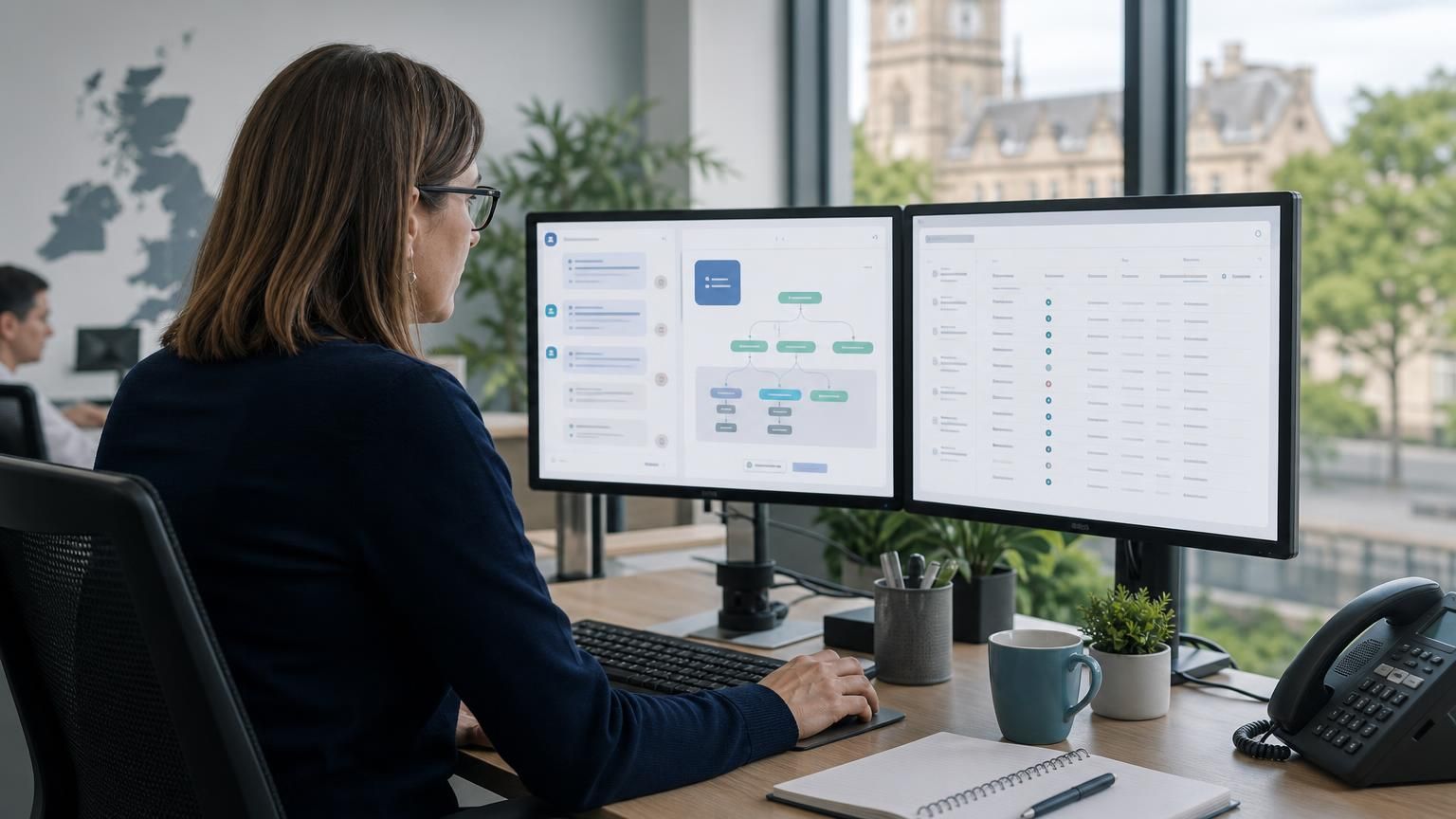
This article outlines a practical path for UK businesses, councils, police teams and regulated organisations to use hybrid AI, RAG knowledge and workflow automation to complete routine actions directly from chat while preserving auditable human oversight and UK data residency. It’s about cutting admin, improving first‑contact resolution and keeping control where it matters.
What 'back‑office acceleration' means in practice
- Capture intent and evidence in chat, then trigger conditional workflows that perform authorised back‑office actions (e.g., raise a repairs order, log a safeguarding referral, update a tenancy record).
- Use RAG‑grounded AI for accurate, contextually‑correct responses and to fill missing fields before actioning tasks.
- Keep a human‑in‑the‑loop when risk or policy thresholds are hit; record the decision trail for audits.
This isn’t speculative — it’s a design pattern supported by modern hybrid AI platforms that combine RAG knowledge bases with visual workflow builders and secure webhooks/APIs. See practical feature coverage from IMSupporting on RAG knowledge and hybrid chat workflows. (imsupporting.com)
Clear definitions: rule‑based bots, pure LLM bots, and hybrid AI
- Rule‑based chatbots: deterministic flows (menus, if/then branches). Reliable for static, low‑risk tasks but brittle for ambiguous questions.
- Pure LLM bots: large language models that generate fluent answers from pattern‑learning. Strong at handling language but prone to hallucination and often lack up‑to‑date, organisation‑specific facts unless carefully controlled.
- Hybrid AI live chat: the middle path. RAG‑grounded LLMs retrieve exact documents or canonical answers, a decisioning layer applies policy and risk checks, and human agents are automatically looped in when needed. This is the pattern you want for actions that touch back‑office systems because it balances speed, accuracy and auditability. Use RAG to anchor responses in your facts and workflows to translate a resolved chat into a safe, authorised action. (imsupporting.com)
Five practical design rules for UK public and regulated teams
- Build actions, not drafts
- Design the chat to gather exactly the fields your back office needs (e.g., property ID, urgency, attachment). Use the AI agent to pre‑fill and validate answers from past tickets before triggering a task.
- That reduces manual form‑filling for teams and speeds resolution. Platforms that combine RAG with workflows make this feasible. (imsupporting.com)
- Set policy gates and human thresholds
- Only allow automated completion up to defined risk tiers. If a case involves safeguarding, legal exposure or a flagged fraud risk, hand off immediately to a human with the collected context and suggested next steps.
- Record who authorised what and why for later audit. This aligns with ICO guidance on AI and data protection and civil‑service guidance on generative AI use. (ico.org.uk)
- Keep your knowledge onshore and fresh
- RAG makes the AI accurate by retrieving from your own documents rather than relying on model memory. For UK public bodies and regulated teams the governance and data residency benefits of UK‑hosted RAG are material: policy, legal and procurement teams need to see where the facts live. IMSupporting explains how RAG boosts reliability by grounding responses in your facts. (imsupporting.com)
- Make the workflow auditable and exportable
- Every automated action should generate an immutable record: which knowledge source answered, what fields were auto‑filled, when a human intervened, and the webhooks/APIs called.
- That audit trail is essential for FOI, complaints and tribunal evidence — and avoids the ‘black box’ problem. (imsupporting.com)
- Design for citizen trust
- UK research shows customers still value human contact and will reject fully automated service in many scenarios; automation must build trust, not replace it. Embed clear signals that a human will review decisions for sensitive cases. ()
Typical automated actions you can safely accelerate today
- Scheduling repairs and creating a work order with pre‑validated address and priority.
- Renewing low‑risk licences or permits after identity checks handled by the human reviewer if required.
- Updating CRM/tenancy records where data provenance is clear.
- Triage and routing for multi‑agency incidents (police + council) with policy gates for escalation.
Each use case needs a short risk mapping exercise and a corresponding handover rule. The technology to implement this — RAG + hybrid workflows + secure APIs — is available now. (imsupporting.com)
Security, compliance and procurement realities for UK teams
- Data residency and contractual controls matter. Choose platforms that offer UK‑hosted options and clear data processing terms.
- Procurement officers should map automation thresholds into procurement documents: what can be automated, what must be human‑approved, and what audit logs must be retained. The Cabinet Office transparency guidance on AI procurement is a helpful frame when writing those requirements. (gov.uk)
- The ICO’s guidance on AI and data protection requires risk‑based governance and human review where outputs affect people. Bake human sign‑off into higher‑risk automated actions. (ico.org.uk)
Quick ROI model — where savings come from
- Reduce manual ticket handling by automating validated routine tasks.
- Cut form re‑work by pre‑filling and validating fields in chat before task creation.
- Shorten time to resolution, lowering penalty risk and improving citizen satisfaction.
A conservative target for early adopters: reduce cost‑to‑serve on eligible transactions by 20–40% in the first 12 months by focusing on high‑volume, low‑risk actions and iterating policy gates.
How to start — a three‑stage rollout for risk‑aware teams
1. Pilot (30–60 days)
- Map 2–3 repetitive back‑office tasks (e.g., repairs, licence renewals).
- Train a RAG agent on the exact documents and run it in read‑only mode to validate answers. Use a visual workflow builder to simulate the task triggers. (imsupporting.com)
2. Controlled automation (3 months)
- Enable auto‑creation for low‑risk cases with human review for exceptions. Add audit logs and exportable evidence bundles.
- Measure first‑contact resolution and admin time saved.
3. Scale and govern (6–12 months)
- Expand action types, formalise policy gates, and update procurement and data protection documentation. Keep knowledge sources refreshed and versioned.
Example platform capabilities to require in any procurement
- UK‑hosted RAG knowledge and clear data processing terms.
- Visual hybrid AI workflow builder with API/webhook connectors and conditional human handover. (imsupporting.com)
- Immutable audit logs and exportable case bundles for FOI/complaints.
Final checklist for decision‑makers
- Have you mapped the top 10 repetitive actions where automation is low‑risk?
- Do your workflows include policy gates and human handover thresholds?
- Are knowledge sources UK‑hosted and versioned for audit?
- Have procurement and legal received a pilot‑level spec aligned with Cabinet Office transparency guidance? (gov.uk)
If you want to see this pattern in a UK‑hosted platform that combines RAG grounding and a visual hybrid workflow builder, review IMSupporting’s RAG and hybrid workflow features here: https://imsupporting.com/feature-rag-based-ai-agent-knowledge.php and https://imsupporting.com/feature-hybrid-ai-chat-workflows.php. (imsupporting.com)
For a no‑nonsense demo and a checklist tailored to councils, housing associations and police teams, visit https://imsupporting.com/ — book a conversation with their UK support team and see how to convert chat into completed, auditable actions.