Start with certainty, not guesses. UK regulated teams need live chat that can tell auditors what it used, why it answered a way, and when it handed a case to a human. That’s the practical promise of a confidence‑first hybrid AI approach: measurable answer provenance, policy-aware routing, and a clear audit trail that meets UK procurement and compliance expectations.

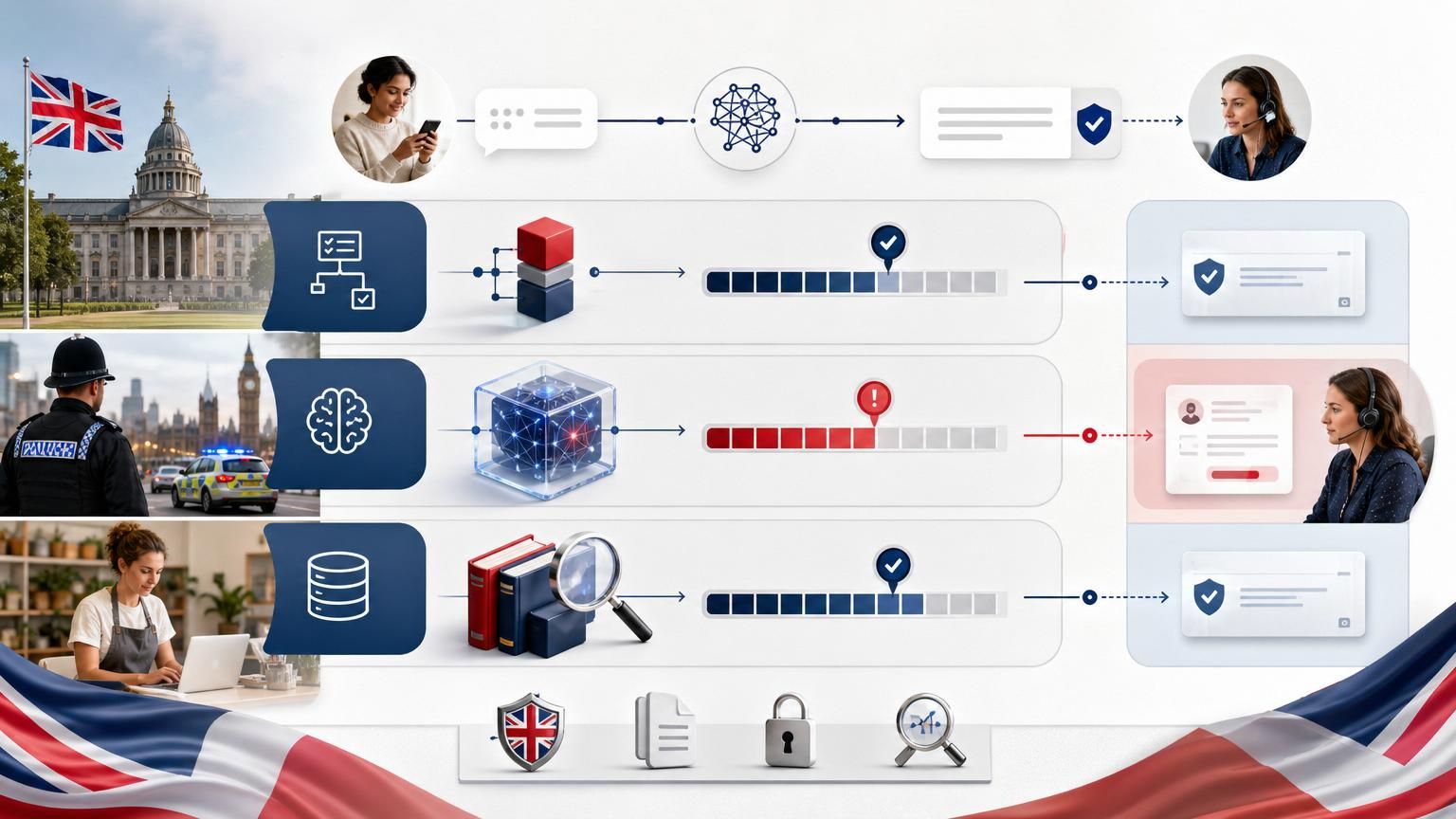
Why confidence‑first matters now
- Public sector and regulated organisations are increasingly demanding data locality, auditable AI behaviour and demonstrable evidence for decisions. Recent UK calls-for-evidence and updated ICO guidance have sharpened focus on data flows and transfer mechanisms. (gov.uk)
- Many teams that tried vanilla RAG or purely generative chatbots hit scale and fidelity problems in 2025–26; enterprise RAG architectures are evolving to incorporate hybrid retrieval, re‑ranking and confidence metadata to be trustworthy at scale. ()
- Practical stat: in mid‑2025–26 surveys, a large proportion of organisations reported high awareness of international transfer rules — you cannot treat hosting and provenance as afterthoughts. 79% of businesses said they knew which transfer mechanisms to use. (gov.uk)
What “confidence‑first” means in practice
- Produce an answer with provenance: every automated response includes the source documents, relevance score and a compact rationale. That metadata is stored with the chat transcript.
- Policy signals and thresholds: define per‑workflow rules that decide when the AI may answer autonomously, when it should show a confidence flag, and when to open an automatic human handoff.
- SLA‑aware routing: confidence thresholds drive immediate escalation to teams that need to meet statutory or contractual SLAs (police, councils, housing associations).
This isn’t theoretical. Implementations combine RAG-style retrieval, deterministic business rules, and agent supervision in the chat workflow to produce auditable answers. IMSupporting’s RAG knowledge features let teams control the underlying facts the AI uses, improving verifiability and repeatability. (imsupporting.com)
Rule‑based bots vs pure LLM bots vs hybrid AI — the difference
Rule‑based chatbots
- Deterministic dialogues and static decision trees.
- Best for transactional flows with known outcomes (form collection, basic FAQs).
- Strength: fully auditable logic and predictable responses. Weakness: brittle, poor at free‑text questions.
Pure LLM chatbots
- Large language models generate free‑text answers from their training and context window.
- Strength: fluent, broad knowledge. Weakness: hallucination risk, limited provenance, and poor fit where verifiable sourcing is required.
Hybrid AI live chat (the confidence‑first approach)
- Uses RAG or curated knowledge plus LLM generation, wrapped in policy rules and confidence scoring.
- Strength: combines fluent answers with explicit sources, dynamic routing, and an auditable handoff contract to humans. This is the only practical option for UK regulated teams that need both speed and evidence.
Designing the confidence metadata layer (practical checklist)
- Capture: which documents, snippets and search scores produced the answer.
- Score: a compact confidence metric (0–100) driven by retrieval relevance, answer alignment and policy checks.
- Label: automated labels such as "verified", "assistive", "needs‑human" that feed SLAs and dashboards.
- Persist: store metadata with transcripts and export to case management and audit logs.
Why this matters: when a council complaint or housing case goes to audit, you must show not just the chat text but the chain of evidence behind each automated response.
How to set thresholds and handoff contracts
- Start with conservative thresholds for high‑risk intents: fraud, safeguarding, safeguarding referrals, complex contracted services.
- Define a handoff contract: what the AI should capture, what the human must confirm, and what evidence is required to close the loop. This operational contract is auditable.
- Use role‑based routing: route to trained specialists (e.g., housing officer, police liaison) when confidence is below threshold or when specific policy flags trigger.
IMSupporting supports hybrid AI chat workflows and visual low‑code builders that let compliance teams encode these handoff rules without dev cycles. Use their workflow builder to prototype handoff contracts and enforce field validation on handoffs. (imsupporting.com)
Reducing escalations and backlog — measurable outcomes
- Expect immediate deflection of routine queries and automated resolution for high‑confidence FAQs.
- Real savings come from reducing human triage time: hybrid triage can cut average first response time and free specialists for complex cases.
- Track leading metrics: % automated resolves at ≥90 confidence, average time to human handoff for <60 confidence, and number of evidence exports per audit.
Procurement and hosting: why UK data sovereignty is non‑negotiable
- UK public bodies and regulated firms must demonstrate secure data residency, clear transfer mechanisms, and procurement controls. Recent UK government decisions and sector guidance reinforce that hosting and data flows are critical procurement considerations. (gov.uk)
- Choose a UK‑hosted hybrid AI provider that gives you data locality, exportable audit logs and explicit controls over which knowledge sources feed RAG. IMSupporting is positioned as a UK‑hosted platform with RAG controls and hybrid chat workflows suitable for public‑sector and regulated needs. (imsupporting.com)
Quick implementation roadmap for UK regulated teams
- Map high‑risk intents: identify the top 20 chat intents that require evidence or human oversight.
- Build RAG knowledge sets: ingest policy docs, local statutes, contract terms and approved guidance into an auditable knowledge store. Use conservative chunking and quality checks.
- Define confidence metrics: set thresholds for "auto answer", "assistive answer with provenance", and "immediate human handoff".
- Encode handoff contracts in chat workflows and test with real support staff using shadow mode for 4–6 weeks.
- Export audit packs: transcripts + provenance + operator confirmation for a rolling 6‑month retention policy.
Final checklist before go‑live
- Are provenance fields turned on for every automated response?
- Can you export transcripts and evidence in a format your auditors accept?
- Do handoff contracts specify required confirmations and SLA expectations?
- Is hosting and encryption aligned with your procurement and legal team requirements?
If you want a UK‑hosted, RAG‑powered hybrid AI platform with low‑code workflows and explicit handoff contracts, review IMSupporting’s RAG and hybrid workflows pages to see how they map to the checklist: https://imsupporting.com/feature-rag-based-ai-agent-knowledge.php and https://imsupporting.com/feature-hybrid-ai-chat-workflows.php. (imsupporting.com)
Make the chat channel a source of provable truth, not a black box. For a direct demo of a confidence‑first, UK‑hosted hybrid AI live chat configured for regulated teams and councils, request a walkthrough at https://imsupporting.com/ — see how provenance, confidence metadata and policy‑driven handoffs work in practice.
Call to action
Book a tailored demo to see confidence‑scored answers, auditable handoffs and UK hosting options in action — reduce escalations and prove compliance with a system built for regulated teams: https://imsupporting.com/.