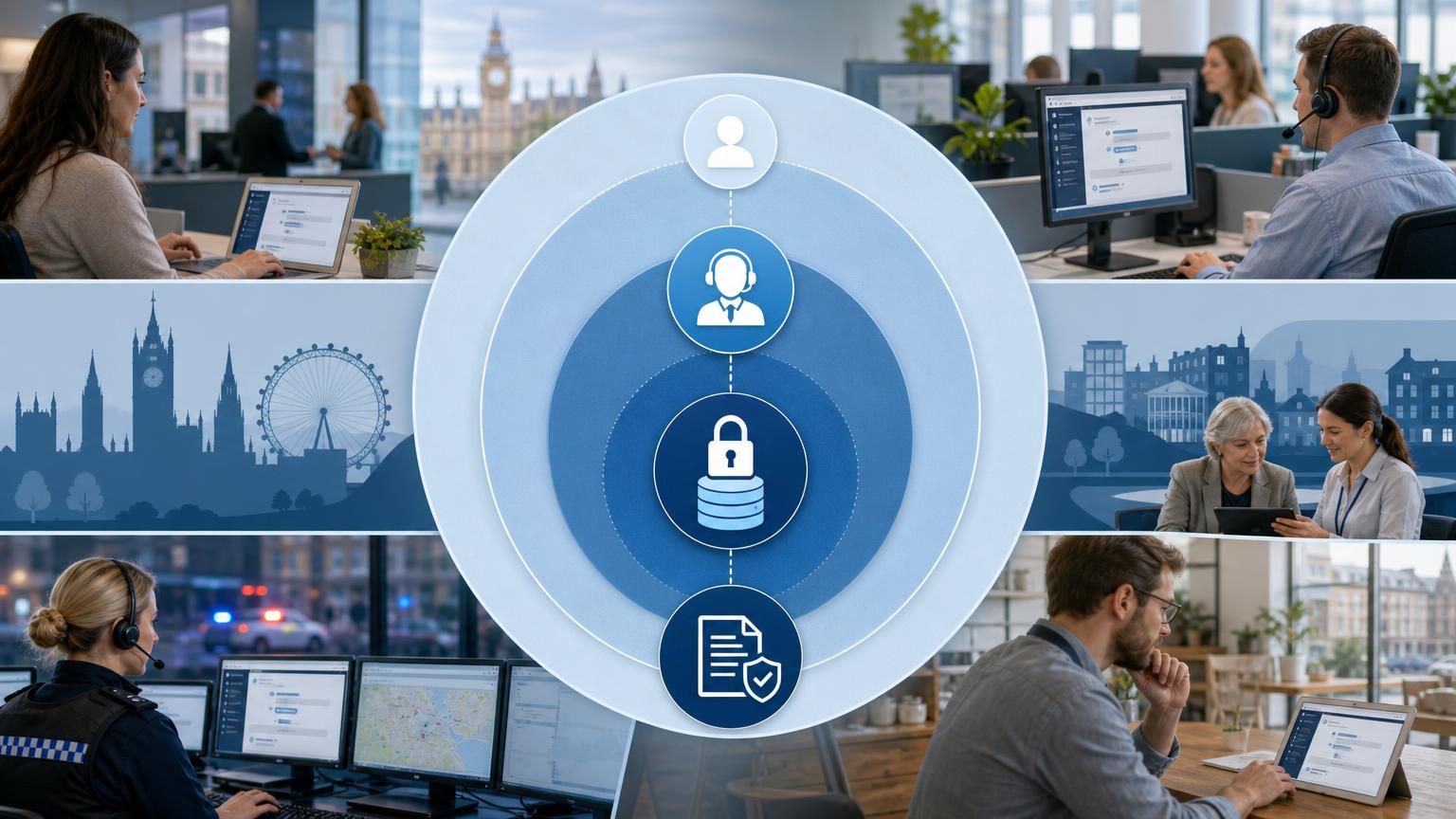
Why consent-tiered chat matters now
UK councils, police forces, housing associations and regulated teams face two simultaneous pressures: rising demand for immediate support, and an intensifying regulatory spotlight on how AI uses personal data. The solution isn’t to turn off automation — it’s to design chat that changes behaviour based on the user’s consent level and data sensitivity. This reduces risk, increases FCR (first-contact resolution), and preserves audit trails that compliance teams can trust.

The ICO has clear, practical expectations for AI systems that process personal data; procurement and technical teams must consider those rules when buying or building chat solutions. (ico.org.uk)
The consent-tiered pattern (practical summary)
Implement a three-tier consent model inside your live chat UX and backend logic:
- Tier 1 — Public queries: anonymous, fully automated responses with cached public knowledge.
- Tier 2 — Identified users: pseudonymised retrieval plus RAG-sourced contextual suggestions for agents; limited local logging.
- Tier 3 — Sensitive / casework: automatic human handoff; no LLM generation against PII; strict audit trail and longer retention controls.
This pattern keeps low-risk interactions fast and cheap, while placing strong, auditable controls on anything that could affect rights or safety.
How rule-based, LLM and hybrid chat differ (and why hybrid wins for UK teams)
- Rule-based chatbots: deterministic flows, good for FAQs and forms. Low risk but brittle and poor at handling novel queries.
- Pure LLM bots: generative, flexible, and conversational — but potentially dangerous with personal data if used without retrieval controls and provenance.
- Hybrid AI live chat: the pragmatic middle path. A hybrid system runs fast rule checks, uses RAG to ground LLM responses to your documents when allowed, and automatically routes sensitive queries to a human agent with the conversation history and precise citations.
Hybrid models combine control and creativity: RAG provides evidence, rules enforce consent, and human agents cover empathy, nuance and high-risk decisions. See a RAG-based implementation that maps to this model. https://imsupporting.com/feature-rag-based-ai-agent-knowledge.php ()
Technical blueprint (concise)
- Consent capture at entry
- Present short, clear options (anonymous / identified / case-sensitive) before collecting any data.
- Persist the consent tier as metadata for the session and for downstream policy checks.
- Policy-first routing
- Enforce automatic rules: Tier 3 = immediate human handoff; Tier 2 = hybrid with redaction; Tier 1 = automated only.
- Maintain a policy decision point (PDP) that checks consent + user attributes before any model call.
- Retrieval & provenance
- Use micro-RAG: index only UK-hosted, approved documents; attach the retrieved source IDs to every reply for audit.
- Avoid sending raw PII into an LLM context; instead use tokenised, redacted summaries for hybrid responses.
- Session-safe handoffs & logging
- Hand off with a minimal, auditable summary: consent level, data retrieved, recommended next steps, and the provenance list.
- Encrypt logs and host them in UK data centres to meet sovereignty needs.
- Agent controls and explainability
- Present agents with suggested replies plus exact citations so they can accept, edit, or override.
- Log agent edits to create an edit trail for later review.
IMSupporting’s hybrid AI chat workflows enable many of these steps out of the box. https://imsupporting.com/feature-hybrid-ai-chat-workflows.php
Governance and compliance checklist for procurement teams
- Is the vendor able to host all data and logs in the UK with demonstrable controls? If not, don’t proceed.
- Can the platform enforce a consent tier decision before any external model call?
- Does the system attach provenance to every AI-sourced answer and make that provenance available in the audit trail?
- Does the live chat provide a configurable human handoff trigger and tamper-proof logging for Tier 3 workflows?
- Can you produce exportable, human-readable logs for FOI/SARs and regulatory reviews?
Government guidance expects meaningful human control and documented privacy impact assessments for AI systems used in public services. Plan the DPIA before you start pilots. (gov.uk)
Measuring success — metrics that matter for UK organisations
Focus on metrics that demonstrate both service improvement and risk reduction:
- First-contact resolution (FCR) for Tier 1/2 vs. pre-deployment baseline.
- Percentage of sessions automatically escalated to Tier 3 (should be low but clearly auditable).
- Time-to-handoff and agent handling time with hybrid suggestions (target: reduction vs. legacy workflow).
- Compliance KPIs: percent of AI responses with attached provenance; DPIA closure rate; audit review pass rate.
Generative AI adoption has shown real productivity gains in customer operations; a robust hybrid approach lets public sector teams capture those gains while keeping regulatory control. For example, sector studies show material reductions in handling time and improved resolution rates when AI is used as an assist rather than an autonomous decision maker. ()
Fast wins for a pilot (60–90 days)
- Run an anonymised Tier 1 pilot on a low-risk FAQ page, hosted entirely in the UK.
- Add a Tier 2 path for identified users that uses micro-RAG to attach doc citations to replies.
- For any Tier 3 triggers (benefit claims, safeguarding, legal advice), force a human agent handoff and lock the LLM out of the raw PII.
- Review DPIA and retention policy after the first 500 sessions and iterate.
Practical implementations are already available in UK-hosted platforms that combine RAG-based knowledge and hybrid workflows — useful when you need rapid procurement and demonstrable auditability. https://imsupporting.com/feature-rag-based-ai-agent-knowledge.php https://imsupporting.com/feature-hybrid-ai-chat-workflows.php
Final pragmatic advice
- Start with clear consent UI and enforce it programmatically — a checkbox is not enough unless your system uses that choice to control model behaviour.
- Design for auditability from day one: provenance, redaction, and encrypted UK logs are non-negotiable for regulated teams.
- Use hybrid AI to shift left (handle more routine queries) but keep humans in the loop where rights, safety or legal outcomes matter.
If you want a UK-hosted, compliance-ready way to implement consent-tiered hybrid AI live chat quickly, explore a proven hybrid stack and RAG-based knowledge features that map directly to the model above: https://imsupporting.com/. For a pilot or procurement brief, contact IMSupporting today and get a UK-hosted demo tailored to councils, police and regulated organisations.