Start with the problem: multiple UK services (councils, police, housing associations, health partners) need fast, accurate answers during multi-step cases, but they can't freely share raw data, and they must prove compliance. Live chat is already the front door for many citizens — but most live chat setups are siloed, either noisy with unsupported bot answers or brittle when human agents must manually pull information across systems.
Why cross-agency knowledge exchange matters now
- Citizens expect immediate, consistent answers even when their issue spans two or three local services.
- Procurement and risk teams need auditable workflows and data residency guarantees.
- Public bodies are under pressure to reduce phone queues while keeping legal obligations to data protection and equality.
UK public-sector teams are already experimenting with Retrieval-Augmented Generation (RAG) to ground LLM outputs in real documents — GOV.UK Chat is a live example of RAG-based public service tooling in production. (gov.uk)
What “cross-agency hybrid AI live chat” actually is
- Rule-based chatbot: deterministic scripts and decision trees. Good for narrow, predictable flows (opening hours, form links). It cannot synthesise or contextualise multiple documents.
- Pure LLM bot: a generative model that answers from its parametric memory. Fast and flexible but prone to hallucinations and hard to control for compliance-heavy scenarios.
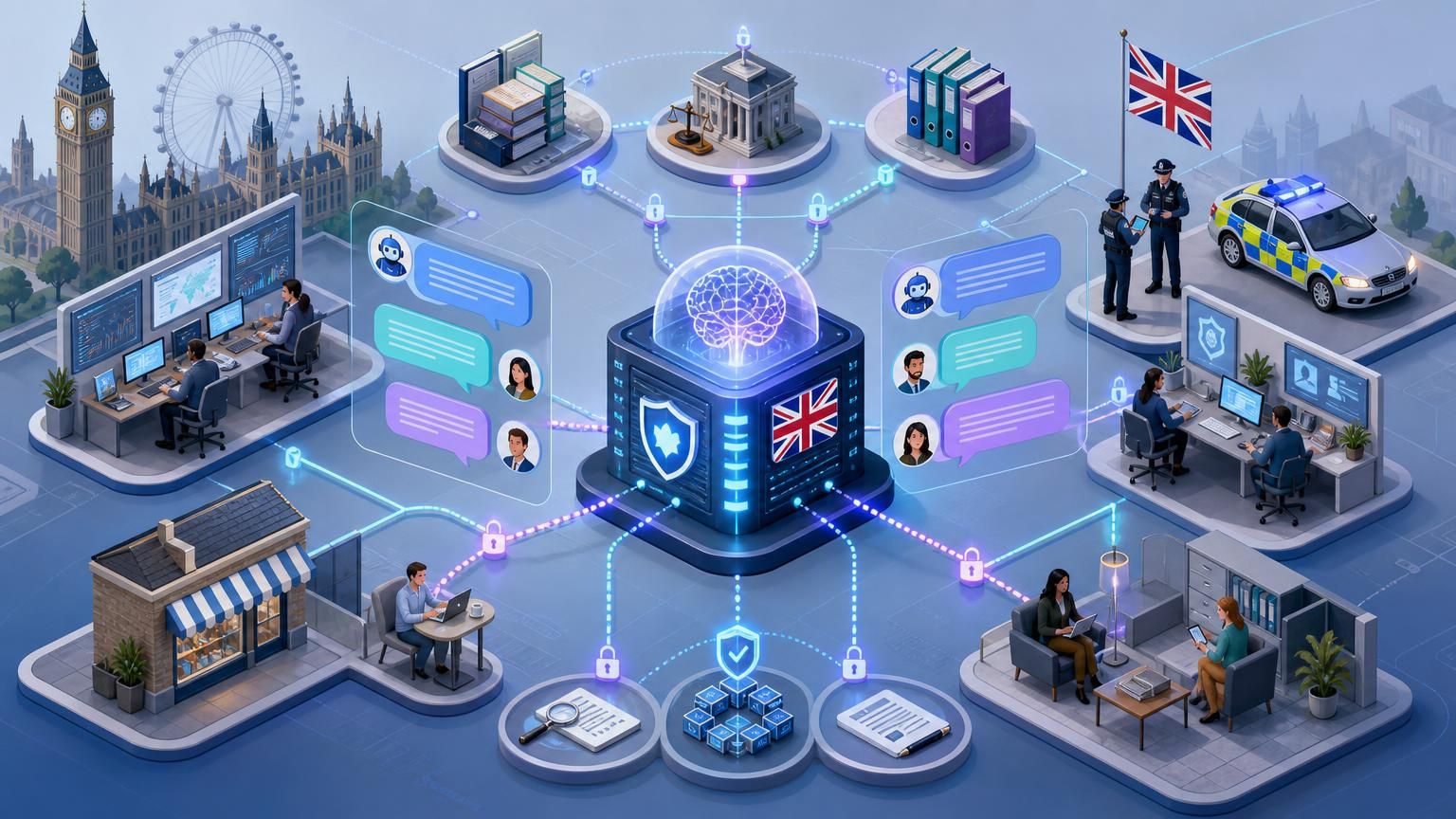
- Hybrid AI live chat: a staged approach where RAG or knowledge retrieval supplies validated source snippets to an LLM, while human agents are in the loop for sensitive, complex or higher-risk cases. This keeps answers grounded and gives clear handoff points to humans. IMSupporting documents how RAG can be used to augment an AI agent’s knowledge base so responses are based on exact facts you provide. (imsupporting.com)
The protective design pattern: kept-in-UK, RAG-first, human‑centred
Design the chat platform around three enforceable guarantees:
- UK data residency and hosting — store transcripts, attachments and knowledge sources in UK infrastructure to meet procurement and sovereignty requirements. IMSupporting is positioned as a UK-hosted hybrid AI live chat platform built for that audience. (imsupporting.com)
- RAG-first answers — always retrieve and display the origin of any factual statement the AI makes (document title, date, redacted snippet). This turns generative answers into explainable ones. See IMSupporting’s RAG-based agent features for practical implementation. (imsupporting.com)
- Human-in-the-loop escalation — embed clear thresholds in workflows so any case with legal, safeguarding or equality implications routes to named specialists. Use workflow builders to codify these triggers. IMSupporting’s visual flow builder shows how conditional logic and agent-online rules make this reliable. (imsupporting.com)
Practical architecture: how to wire it without leaking data
- Source connectors: keep copies of relevant policies, case notes and service manuals in a controlled knowledge store (access logged and versioned).
- RAG retrieval layer: vector-search against the controlled store; rank by recency and compliance tags (e.g. FOI-sensitive, PII, safeguarding).
- Response composer: produce an answer that includes a short, redacted summary + link to source reference (not full PII) and a confidence score.
- Escalation pipeline: if confidence < threshold, or tags include "safeguarding" or "legal", hand to a named agent team and create an auditable ticket.
This combination preserves the speed of AI but keeps humans responsible for decisions that matter.
Use cases that deliver measurable value for UK organisations
- Multi-agency enquiries: a housing association can immediately see local-council eligibility rules pulled into chat without copying full tenancy files.
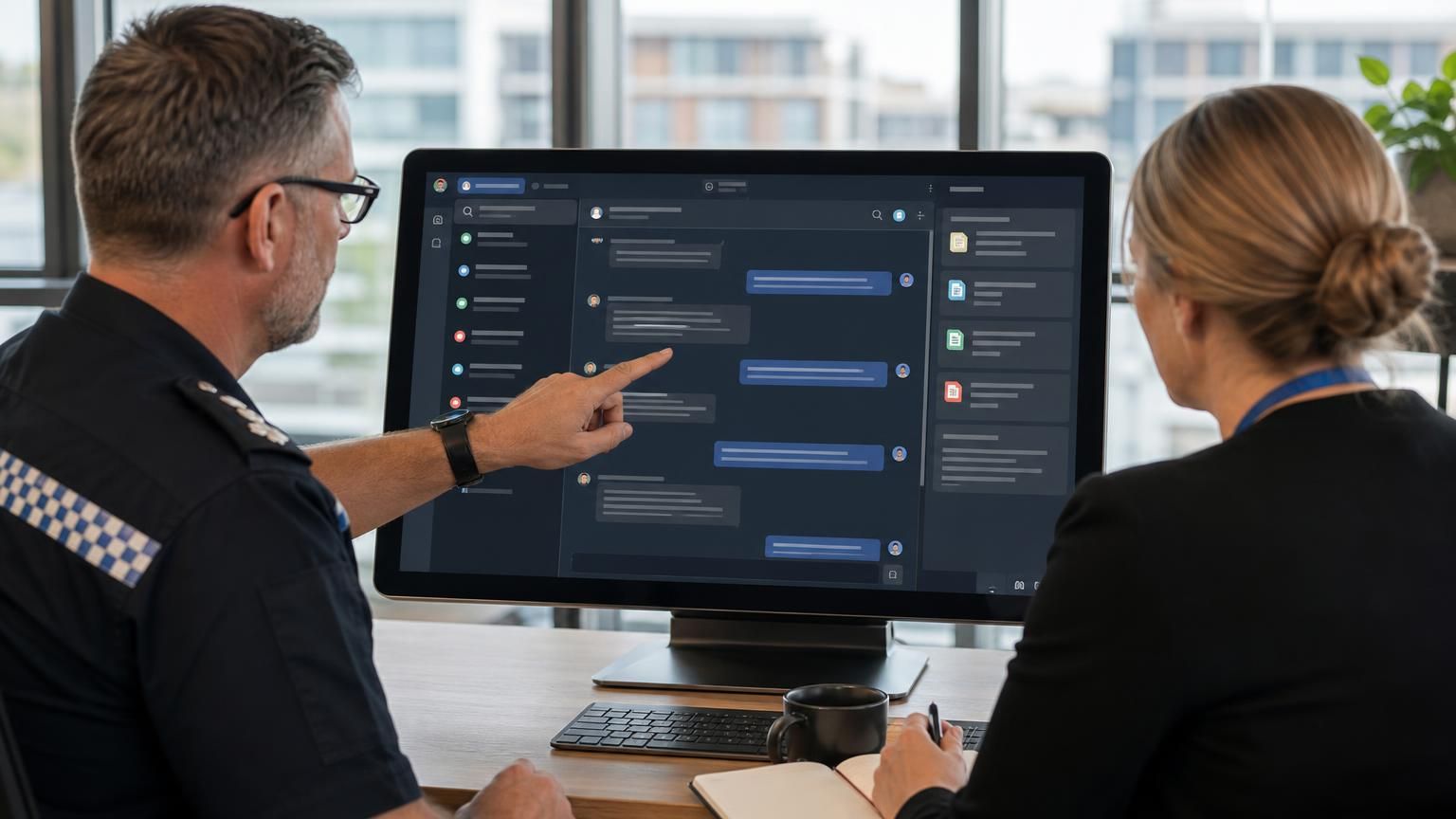
- Police custody queries: front-line staff get grounded SOP excerpts and escalation paths, with any redactions applied automatically before display.
- Council benefits triage: a hybrid agent suggests form routes and pre-populates fields; complex cases escalate to a welfare officer with the evidence logged.
Live chat is demonstrably commercial: industry case studies show live chat engagement can lift average order value and conversion — case results range from single-digit to 40%+ lifts depending on sector and execution. Use those revenue gains as a funding argument for modernising support tech. ()
Implementation checklist (practical, procurement-ready)
- Insist on UK hosting and data residency in contracts.
- Require a RAG-capable knowledge feature and the ability to upload and tag authoritative documents. (See IMSupporting’s RAG knowledge feature.) (imsupporting.com)
- Define escalation policies as code: implement conditional branches in the chat workflow for legal, safeguarding, and FOI risk. IMSupporting’s workflow modules demonstrate how to map these rules visually. (imsupporting.com)
- Audit trail: ensure every AI-supplied answer links back to source metadata and that all handoffs create immutable tickets.
- Privacy-preserving defaults: apply redaction rules and minimise PII in retrieval responses; review ICO guidance and adopt PETs where practical. (ico.org.uk)
Risk register — what procurement and SIROs will ask
- Hallucination risk: mitigated with RAG sourcing and clear confidence thresholds.
- Data leakage: mitigated by UK hosting, connector-level permissions and redaction rules.
- Equality and bias: mitigate by testing retrieval relevance across protected-groups data and aligning with EHRC/ICO expectations; include regular bias audits. ()
Measuring success (KPIs that matter to budget holders)
- Deflection rate: % of chats completed without human handoff for low-risk enquiries.
- Mean time to resolution for cross‑agency cases.
- Escalation accuracy: % of AI triages that needed corrective human intervention.
- Audit completeness: % of answers with source metadata attached.
- Operational ROI: convert a conservative chat-AOV improvement and reduced case processing time into cashable savings. Case studies in the field show meaningful AOV and conversion lifts when chat is executed correctly. ()
Quick win roadmap (90 days)
- Pilot: ingest three authoritative doc sets (policy, SOP, FAQs) into a RAG-enabled index and run non-sensitive internal trials.
- Policy encode: map escalation rules and redaction policies as workflow branches.
- Live pilot with shadow mode: run hybrid AI answers but require human approval for public-facing responses for 2–4 weeks.
- Go live: enable automatic low-risk answers with clear source links and monitored thresholds.
Final takeaway
Cross-agency hybrid AI live chat is not about replacing human judgement — it’s about making human decisions faster, traceable and safer. For UK councils, police forces, housing associations and regulated teams the levers are clear: insist on UK hosting, choose RAG-first architectures, codify escalation as workflows, and demand auditable source links on every AI answer. The tooling exists today; balance speed with governance and you turn live chat into a secure, multi-agency knowledge exchange that both reduces cost and improves outcomes. (gov.uk)
Ready to pilot a UK-hosted, RAG-backed hybrid AI live chat for your organisation? Learn how IMSupporting fits this model and start a secure trial today: https://imsupporting.com/. For details on the RAG knowledge system and workflow builder, see https://imsupporting.com/feature-rag-based-ai-agent-knowledge.php and https://imsupporting.com/feature-hybrid-ai-chat-workflows.php. (imsupporting.com)