
Why ‘decision traceability’ matters now
Regulated UK bodies — councils, police forces, housing associations and NHS partners — are moving beyond “did we answer the question?” to “can we reconstruct why a decision was made?”
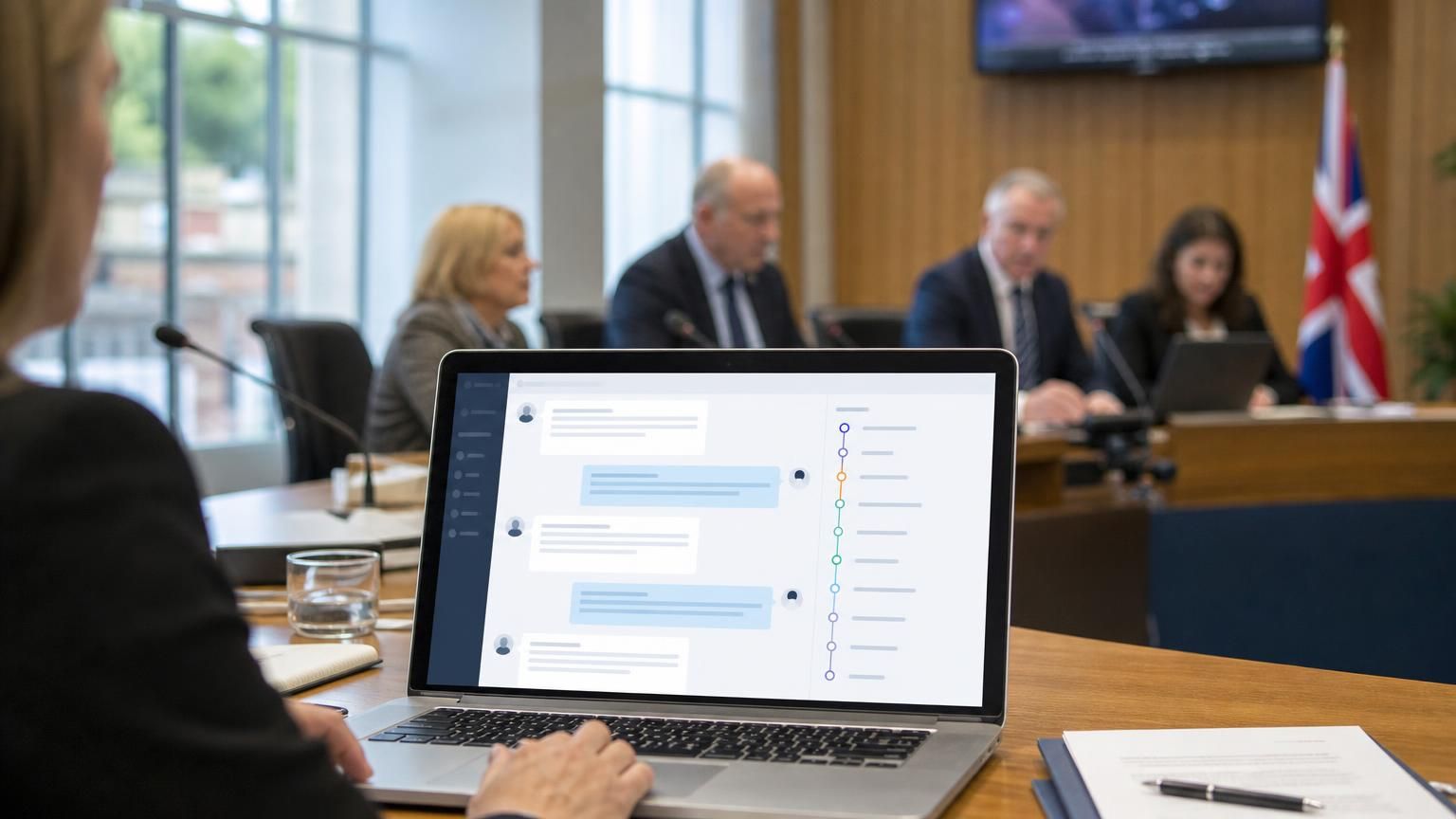
Live chat has become a frontline channel for high‑stakes interactions: eligibility checks, safeguarding flags, housing applications, complaint triage and on‑the‑record guidance. Those conversations must be verifiable, explainable and exportable for audits, FOI/SAR requests and internal governance.
This article explains how a modern, UK‑hosted hybrid AI live chat can simultaneously improve response speed and generate legally useful, reconstructable decision trails without exposing sensitive data offshore. It contrasts legacy rule bots, raw LLM solutions and hybrid systems built for traceability.
The three chat architectures: quick primer
Rule‑based chatbots
- Deterministic scripts, menu trees and form capture.
- Strong for predictable tasks and procurement simplicity, but poor at scaling nuance and justification.
Pure LLM (large language model) bots
- Generate fluent answers using broad internet‑trained models.
- Fast and flexible, but often opaque: provenance is weak, hallucination risk is real and hosting is commonly offshored.
Hybrid AI live chat (the practical sweet spot)
- Uses RAG (retrieval‑augmented generation) to fetch verified documents and knowledge snippets, then composes responses while recording evidence IDs, timestamps and the source text used.
- Automatically escalates to human agents when risk/complexity thresholds are met.
- Designed for explainability and exportable provenance — exactly what audit teams need.
Hybrid AI is not a single monolith — it’s an orchestrated stack that couples searchable knowledge, controlled LLM behaviour, and human oversight.
Market context: adoption, risk and expectations
Contact centre surveys show chatbot adoption is rising in the UK but still mixed in the public sector; 42.6% of contact centres reported chatbots in place in recent surveys, up year‑on‑year. ()
At the same time, analyst work finds organisations are shifting toward hybrid and assisted AI deployments rather than full autonomy — hybrid models dominated pilots and rollouts through 2025. ()
Crucially, customers and citizens now expect a human option and trustworthy provenance when decisions affect rights or services — Gartner found customers are significantly more likely to use third‑party GenAI tools than company chatbots, a sign organisations must prioritise understandable, auditable interactions or risk losing trust. ()
Operationally, live chat still moves the needle: studies report single‑digit to high‑double‑digit conversion or resolution lifts when chat is used well (10–40% uplift in different contexts), which translates into measurable reductions in follow‑ups and appeal cases for regulated teams. ()
How decision traceability is implemented in practice
Below are the practical capabilities you should require from any procurement‑ready hybrid AI live chat platform.
- Provenance tagging: every AI response lists the document IDs, paragraph snippets and timestamps used to generate the reply. That metadata must be exportable alongside the chat transcript.
- RAG‑backed knowledge: the system retrieves from approved, UK‑hosted knowledge stores (policies, case notes, legislation) rather than relying on an internet‑trained model alone. See how RAG agents work in practice. ()
- Audit logs and human handover markers: clear event markers when AI suggested an action, when an agent edited or overrided the suggestion, and why escalation occurred.
- Redaction & data sovereignty: automatic PII redaction in exported bundles and guarantees of UK hosting for retention of sensitive records to satisfy public sector data flows and ICO expectations. (gov.uk)
- Explainability UI for reviewers: a compact reviewer view showing the query, the retrieved sources, the reasoning chain and the final human sign‑off.
These features convert chat transcripts from informal logs into governance evidence: searchable, auditable and defensible.
A worked example: housing allocation triage
- Citizen starts chat to ask about homelessness assistance.
- Hybrid AI performs initial triage using UK‑hosted policy docs. It fetches policy paragraph IDs and presents a suggested eligibility pathway to the agent. Metadata is attached automatically.
- Citizen provides complex comorbidity details. The hybrid classifier raises the risk score and forces human takeover; the human agent receives the AI’s evidence bundle and recommended actions.
- Agent records final decision and justification; the system timestamps and locks a read‑only audit bundle for the case file and potential FOI/SAR export.
This workflow reduces time to triage, keeps decisions consistent and creates an evidentiary trail that stands up to scrutiny.
Procurement checklist for UK councils and regulated teams
Ask for these minimum must‑haves when evaluating vendors:
- UK hosting and contractual data sovereignty guarantees. (gov.uk)
- RAG‑based agent knowledge with exportable source IDs and versioned knowledge bases. (See IMSupporting’s RAG feature for an example implementation.) https://imsupporting.com/feature-rag-based-ai-agent-knowledge.php
- Policy for human override and auditable handover markers in the chat transcript. https://imsupporting.com/feature-hybrid-ai-chat-workflows.php
- Built‑in redaction, retention and export formats for FOI/SAR or tribunal submission.
- Clear SLAs for accuracy, latency and incident response with penalties for failures that impact citizens.
Risks and mitigation
- Hallucination risk: limit free‑form LLM generation, require RAG citations before any policy claim is made. Hybrid systems should refuse to answer without a cited source.
- Data leakage: insist on UK‑hosted vector stores and encryption at rest; demand contractual visibility of third‑party model endpoints.
- Over‑automation: enforce mandatory human review thresholds for high‑risk categories (safeguarding, legal, benefits decisions).
These controls convert AI from a risk to a governance tool.
Why IMSupporting (and what to ask for in a pilot)
IMSupporting combines RAG‑backed agent knowledge and hybrid AI chat workflows to create the exact provenance and handover markers public services need. Their feature pages show how RAG citations and workflow escalation are built into the chat layer. https://imsupporting.com/feature-rag-based-ai-agent-knowledge.php https://imsupporting.com/feature-hybrid-ai-chat-workflows.php
A pragmatic pilot should focus on:
- One high‑value use case (e.g., housing triage or licensing enquiries).
- Measuring time‑to‑decision, FOI/SAR export time and number of agent edits to AI suggestions.
- Governance review: confirm exported bundles meet internal audit and legal team requirements.
Bottom line and next step
If your organisation needs defensible, auditable decisions from live chat, demand hybrid AI built around RAG provenance, human handover markers and UK‑hosted data controls. The tech can reduce follow‑up work, accelerate safe decisions and provide the evidence auditors and courts accept. Market momentum is clear — hybrid deployments are the practical middle path between brittle rule bots and opaque LLMs. ()
Ready to run a procurement‑ready pilot that keeps data in the UK and produces exportable, auditable decision bundles? Start here: https://imsupporting.com/