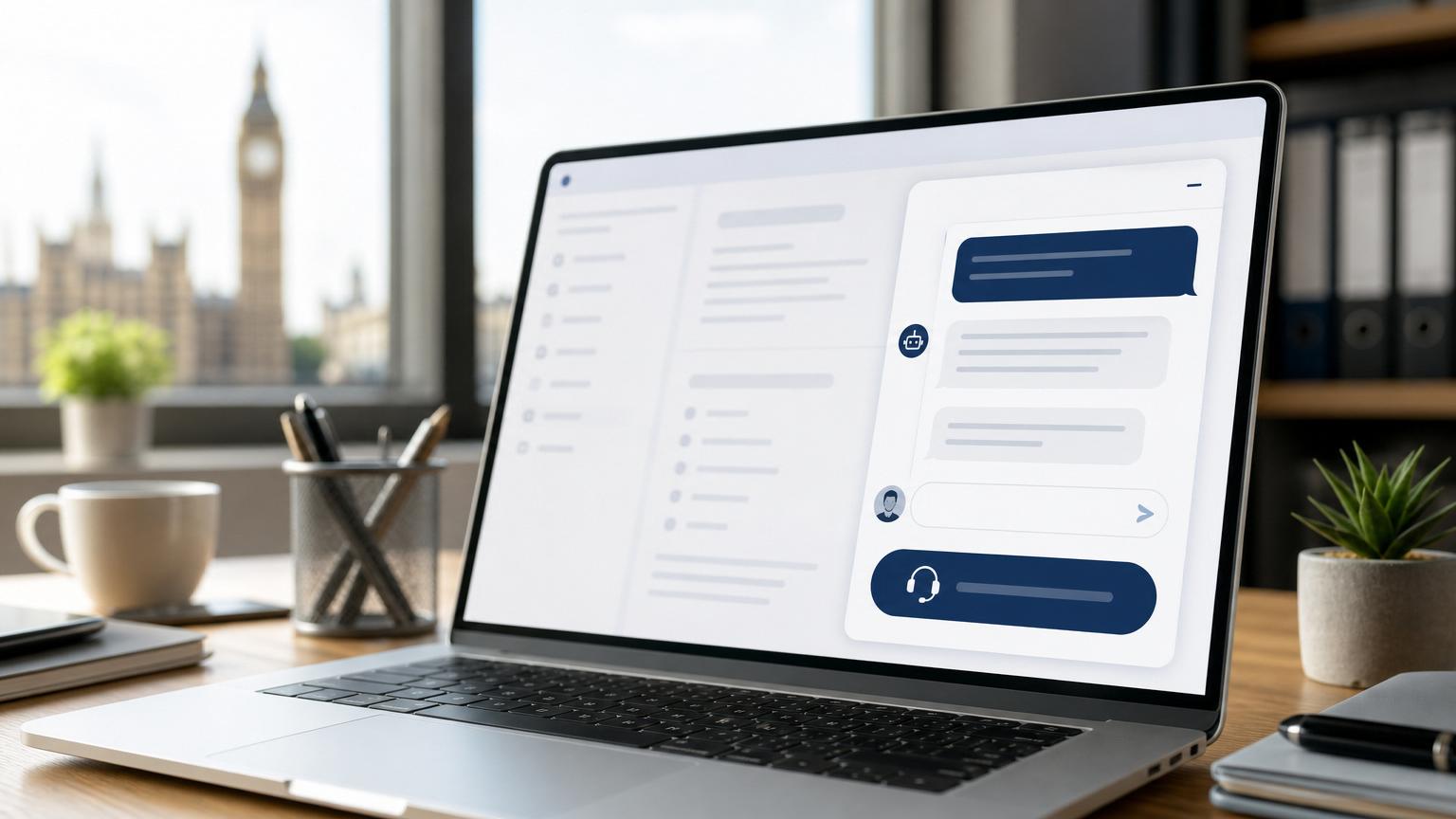
The specific UX problem: friction at the exact moment a citizen or buyer needs help
Public-sector and regulated teams lose trust — and leads — when a chat widget asks for a form, then passes the visitor to a third-country AI or an unclear process. The fix is not more bells; it’s a friction-minimising conversation design that both safeguards UK data and moves people toward resolution or a qualified handoff.

Designing for that moment requires three things: fast, useful answers; clean, light-weight detail capture; and a seamless human handoff when empathy, authority or legal judgement is needed.
Why hybrid AI chatflows are the practical choice for UK organisations
Hybrid AI combines instant AI triage with clear human escalation paths. It’s not an either/or between a rigid rule-based script and an unfettered generative model — it’s a workflow that chooses the right tool at the right time. Hybrid flows let AI handle repeatable queries and form-free qualification, while humans own the complex, sensitive, or high-risk interactions.
- Immediate answers and scaled coverage without putting high-risk processing outside the organisation.
- Lower average response time and fewer abandoned sessions.
- Measurable handoff points so teams can improve triage and reduce escalations.
Real-world benchmarks show chat-to-conversion rates for business-focused chat flows often sit in the 10–20% range, well above traditional form-fill rates. This matters when you’re trying to justify a procurement spend from a small council budget or a regulated services team. ()
Rule-based bots, pure LLMs and hybrid AI — clear differences for designers
Design decisions depend on which approach you adopt:
- Rule-based chatbots: deterministic scripts, ideal for simple FAQs and form-like flows. They’re low-risk but brittle for unexpected questions.
- Pure LLM bots: generative, flexible, and good at free-text answers — but they can hallucinate, expose PII to external models, and make compliance unpredictable if not carefully controlled.
- Hybrid AI Live Chat: the designer’s sweet spot — AI (often RAG-enabled) handles retrieval and triage, but deterministic checks and human escalation gates control risk and ensure explainability. Hybrid also lets you log, audit and keep data processing within UK-hosted infrastructure when required. ()
Core UX patterns that reduce friction and increase conversions
Design these patterns into every workflow you build for councils, police or regulated services:
- Conversational micro-onboarding: capture just a name and one high-value identifier (e.g., council tax reference, ticket number) rather than full forms up-front.
- Intent-first prompts: lead with high-intent options ("Pay my council tax", "Report a pothole", "Book an appointment") so AI routing is fast and predictable.
- Smart deflection with a human fallback: show concise FAQ answers and surface a single clear button: "Talk to an advisor". Don’t hide the handoff behind menus.
- Progressive disclosure: ask for deeper data only after intent is clear and the user trusts the channel.
- Transparent data handling copy: tell citizens where data is stored (UK-hosted), why it’s needed, and how it will be used — in one short sentence before collection.
These patterns are the difference between a helpful chat and a regulatory risk. The visual workflow approach used by some UK-hosted platforms lets teams test and iterate these patterns without months of development. (imsupporting.com)
Conversation design checklist for regulated services
Use this checklist during discovery and before procurement:
- Map the decision points where human judgment is required.
- Tag every data field with sensitivity and retention rules.
- Define mandatory handoff triggers (keywords, long dwell time, sensitive topic categories).
- Specify audit logs, exportability and where AI model calls occur (on-premise, UK cloud, or third-party).
- Run small A/B tests on micro-onboarding vs full-form capture and measure drop-off.
If you can’t answer where the chat data is processed and whether the model calls cross borders, procurement teams will flag it. The ICO’s updated international transfer guidance emphasises clear transfer risk assessments and appropriate safeguards — this must be part of your design and vendor evaluation. (ico.org.uk)
Technical UX decisions that matter (and how to specify them)
When you brief architects or vendors, be precise:
- Hosting: insist on UK-hosted data centres and clear contractual guarantees for data residency.
- RAG vs. online LLMs: prefer retrieval-augmented generation built on your knowledge base (RAG) to reduce hallucination risk and improve factual accuracy.
- Auditability: require immutable logs, redaction controls and easy export for FOI or internal audits.
- Handoff metadata: ensure the AI passes a context bundle (intent, confidence, conversation transcript snippet, data collected) to the human agent to avoid repetitive questioning.
Platforms that provide a visual hybrid workflow builder make these UX and technical requirements explicit and testable; teams can map touchpoints and handoffs before buying. (imsupporting.com)
Two practical conversation templates to copy (and measure)
Template A — Citizen support triage (council):
- Greeting + 2-button intent: "Pay bill" / "Report issue".
- If "Pay bill": ask for reference (single field), confirm, show quick-pay link or route to payments agent.
- If unresolved: escalate to human with context bundle.
Template B — Sensitive escalation (police non-emergency):
- Initial AI triage to classify urgency (non-emergency, request for advice, report requiring officer review).
- If sensitive keywords appear or the model confidence is low → immediate human handoff and remove PII from AI model calls.
Measure: conversion to outcome (payment, ticket raised), time to resolution, and drop-off at each micro-step.
Procurement-ready talking points for UK teams
When you sit in a procurement meeting, present these facts:
- Hybrid AI improves scale while protecting sensitive interactions for regulated services. ()
- Chat-driven qualification converts at materially higher rates than static forms; expect uplift in qualified contacts and fewer abandoned sessions. ()
- Require a transfer risk assessment clause and UK hosting guarantees to stay aligned with ICO guidance. (ico.org.uk)
Quick next steps — implement a low-risk pilot in 30 days
- Map 2 high-value tasks (payments, ticket creation).
- Build hybrid workflows that capture minimal data, use RAG for answers, and define handoff triggers.
- Run a 30-day pilot, track conversion and handoff metrics, and iterate.
If you want a UK-hosted platform with a drag-and-drop hybrid AI workflow builder and explicit public-sector templates, see IMSupporting’s Hybrid AI Chat Workflows and platform overview for features and pricing details. (imsupporting.com)
Final commercial point and CTA
Good conversation design reduces friction, limits unnecessary data sharing, and makes procurement approvals easier — which matters to councils, police teams and regulated organisations. Start with a tightly scoped pilot that proves the UX, compliance and conversion uplift before scaling.
See how a UK-hosted hybrid AI live chat workflow can be deployed quickly and securely: visit https://imsupporting.com/ to review features, examples and pricing, then book a demo with a public-sector specialist.