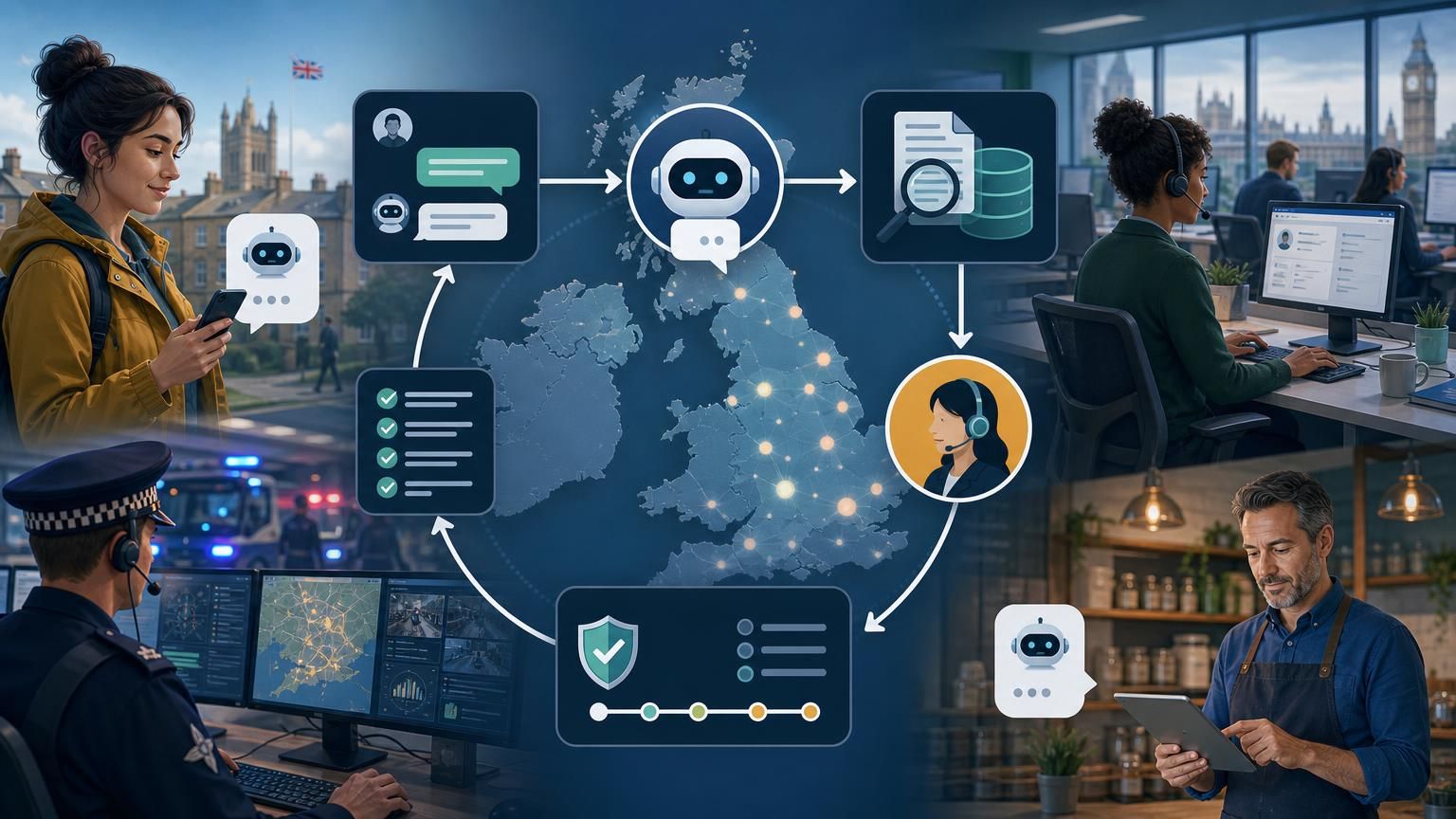
The idea — a 24/7 Digital Duty Officer for UK services
Public sector teams, housing associations, police contact centres and regulated businesses need a different live chat proposition: not a marketing widget, but a resilient, auditable, UK-hosted "Digital Duty Officer" that triages incidents round the clock, applies policy‑aware logic, and hands off seamlessly to human teams when needed.

This post explains how to build that capability with modern hybrid AI: RAG-backed knowledge, event-driven workflows, and explicit handover provenance — all hosted to UK data sovereignty standards.
Why this matters now
- Citizens expect instant answers any time of day, but many UK public services can’t afford an always-on human rota. Hybrid AI fills the gap without sacrificing auditability.
- Adding live chat to high‑intent pages typically lifts conversions and contact outcomes — studies show an average ~20% uplift when chat is used effectively. ()
- Speed-to-response still matters: classic lead-response research shows the odds of making meaningful contact fall sharply when teams delay; automating initial triage preserves intent and reduces time‑to‑first‑touch. ()
Those two facts give the business case: faster, always-on initial response that catches intent — then a controlled escalation path that meets public‑sector audit and data rules.
What 'Digital Duty Officer' actually does
- 24/7 triage: greets, classifies urgency (e.g., urgent ASB, welfare, benefit query) and applies policy-level rules.
- RAG-powered answers: retrieves specific guidance, case notes and local SOPs from secure knowledge stores rather than hallucinating. This keeps responses evidence-aligned and auditable. ()
- Risk-aware autonomy: for low-risk FAQs the AI can act autonomously; for medium/high-risk queries it captures structured data, attaches provenance and queues a human with priority flags.
- Human-in-the-loop workflows: when the AI escalates, it creates a structured case record with the retrieval trace, suggested next steps, and required redaction flags for PII.
Technical anatomy — rule-based vs pure LLM vs hybrid AI
- Rule-based chatbots: deterministic, cheap, predictable. Great for guided forms and compliance-triggered flows, but brittle when information changes.
- Pure LLM bots: fluent and flexible, but without retrieval they risk hallucination and lack of traceable provenance — a problem for regulated teams.
- Hybrid AI (the Digital Duty Officer): combines a retrieval layer (RAG) that sources authoritative documents and local case history with LLM capabilities for phrasing and triage. The result: fast, explainable answers that include the retrieval trace the human team can audit. ()
UK data sovereignty and regulation — the non-negotiables
- Host knowledge stores and chat logs in UK jurisdictions to satisfy data sovereignty and procurement expectations; the UK government has prioritised sovereign cloud capability and public-sector controls in recent guidance. (gov.uk)
- Apply ICO guidance on AI and data protection: be explicit about how personal data flows into AI, keep human oversight where required, and document automated decision stages. (ico.org.uk)
Design principle: keep raw personal data separate from the RAG index unless strictly required, and log retrieval provenance with every automated reply.
Practical architecture decisions (what support and solution teams must demand)
- RAG-based knowledge store: vector index + metadata so every suggested answer links back to the exact policy paragraph or local case note. See IMSupporting’s explanation of RAG-based AI agent knowledge for practical implementation details: https://imsupporting.com/feature-rag-based-ai-agent-knowledge.php.
- Hybrid AI chat workflows: the platform should let you encode escalation SLAs, risk bands and audit hooks so human agents receive a case with the retrieval trail and a suggested action list: https://imsupporting.com/feature-hybrid-ai-chat-workflows.php.
- Configurable autonomy rules: choose when the AI may answer directly, when it must ask extra verification, and when it must escalate — editable by ops teams without code.
- Full provenance logging: every automated message must store the retrieval IDs, timestamps, and agent handover notes for audit.
UX and operational playbook (how teams should run this)
Before launch
- Map out 10 highest-volume intents and their acceptable autonomy levels.
- Export the relevant SOPs and create canonical, versioned documents for the RAG index.
Day-to-day operations
- Monitor triage accuracy and escalation rates in a weekly cadence.
- Train agents on the RAG trace: they should review the retrieved sources before escalating or closing a case.
Incident handling
- For urgent incidents (e.g., safeguarding, immediate risk), the bot must immediately create a high-priority ticket and notify the on-call human with all provenance. No outbound automated decisions.
Measurable outcomes (commercial and service KPIs)
- Faster first contact time and higher contact rates for inbound queries — expected uplift when executed well. ()
- Reduced human hours on low‑risk enquiries; concentration of skilled staff on complex cases.
- Improved audit posture: every automated interaction is tied to source documents and human sign‑offs, reducing risk in audits and FOI reviews.
Procurement checklist for UK buyers
- UK-hosted data centres and contractual clarity on data flows (essential for councils, police and regulated bodies). (gov.uk)
- RAG support and exportable retrieval traces for every reply. ()
- Configurable escalation SLAs and human override controls.
- ICO‑aligned data protection impact assessment (DPIA) and policy for AI use. (ico.org.uk)
Quick implementation path (90 days)
- Week 1–3: intent mapping, SOP consolidation, DPIA scoping.
- Week 4–8: index documents, train retrieval vectors, configure autonomy rules.
- Week 9–12: pilot live chat on low-risk pages, measure escalation accuracy, refine playbooks.
Final recommendation and next step
If you run a UK council, police contact centre, housing association or a regulated service team, treat live chat as a mission-critical duty role — not a marketing afterthought. Build or buy a hybrid AI stack that prioritises RAG knowledge, auditable handovers and UK hosting.
To see a production-ready approach to RAG-backed agents and hybrid chat workflows built for UK organisations, review IMSupporting’s feature pages and speak to their team about a practical pilot: https://imsupporting.com/feature-rag-based-ai-agent-knowledge.php and https://imsupporting.com/feature-hybrid-ai-chat-workflows.php.
Ready to deploy a Digital Duty Officer for your service? Book a demo and audit-ready pilot with a UK-hosted hybrid AI partner today: https://imsupporting.com/.