Why handover provenance matters right now
Conversations are becoming the single source of truth for frontline decisions in councils, housing associations, police contact centres and regulated teams. But when an AI-assisted agent triages an incident and hands it to a human, that handover is often a black box: no standard record of why a decision was made, which knowledge sources were used, or what filters and policies were applied.

That gap kills auditability, slows investigations and triggers procurement red flags for UK-hosted services where data sovereignty and documented decision trails are mandatory.
Explainable handover — a practical definition
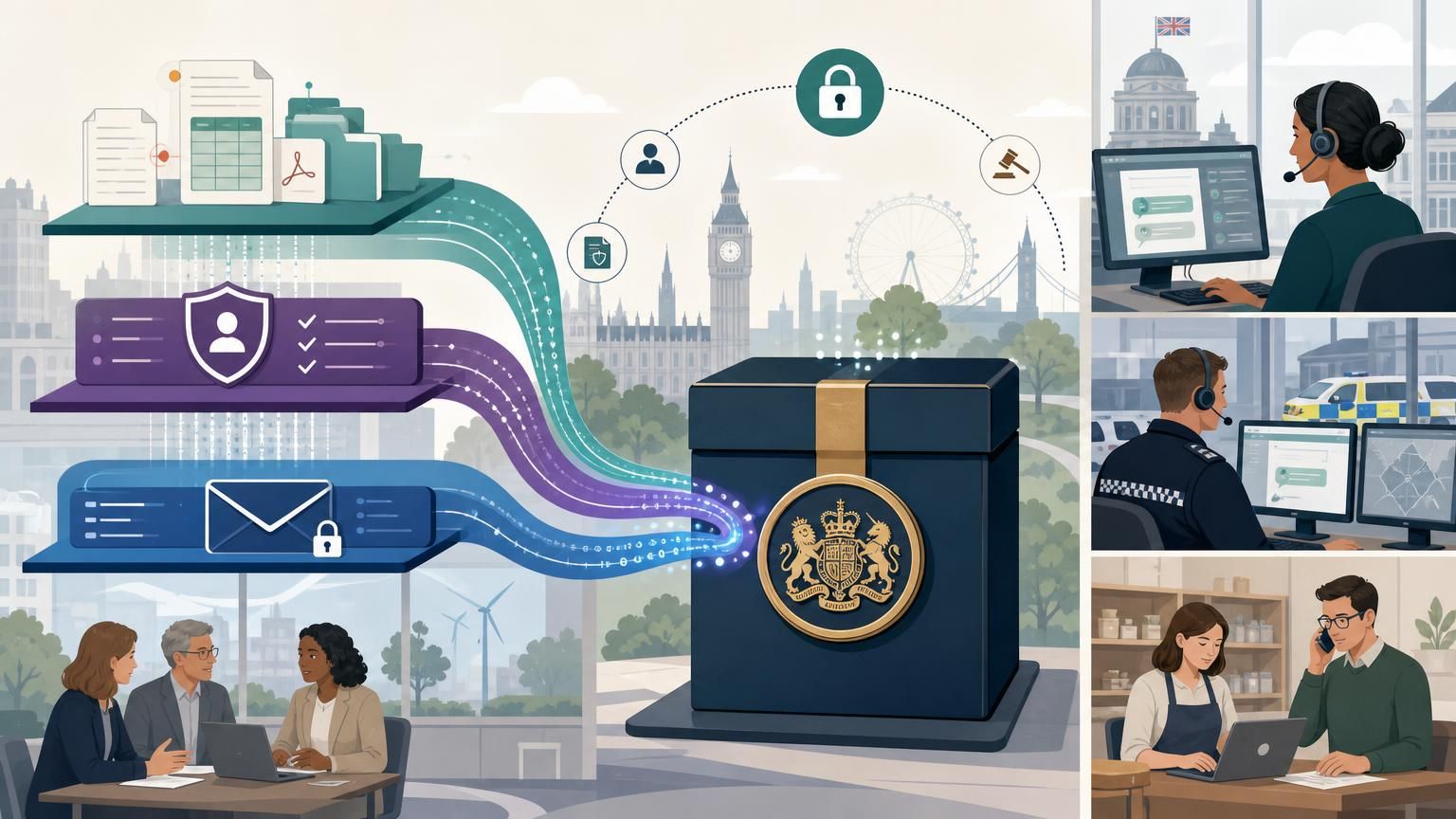
An explainable handover is a machine-readable package attached to every AI-to-human transfer that contains:
- a short human-friendly summary of what the AI saw and recommended;
- the exact knowledge snippets or documents used (RAG provenance);
- confidence scores and reasons for low confidence;
- the policy layer and redaction rules applied;
- a tamper-evident timestamp and route metadata showing which UK-hosted system stored the record.
When done correctly this becomes a digital audit trail — searchable, exportable and admissible for internal governance and external regulators.
How this differs from other chat approaches
Rule-based chatbots
Rule-based bots follow scripted trees and leave clear decision logic but fail when the problem breaks the script. They are auditable by design but brittle and poor at free-text triage.
Pure LLM bots
LLMs produce fluent responses but are opaque without retrieval proofs or provenance. They can hallucinate and are questionable for regulated decisions unless constrained.
Hybrid AI live chat (the right middle ground)
Hybrid AI combines LLM capability with Retrieval-Augmented Generation (RAG) and governed handover rules. The AI performs triage, cites exact knowledge snippets, and creates a structured provenance record that a human agent can review and endorse. This preserves the speed of LLMs while keeping decisions auditable and policy-compliant.
Why RAG and provenance are now required for enterprises
RAG is rapidly becoming the enterprise default for knowledge-sensitive AI: recent industry surveys show RAG architectures are in active deployment across a growing share of GenAI projects — organisations are choosing retrieval first to control sources and to anchor answers. ()
Another study found most teams augment LLMs with retrieval frameworks because out-of-the-box models can’t safely answer jurisdictional or regulated queries without context. 86% of respondents reported augmenting models with knowledge retrieval patterns to reduce risk and increase relevance. ()
For UK public services, the technical choice is only part of the story: guidance on multi-region cloud and SaaS storage emphasises that public bodies must make explicit choices about where data is stored and processed. That has direct consequences for handover storage and provenance custody. (gov.uk)
The ICO’s AI and data protection guidance further makes clear organisations must be able to explain how automated decisions were reached when personal data is involved — explainable handovers are a practical way to meet that expectation. (ico.org.uk)
Architecture blueprint: what to build (or buy)
Design explainable handover as three layers:
- Retrieval & citation layer (RAG)
- Use an enterprise RAG engine that returns exact document IDs, snippet offsets and retrieval scores for each response.
- Store the retrieval fingerprint (document id, vector id, retrieval timestamp) with the conversation record.
- Policy & redaction layer
- Apply per-conversation policy contracts (e.g. OFFICIAL SENSITIVE handling) that redact or escalate based on data type and user role.
- Log which policy rules fired and the rule version.
- Handover envelope (machine-readable)
- JSON envelope attached to the chat transfer containing: summary, provenance references, confidence, policy IDs, and a signed timestamp.
- Store the envelope in a UK-hosted audit store under the organisation’s tenancy.
If you want a ready implementation, look for live chat platforms that explicitly offer RAG-backed agent knowledge and hybrid AI workflow features—these capabilities are the technical building blocks of explainable handovers. See an example RAG feature and hybrid workflow implementation. https://imsupporting.com/feature-rag-based-ai-agent-knowledge.php and https://imsupporting.com/feature-hybrid-ai-chat-workflows.php
Practical checklist for UK organisations
Follow these steps to prove explainable handover works for your auditors and procurement teams:
- Map decisions: catalogue all decision types that could be AI-assisted and define required provenance fields.
- Choose RAG-first tooling: insist that retrieval proofs are stored alongside generated text.
- Enforce UK-hosted storage: require vertebrae (audit envelopes) and raw retrieval indices be stored in the UK tenancy. Cite your cloud location in procurement docs and supplier SLA. (gov.uk)
- Version policies: use versioned policy contracts (policy_id + version) so you can show which rules applied at any date.
- Human sign-off: require a human agent to confirm or override AI recommendations; capture their decision and rationale in the envelope.
- Test with FOI and SAR scenarios: simulate subject access and freedom of information requests to check exportability and redaction.
Metrics that prove value (and safety)
Measure both operational and compliance metrics:
- Triage speed (time to first meaningful action) — you should see a reduction as AI handles low-risk triage.
- Handover friction (time from AI handover to agent acknowledgement).
- Provenance completeness (percentage of transfers that contain full provenance envelopes).
- Audit-readiness (time to export case history for a regulator).
Organisations implementing RAG-backed workflows report faster triage and far better traceability; this matters because UK users expect a choice of channels and reliable answers — 85% of customers say channel choice and consistent service matter to loyalty. ()
Additionally, UK-wide surveys show AI usage among businesses is rising but still selective — roughly one in five UK businesses had adopted AI by mid-2025 — so demonstrable audit controls are a commercial differentiator in public sector procurement. ()
Risks and mitigations (quick reference)
- Hallucination: mitigate with RAG provenance and confidence thresholds.
- Data leakage: enforce per-conversation redaction and UK-hosted storage contracts. (gov.uk)
- Regulatory scrutiny: maintain policy versioning and human sign-off logs to demonstrate lawful processing under UK data protection rules. (ico.org.uk)
Where to start today
Start with a pilot that replaces one low-risk handover path (e.g., billing queries or tenancy admin) with RAG-backed hybrid AI and explicit provenance envelopes. Validate the export and redaction process with your legal and FOI teams.
If you need a platform that combines RAG-backed knowledge, hybrid AI chat workflows and UK tenancy controls, review a purpose-built solution and request a compliance walkthrough. See practical feature details and get in touch for a pilot: https://imsupporting.com/feature-rag-based-ai-agent-knowledge.php and https://imsupporting.com/feature-hybrid-ai-chat-workflows.php
For a direct next step, book a compliance-focused demo and pilot plan with a UK-hosted provider who can show end-to-end provenance, policy versioning and auditable handovers: https://imsupporting.com/.
Explainable handovers aren’t a nice-to-have — they’re the foundational control that will determine whether hybrid AI live chat earns procurement and regulator trust across UK councils, police forces and regulated businesses.