Why federated hybrid AI matters for UK shared service desks
Shared service arrangements — where two or more councils, housing associations or public bodies run a combined contact centre — are common in the UK. They save money but multiply data governance, tenancy and SLA complexity. A federated hybrid AI live chat model treats each organisation as a separate tenant for knowledge, policy and evidence, while sharing a single front door for citizens and customers.

This approach reduces cost-to-serve without compromising UK hosting, data separation or compliance — vital for councils, police contact points and regulated teams.
Defining the three chat architectures (and why the difference matters)
Rule-based chatbots
- Operate on scripted flows and decision trees.
- Good for narrow, repetitive tasks (form-fill, simple FAQs).
- Strength: predictability, audit trails. Weakness: brittle for unexpected queries.
Pure LLM bots
- Use large language models to generate freeform replies from patterns in training data.
- Strength: fluent, flexible. Weakness: hallucination risk, often needs external grounding and stricter data controls before public‑sector use.
Hybrid AI live chat (the practical sweet spot)
- Combines rule-based routing, RAG-grounded LLM answers, and instant human handoff when policy/complexity requires it.
- Delivers fast, accurate triage and response while preserving human judgement for high-risk or regulated cases.
- IMSupporting’s architecture is an example of this hybrid model, pairing RAG-based agent knowledge with policy-driven hybrid chat workflows. See their RAG feature and workflow design pages for technical detail: https://imsupporting.com/feature-rag-based-ai-agent-knowledge.php and https://imsupporting.com/feature-hybrid-ai-chat-workflows.php.
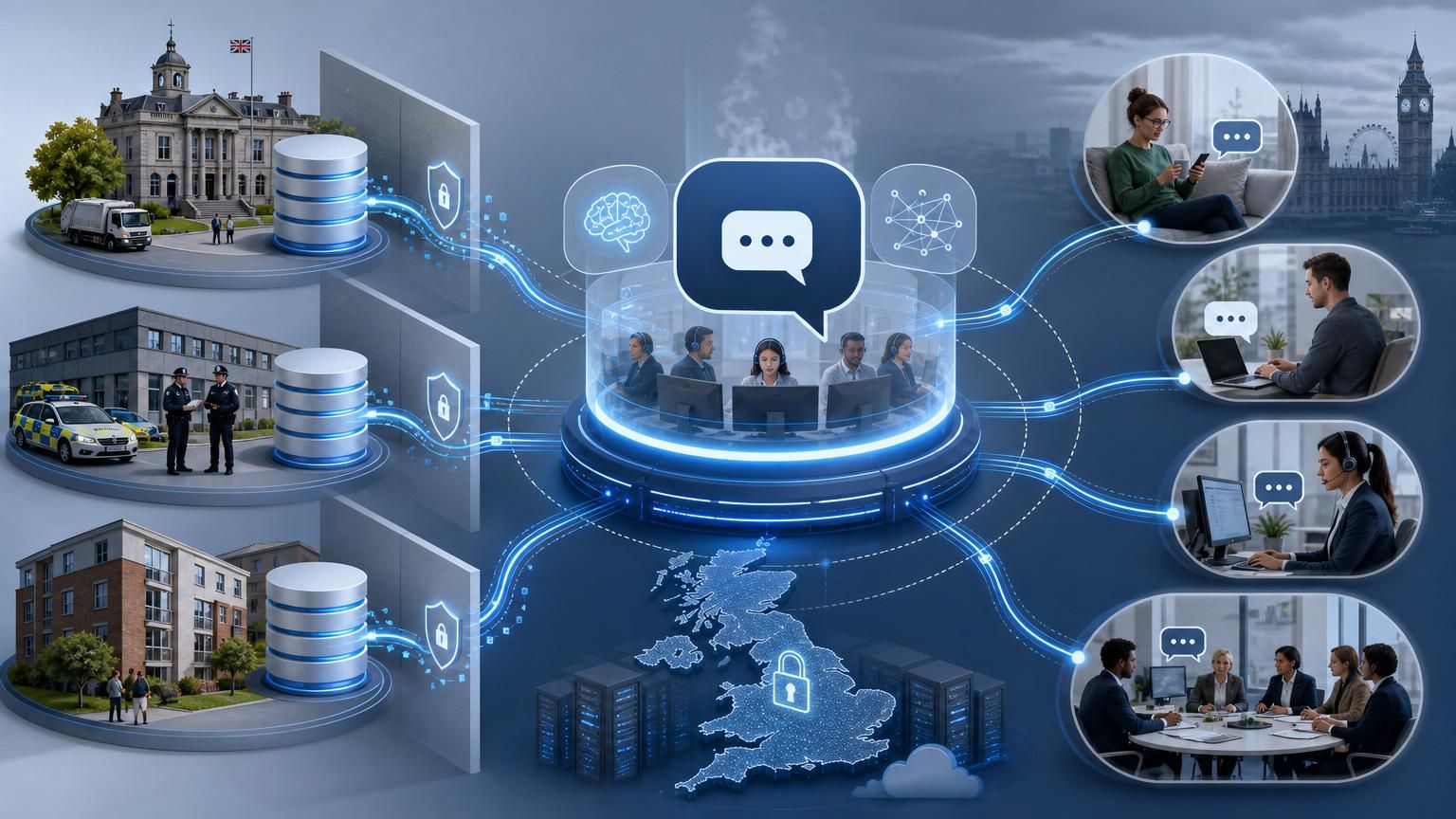
The federated model: architecture at a glance
- Tenant isolation: each organisation keeps its own knowledge store, audit logs and policy rules, hosted within the UK.
- Shared gateway: a single chat widget and intake layer performs profiling and routes to the correct tenant.
- RAG+Policies: retrieval‑augmented generation provides grounded answers from tenant-owned documents; policies check for FOI, safeguarding or escalation triggers before any automated reply.
- Human handoff with context: when escalation is needed, the agent receives a complete, auditable conversation summary plus the relevant tenant data.
This design preserves the efficiency of shared services while ensuring each tenant meets its statutory obligations and data residency requirements.
Commercial case: why federated hybrid AI beats the status quo
- Lower cost-per-contact: live chat and messaging typically cost less than phone channels and scale better with concurrent sessions. Organisations reporting channel comparisons show live chat costs materially less than voice while handling rising contact volume. ()
- Faster resolution and lower AHT: automating context assembly and RAG responses shaves time agents spend hunting for records; AHT improvements of multiple minutes per contact are realistic when tooling removes manual lookups. ()
- Better outcomes for conversion and service completion: visitors who engage via chat are significantly more likely to convert or complete a service transaction when the chat is proactive and properly staffed. Some industry benchmarks show strong conversion uplift for engaged users. ()
Stat: a clear, measurable KPI to track is ‘contacts resolved without human escalation’ versus ‘time-to-first-human’ — federated hybrid setups lower both while keeping compliance intact.
Implementation checklist for UK public-sector teams
- Choose UK-hosted tenancy: insist on physical UK data residency and separate tenant stores for each council or trust.
- Define tenant policies up-front: FOI, safeguarding flags, vulnerable-citizen routing and retention schedules must be encoded into the intake layer.
- Build a shared intake and identity layer: use a single widget to profile the user and resolve tenancy; keep PII minimal at triage and fetch sensitive data only after proper consent/verification.
- Ground AI with tenant documents via RAG: make external LLM responses rely only on tenant-owned sources for facts, reducing hallucination risk and making replies auditable. See how a RAG-based agent knowledge base is implemented in practice. https://imsupporting.com/feature-rag-based-ai-agent-knowledge.php
- Hybrid workflows and escalation paths: codify when the bot must transfer to a human, when it can issue templated guidance, and how evidence is logged for later audit. For technical workflow patterns see: https://imsupporting.com/feature-hybrid-ai-chat-workflows.php
Practical governance and procurement points
- Tender for composability: require the ability to attach tenant-specific data stores, retention rules and policy modules.
- SLA-aware routing: federated models must respect different SLAs per tenant (e.g. vulnerable-citizen response within X minutes for council A, different priority for housing association cases).
- Audit and exportability: logs, transcripts and RAG sources must be exportable per tenant for FOI and case reviews.
- Procurement tip: ask for demonstrable UK-hosted case studies and a clear pathway for data export if the shared service dissolves.
Measuring success (metrics that matter to finance and service owners)
- Cost-per-contact and total cost-to-serve (expect initial tooling investment, then steady operational savings).
- % resolved without agent + safe handoff rate (how often the AI correctly triages to human intervention).
- Average handle time (AHT) and time-to-resolution — both should fall as contextual information is pre-assembled by the hybrid AI. ()
- Citizen satisfaction and compliance audits — these are non-negotiable for police, councils and regulated bodies.
Common pitfalls and how to avoid them
- Treating LLMs like self-sufficient agents: pure LLM bots have hallucination risk and are rarely acceptable for regulated UK public work without RAG grounding and human oversight.
- Centralising without tenancy controls: a single knowledge pool is a legal and operational risk for multi‑tenant public services.
- Over-automation of vulnerable cases: always default to human review when safeguarding indicators appear.
Quick rollout plan (90 days)
- Discovery (0–30 days): map tenants, SLAs, data residency needs and high-risk query types.
- Pilot (30–60 days): deploy a single-widget intake routed to two tenants; enable RAG for non-sensitive queries and human handoff for complex cases.
- Scale (60–90 days): add tenant-specific policies, audit exports and SLA-aware routing; measure cost-per-contact and citizen outcomes.
Why choose a UK-hosted federated hybrid approach now
- Shared service models are maturing across UK local government; hybrid AI lets you deliver consistent citizen journeys while keeping legal boundaries clean.
- The right architecture combines predictable rule-based controls, RAG-grounded LLM answers and human oversight — balancing speed, accuracy and auditability. For implementation patterns and feature-level detail, review IMSupporting’s RAG and hybrid workflows pages: https://imsupporting.com/feature-rag-based-ai-agent-knowledge.php and https://imsupporting.com/feature-hybrid-ai-chat-workflows.php.
Next step (practical CTA)
If you’re a support lead or procurement owner in a council, housing association or regulated body planning a shared service or consolidation, start with a short technical review and pilot brief. Learn how a UK-hosted federated hybrid AI live chat can be deployed with tenant separation, RAG‑grounded answers and auditable handoffs at https://imsupporting.com/.