Why build a High‑Trust Escalation path now
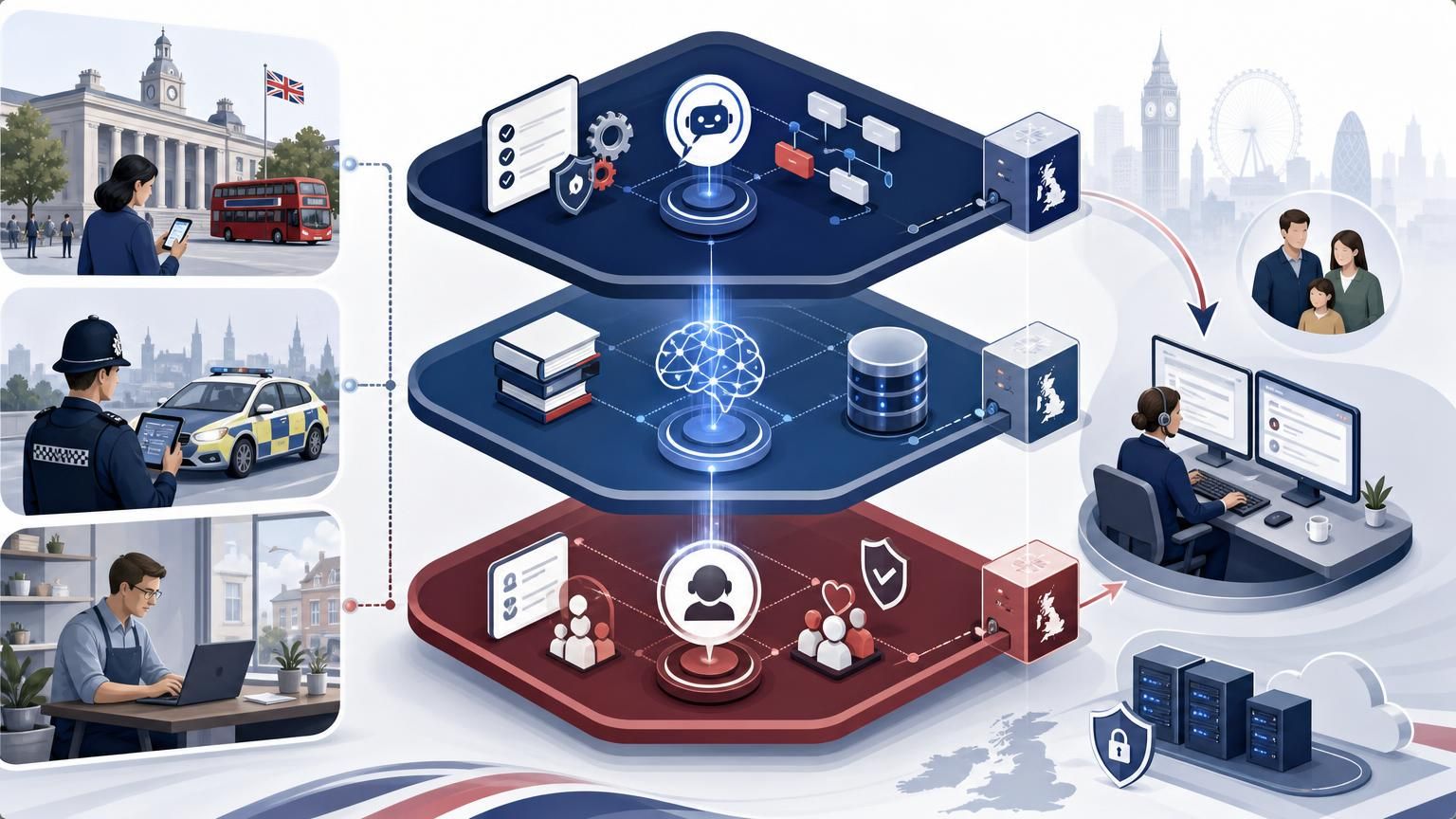
Regulated organisations — councils, police, housing associations and NHS-adjacent teams — no longer accept “we’ll patch the ticket later.” High‑risk queries (eligibility, safeguarding, legal requests) need evidence, explicit consent, and a clear chain of custody before a human agent spends time on the case. A UK‑hosted hybrid AI live chat can act as that first, auditable mile: capture the right facts, surface risk signals and hand the case to a specialist with everything they need.

Hybrid models are now the dominant preference among enterprise CX leaders because they balance efficiency with control. Recent industry research shows most CX leaders want hybrid AI + human models rather than fully autonomous bots. ()
What a High‑Trust Escalation actually does
- Capture explicit consent, preferred contact channel and data-sharing limits on the first touch.
- Collect structured evidence fields (dates, IDs, documents placeholder) and preserve originals for audit.
- Run a lightweight risk score (fraud, safeguarding, urgent legal) that prioritises cases for fast human response.
- Ground answers with retrieval-augmented-generation (RAG) so any automated suggestions are verifiable.
This workflow reduces rework, prevents SLA breaches, and leaves a clear digital trail for auditors and data‑protection officers.
Three technologies: rule‑based bots, pure LLMs and hybrid AI — what to use when
Rule‑based chatbots
- Deterministic flows, checkbox-style logic and simple form capture.
- Best for mandatory triage steps (consent capture, statutory tick boxes) where you must enforce exact wording.
- Limited for nuance or ambiguous queries.
Pure LLM bots
- Generative, conversational, good at summarising messy inputs and drafting free‑text responses.
- Risk: hallucination, lack of provenance, and weak controls for regulated evidence capture.
Hybrid AI live chat (the recommended stack)
- Uses LLMs for natural language understanding + RAG for sourcing verifiable answers, wrapped in policy checks and hard stops (rule‑based) that enforce consent and mandatory fields.
- If the AI cannot meet a confidence threshold or policy gate trips, the system hands off instantly to a human with full context and the captured evidence.
- This approach preserves conversational quality while delivering auditability and safety.
Hybrid deployments are already producing measurable benefits: many teams report faster responses and higher CSAT when AI handles triage while humans resolve complex, high‑value interactions. ()
Design checklist for High‑Trust Escalation workflows
- Mandatory consent flow up front — record timestamp, exact wording and channel consent. Use a rule‑based gate to prevent further progress without it.
- Structured evidence capture — require fields, file placeholders and contextual metadata (IP, session ID, agent ID after handoff).
- RAG grounding for suggested answers — link any AI‑generated recommendation to a source snippet and include that as part of the case record. See an example RAG implementation. IMS Supporting — RAG feature.
- Confidence threshold + policy gates — if the model confidence is below threshold or a policy flag is raised, escalate immediately.
- Human handoff with pre‑populated brief — agent receives summary, risk score and exact evidence attachments.
- Audit trail export — make it easy to produce an export that satisfies internal audit or FOI requests.
KPIs that matter (and what to expect)
- First Response Time: target a 30–60 second automated triage and consent capture.
- Mean Time To Resolution (MTTR): expect a 20–40% reduction for cases where triage removes repeated evidence requests. Industry signals show hybrid AI containment and triage can significantly speed workflows when combined with human backup. ()
- SLA Breaches: measurable drop when evidence collection is guaranteed on first contact.
- Audit‑ready cases: percentage of escalations with full evidence package — aim for 95%+ in regulated environments.
Use policy and logging to feed governance dashboards; the ICO’s AI guidance stresses accountability and documentation where personal data and decisions are involved. Build for that expectation. ()
Practical UK public sector scenarios
- Housing allocations: capture identity checks, tenancy history and urgency score before housing officers review.
- Domestic abuse triage: mandatory safe‑word checks, consent capture and immediate high‑priority routing.
- Police admin: intake forms that collect reference numbers, witness statements and preserve timestamps while protecting PII in a UK‑hosted environment.
UK teams must weigh hosting and access controls heavily — server location alone is not the whole answer, but UK‑hosted, auditable systems simplify procurement and risk conversations with SROs and data protection teams. Recent debates about cloud procurement and data sovereignty make this a business priority. ()
How to start (practical first 90 days)
- Week 0–2: run a risk mapping session with legal, security and frontline agents; list mandatory fields and consent wording.
- Week 2–6: build a rule‑based consent flow + structured evidence form; connect RAG knowledge sources and set confidence gates. See hybrid chat workflows examples. IMS Supporting — Hybrid AI workflows.
- Week 6–12: pilot on a small queue, measure containment, MTTR and audit completeness; iterate policy thresholds.
Why choose a UK‑hosted hybrid AI partner
- Data sovereignty reduces legal friction in procurement and gives audit teams clearer controls.
- A partner that implements RAG, policy gates and seamless human handoff turns risk into a commercial advantage: fewer callbacks, clearer evidence, and defensible decisions.
If you’re designing an auditable, high‑trust escalation path for regulated support, start with proven building blocks and a UK‑hosted deployment that meets your governance needs. Learn more about practical deployments and feature sets on the IMSupporting site and request a demo to see how these workflows work in a live environment: https://imsupporting.com/.
Next step (CTA)
Book a short design call to map your first High‑Trust Escalation workflow and see a working demo of RAG‑grounded answers, policy gates and human handoff in a UK‑hosted stack. Visit https://imsupporting.com/ to get started.