
Why agent‑coaching should be the next live‑chat KPI
Most live‑chat projects measure response time and CSAT. The next wave of commercial advantage comes from measuring how well chat systems improve agent capability. A live chat that can coach a junior agent through complex, regulated answers in real time turns support from a cost centre into a learning engine and risk control point.
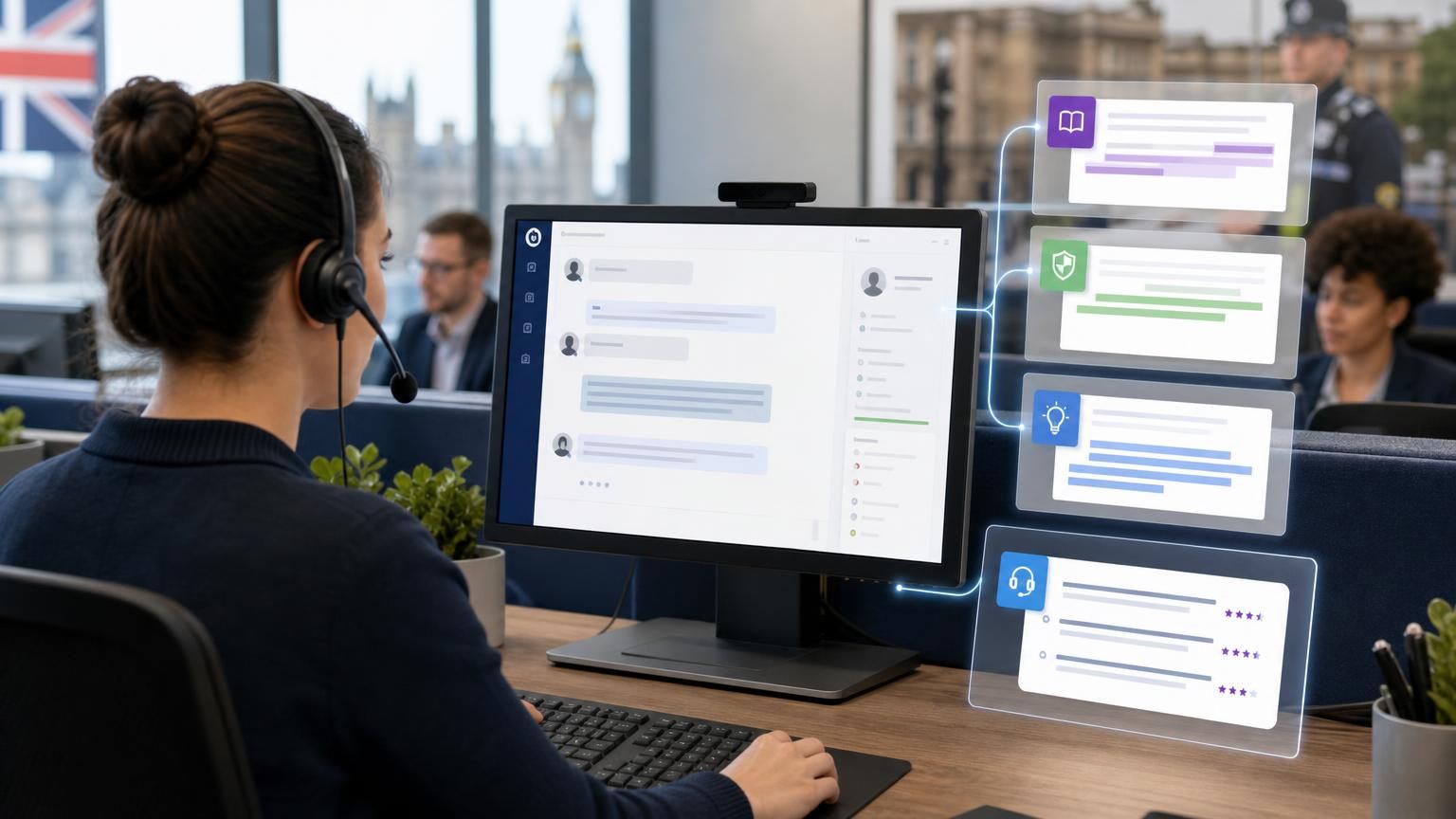
This matters especially in the UK public and regulated sectors — councils, police contact teams, housing associations and regulated firms — where correct, auditable answers and fast resolution are both compliance requirements and political risks.
Three chat architectures — clear differences you must plan for
- Rule‑based chatbots: deterministic flows, good for simple form filling, service status and signposting. They scale but cannot synthesize novel answers or pull from large knowledge archives.
- Pure LLM bots: generate fluent answers but can hallucinate, and unless tightly controlled they risk leaking confidential or incorrect guidance in regulated contexts.
- Hybrid AI live chat: the pragmatic middle path. It uses RAG (retrieval‑augmented generation) and policy guardrails to fetch exact facts from your knowledge base, then combines that with LLM fluency — and crucially, hands off to a human agent (or coaches them) with an auditable trace.
Hybrid AI is not “AI instead of staff.” It is AI that augments staff capability while keeping humans in the loop where judgement, accountability and empathy matter.
Market context: why now is the moment for coaching‑first chat
Enterprises have converged on RAG and hybrid patterns because out‑of‑the‑box LLMs lack enterprise memory and governance; RAG gives those models company knowledge and reduces factual errors. ()
Organisations are actively augmenting models with retrieval: one industry survey found roughly 86% of adopters are using retrieval or similar patterns to make LLMs business‑ready. That trend makes hybrid coaching feasible in production. ()
At the same time UK customers insist on human oversight: research shows a significant portion of the market does not want entirely AI‑driven service, and values human contact for complex problems. That makes agent coaching — not replacement — the credible proposition for public sector teams. ()
What a coaching workflow looks like in practice
- Incoming chat starts; hybrid AI runs fast triage to identify intent and risk.
- RAG retrieves the exact policy sections, templated responses and precedent cases from your UK‑hosted knowledge store. The system highlights the lines and confidence scores for the agent. (This is where RAG beats blind LLM output.)
- The junior agent sees a suggested reply and a short ‘coaching tip’ — why this wording is compliant, or which follow‑up question to ask.
- Agent edits or approves; the chat continues. The entire exchange plus the retrieval trace is stored for audit and training.
This preserves human judgement, reduces time to correct answer, and creates a continuous dataset for staff development.
Two measurable business outcomes you’ll get
- Faster first‑contact resolution (FCR): when agents have precise, sourced answers at hand, complex queries resolve faster — driving lower cost per contact and higher satisfaction.
- Safer, auditable compliance: retrieval traces create explainable decision trails that are essential for councils, police and regulated teams.
A mix of coaching and retrieval is particularly important where policy nuance matters: a council benefits from showing exactly which policy line the answer referenced; a housing association benefits from consistent phrasing to avoid misinterpreting benefit eligibility.
Quick technical checklist for procurement teams
- UK data residency: insist on UK‑hosted knowledge storage and vector indexes to meet data sovereignty expectations.
- RAG traceability: the system must store the exact sources used for each AI suggestion with timestamps and confidence scores.
- Human handover rules: define trigger conditions (risk score, ambiguous intent, vulnerable user flags) where the AI must escalate immediately.
- Agent UI: coaching prompts should fit one screen; too much text = cognitive load.
- Audit and export: ensure transcripts plus retrieval metadata are exportable for FOI, SAR and internal audit.
How to measure success — practical KPIs
- Delta in FCR for coached vs non‑coached agents (target +10–20% within 90 days).
- Average handle time for complex categories (should fall as coaching suggestions improve accuracy).
- Compliance exception rate (policy mis‑advice per 1,000 chats) — should trend down as RAG sources are curated.
- Coaching acceptance rate (how often agents use or edit the AI suggestion) — a leading indicator of trust.
Implementation roadmap for UK councils and regulated teams
Phase 1 — Pilot, 4–8 weeks
- Select 2–3 high‑value complex topics (housing queries, licensing, incident triage).
- Ingest policy PDFs, FAQs and precedent cases into a UK‑hosted RAG index.
- Run a restricted pilot with a small agent cohort and guardrails in place.
Phase 2 — Scale, 3–6 months
- Expand topic coverage, refine the coaching prompts and add confidence thresholds.
- Use audit logs to build a training curriculum for agents and adjust policy copy where ambiguity exists.
Phase 3 — Operate, continuous
- Regularly review retrieval hit rates, coach acceptance and complaint escalations.
- Use the operational dataset to reduce reliance on scripts and to design better citizen journeys.
For practical RAG and workflow features, see IMSupporting’s RAG‑based agent knowledge and hybrid chat workflow pages. These show how source tracing and handover rules work in a UK‑focussed product stack. https://imsupporting.com/feature-rag-based-ai-agent-knowledge.php https://imsupporting.com/feature-hybrid-ai-chat-workflows.php
A short governance note for regulated teams
Keep humans in control of decisions that carry legal or safeguarding consequences. Configure hybrid AI so that anything above a modest risk threshold auto‑escalates. Use the retrieval trace as your single source of truth for “why we answered that way.” Public trust research shows customers still want transparency on AI use — include short disclosures in your chat UI explaining when AI suggested wording. ()
Competitive framing and procurement advice
Vendors will pitch “autonomous bots” and dazzling demos. Ask for three things in procurement:
- Evidence of UK hosting for knowledge and logs.
- Demonstrable RAG source tracing and exportable audit trails.
- A live pilot showing coaching uplift on real tickets, not synthetic metrics.
Teams that synthesise coaching, retrieval and human oversight early will outcompete peers on quality and risk control. Cisco/C-suite research shows that organisations that move from pilots to production faster are significantly more likely to report measurable value; governance and clear KPIs drive that shift. ()
Start small, measure fast, scale safely — a final playbook
- Pick a small, high‑risk use case (e.g., benefit eligibility or incident triage).
- Run a 6–8 week coaching pilot with clear KPIs for FCR and compliance exceptions.
- Iterate sources: better knowledge = better coaching = fewer escalations.
If you want to see a UK‑hosted hybrid AI solution built for auditable coaching workflows and regulated teams, review the platform and book a demo at IMSupporting. https://imsupporting.com/