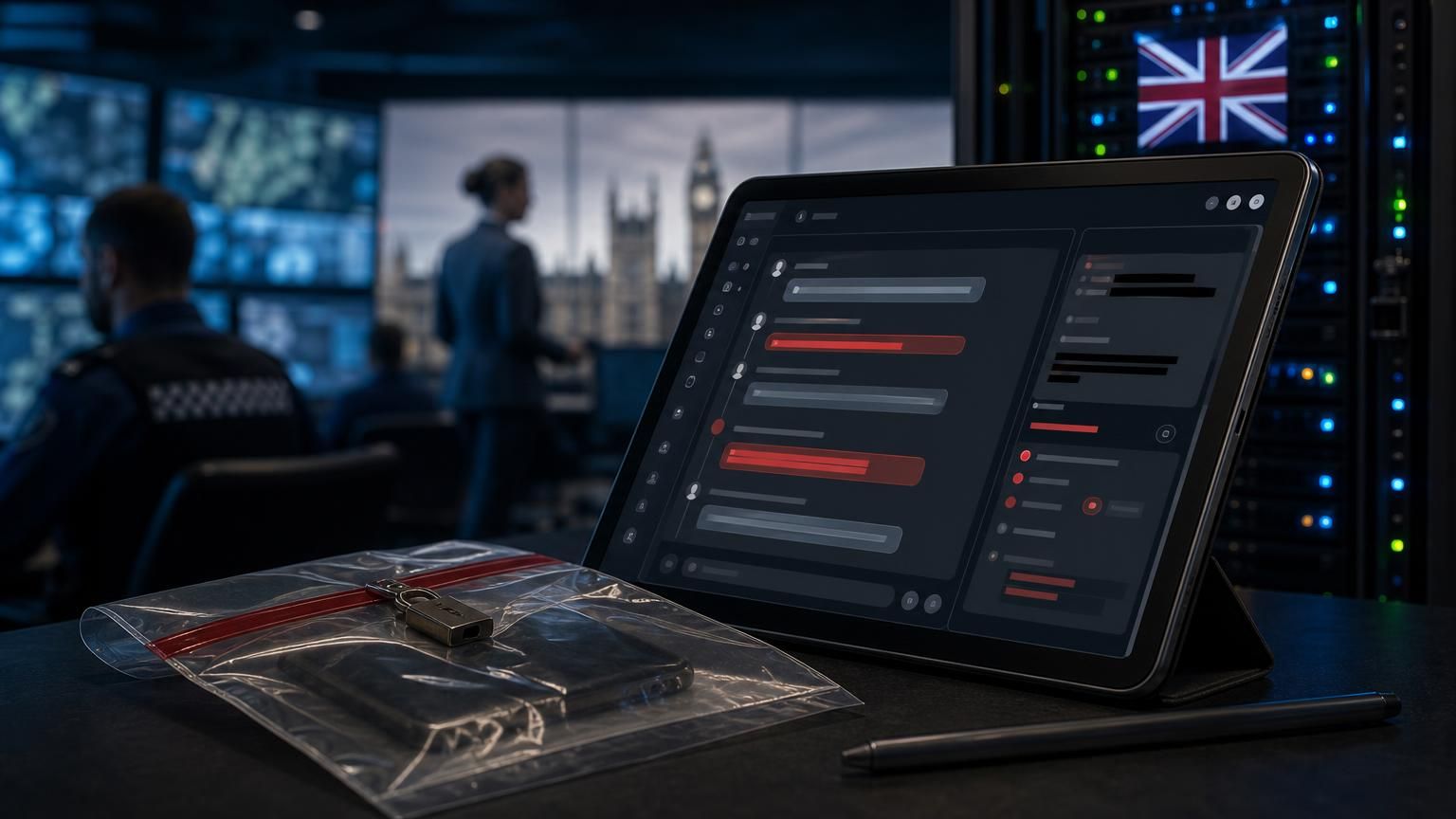
Why UK services need a 'Digital Duty Officer' in live chat
Public services and regulated teams can't treat web chat as a marketing widget. They need a continuous, auditable duty layer that triages incoming reports, preserves forensic evidence, and routes cases to the right team — all while keeping data inside the UK. A hybrid AI 'Digital Duty Officer' does exactly that: instant triage, RAG-backed answers where appropriate, and governed human handovers when complexity or legality requires it.

What the 'Digital Duty Officer' must deliver
- Rapid risk-based triage: identify severity, vulnerability, and safety flags within the first message.
- Evidence grade capture: timestamped transcripts, metadata, and an immutable log suitable for audits and incident reviews.
- Controlled knowledge access: answers generated only from approved, versioned documents.
- Data sovereignty and redaction: ensure UK-hosted storage, and automated redaction when needed.
These capabilities are the difference between a lightweight chatbot and a strategic, mission‑critical channel for councils, police teams, housing associations and regulated services.
Three architectures: rule-based bots, pure LLMs, and hybrid AI — and why it matters
Rule-based chatbots
Rule-based systems follow scripted flows and exact-match rules. They’re safe for simple FAQs and enforceable policies, but brittle for unexpected queries and poor at synthesising documents.
Pure LLM bots
Large language models can generate fluent replies from patterns learned in their training data. They are flexible but have two big problems for regulated UK services: unpredictable hallucinations and opaque provenance of the facts used.
Hybrid AI live chat (the pragmatic choice)
Hybrid systems combine an LLM front-end with retrieval-augmented generation (RAG) and governance controls: the chat agent only answers using retrieved, approved documents and hands over to humans when rules or risk thresholds are met. This preserves the LLM’s natural language ability while ensuring source traceability and compliance — the model is constrained to your facts. See IMSupporting’s RAG-based agent knowledge for an example of how this looks in practice. (imsupporting.com)
How RAG makes answers auditable and safe
RAG works by retrieving relevant passages from a pre‑approved knowledge base and providing them to the generative model as context. That means each reply can be traced back to an origin document or clause — not to the model’s training data. RAG is now the standard pattern for knowledge-intensive chat applications because it combines retrieval accuracy with generative fluency. ()
Designing triage workflows that public sector teams will trust
A 'digital duty officer' must be more than a single flow. Build multi-path hybrid AI workflows that:
- Run automated safety and disclosure checks on every message.
- Attach case severity (high/medium/low) and recommended SLA.
- Capture structured fields automatically (location, person-type, incident code) for downstream systems.
- Queue critical incidents to live operators with full context and an evidence packet.
IMsupporting’s hybrid AI chat workflows show how to build multi-path routing, pre-warmed human handovers and API calls so the chat becomes a case builder, not a dead-end transcript. (imsupporting.com)
Practical controls: provenance, redaction and UK data residency
- Keep the RAG index and conversation logs on UK-hosted infrastructure to meet procurement and data‑sovereignty needs.
- Version and sign knowledge bundles so answers can be traced to a specific policy revision (important for FOI and regulated reviews).
- Add automated redaction and data-minimisation in the workflow to strip sensitive identifiers before storage or cross-agency sharing.
This technical setup mirrors ICO guidance on AI and data protection — public sector projects must demonstrate lawful processing, transparency and risk management when adopting AI. Designing for provenance and UK hosting removes a major procurement barrier. (ico.org.uk)
Business outcomes: faster triage, fewer escalations, safer handovers
- Faster response and prioritisation reduces time-to-action on safety incidents.
- Repetitive low-risk contacts are resolved automatically, freeing skilled staff for complex cases.
- Structured handovers reduce investigation time once cases reach specialist teams.
For commercial teams, the conversion and contact-quality benefits are real too: adding chat to a web channel increases conversion and engagement metrics — some industry studies show uplift figures in the high single digits to tens of percent when chat is used strategically. Use chat to capture high-intent signals and convert enquiries into completed cases or qualified leads. ()
Implementation checklist for UK councils, police units and regulated teams
- Choose a platform that supports RAG and versioned knowledge bundles. (See IMSupporting’s RAG feature.) (imsupporting.com)
- Insist on UK-hosted data, export controls, and signed processing addenda.
- Build hybrid workflows that automatically escalate on risk flags and attach evidence packets to every handover. (IMsupporting’s workflow builder is a practical example.) (imsupporting.com)
- Run a shadow trial: run the Digital Duty Officer in read-only mode alongside human teams for 6–8 weeks to measure triage accuracy and false positives.
- Log provenance: keep a searchable index of which documents contributed to each AI answer.
Common pushbacks and how to answer them
- "AI will replace officers": Hybrid AI is designed to triage and reduce load, not replace specialist judgment. Use the system to pre-fill structured data and surface evidence to humans.
- "Data protection risk": Mitigate this with UK hosting, automated redaction and clear retention policies, aligned to ICO guidance. (ico.org.uk)
- "We can't trust answers": RAG-backed replies give you traceability — every answer links to source documents you control.
Quick pilot plan (8 weeks)
Week 1–2: Index high-value policies, FAQs and incident templates. Week 3–4: Build triage workflows and risk flags. Week 5–6: Shadow mode with operator review. Week 7–8: Move to live with tight SLAs and audit reporting.
Take the next step: a UK-ready platform example
If you want a ready-built UK-hosted implementation that combines RAG knowledge, hybrid AI workflows and agent tooling, review a platform that demonstrates exactly these features and offers UK data residency. See the IMSupporting RAG agent knowledge and workflow pages for concrete implementation details and setup examples. (imsupporting.com)
For an immediate look at a production-ready UK-hosted hybrid AI live chat platform and how it can be configured as a Digital Duty Officer, visit https://imsupporting.com/ and request a tailored demo.
Final takeaways
- Public services need live chat that goes beyond FAQs — they need auditable triage, evidence capture and governed handover.
- Hybrid AI (RAG + human escalation) is the practical architecture that delivers traceable, safe answers while keeping humans in the loop.
- Prioritise UK-hosted data, versioned knowledge bundles and workflow-driven redaction to meet procurement and ICO expectations.
Start with a short shadow trial and measure triage precision, escalation load and time-to-action — that will show whether the Digital Duty Officer moves your service from reactive contact handling to proactive, auditable incident management.