
What a ‘digital caseworker’ actually is
A digital caseworker is not a glorified FAQ bot. It’s a hybrid AI live chat layer that can intake, validate and complete entire low-risk transactions—think housing repair bookings, licence renewals, benefit checks or straightforward FOI requests—without human rework, while handing off complex cases to a human adviser with a full audit trail.
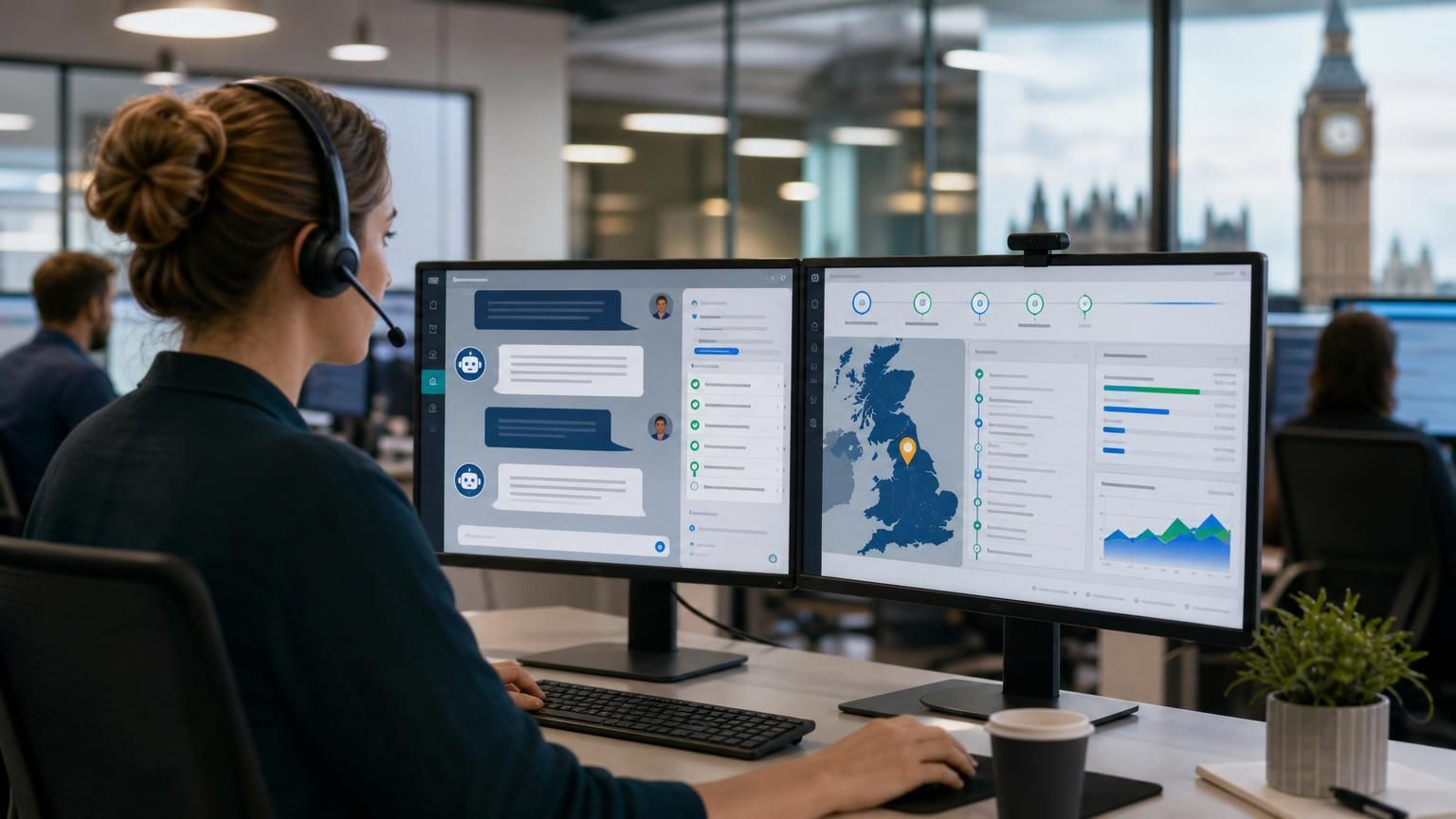
This is commercially important for UK councils, police control rooms, housing associations and regulated teams because it turns high-volume, low-risk demand into completed tasks rather than work tickets. The result: fewer manual steps, faster resolution and defensible, auditable records for compliance.
Why this matters now for UK public services and regulated organisations
- Public-sector budgets are squeezed and service demand rises; automation has to reduce cost-to-serve while keeping legal and audit standards intact.
- UK regulators (ICO and ministers) are increasing scrutiny of AI agents and data flows — councils need solutions that are UK-hosted, auditable, and purpose-limited.
McKinsey case studies show properly designed AI-enabled service programmes can reduce service interactions by 40–50% and cut cost-to-serve by more than 20%. ()
Adoption of agentic AI in customer service is accelerating: many organisations now expect agentic AI to scale across customer operations because it reduces volume, preserves responsiveness, and reallocates human effort to high-value work. ()
Rule-based bots, pure LLMs and hybrid AI: the practical differences
- Rule-based chatbots: pre-scripted flows, great for simple data capture (opening hours, static eligibility checks). Rigid, brittle for anything outside the script.
- Pure LLM bots: excel in natural language, can draft responses and summarise, but risk hallucination, unpredictable data retention, and often require external models (not UK-hosted) unless you control the stack.
- Hybrid AI live chat: the pragmatic middle path. Combines Retrieval-Augmented Generation (RAG) to surface authoritative, context-specific knowledge with rule-based checks and human-in-loop handoffs. It gives instant answers where safe, completes low-risk transactions, and hands off when legal or empathy thresholds are crossed.
An implementation that uses RAG for authoritative answers and workflow automation for transactional completion is the only practical route for regulated UK organisations that need auditability and data residency guarantees. See a clear RAG feature example for implementation patterns. https://imsupporting.com/feature-rag-based-ai-agent-knowledge.php
A measurable playbook: how to build a digital caseworker with hybrid AI
- Map low-risk journeys first
- Pick transactions with low legal risk, high frequency and well-defined success states (e.g., report a pothole, book a missed-bin collection, simple licence renewals).
- Measure volume, average handling time and current rework rate.
- Define strict purpose and data boundaries
- Every field captured must have a recorded purpose and retention policy — because ICO guidance stresses purpose limitation and data protection by design for generative AI. (ico.org.uk)
- Use RAG for authoritative answers, not fuzzy LLM memory
- Store policy, forms and local guidance as the knowledge layer RAG queries. This ensures the AI cites the exact piece of council policy when it gives an instruction.
- Embed workflow automation and guardrails
- After intake, the hybrid layer should: validate identity attributes, pre-fill case management fields, create the record in the CMS, send confirmations and close the interaction when success criteria are met.
- Add mandatory “human review” triggers for flagged phrases, high-risk entities, or when the model confidence is low.
- Keep the human agent in the loop for edge cases
- Agents see the automated summary, the source docs RAG used, and get an explicit ‘takeover’ button with state preserved.
- Audit, log and surface evidence for FOI and compliance
- Save full transcripts, model prompts and RAG sources in a tamper-evident audit log with retention policies aligned to FOI and local governance rules.
- Iterate and measure
- Track conversion-to-resolution (closed tasks per interaction), time to completion, and rework rate. Use these KPIs to expand eligible case types.
Evidence and outcomes: what to expect
- Early deployments in regulated environments report a doubling to tripling of self-service use, with fewer assisted-channel incidents and improved agent productivity. ()
- Consultancies and tech surveys show service innovators who integrated AI-led workflows outperformed peers on financial goals and efficiency metrics. Expect cost-to-serve reductions in the 15–30% range for well-designed programmes; deeper gains are achievable when automation is paired with operating model change. ()
Procurement and security checklist for UK-hosted hybrid chat
- Data residency: insist on UK-hosted processing and storage for personal and sensitive data.
- RAG transparency: you must be able to extract source documents used for every generated answer.
- Audit trails: session-level logging, immutable records and exportable evidence for FOI requests.
- Purpose limitation: documented legal basis for each processing activity (ICO guidance). (ico.org.uk)
Implementation traps to avoid
- Handing PII to external consumer LLMs without explicit controls.
- Treating the hybrid layer as a replacement for governance — it must be an extension of your casework rules.
- Building for every use case at once; start with one high-volume, low-risk workflow and scale.
Quick tech architecture (practical)
- Front-end live chat UI (web/mobile) -> Hybrid AI router (RAG + rule engine) -> Case management system (CMS) -> Audit store (immutable logs) -> Human agent console.
If you want a ready-made feature set that supports RAG-backed knowledge and hybrid chat workflows, review product patterns and examples here: https://imsupporting.com/feature-hybrid-ai-chat-workflows.php and https://imsupporting.com/feature-rag-based-ai-agent-knowledge.php
Final checklist for decision-makers
- Have you identified one low-risk, high-volume process to automate within 60 days?
- Do you require UK-hosting and tamper-evident logs for FOI and regulatory audits?
- Is there a named human escalation path for anything the hybrid agent flags as high-risk?
If you can answer yes to these, you can convert live chat from a routing tool into an operational caseworker that lowers cost-to-serve, improves completion rates and protects compliance.
McKinsey and industry studies indicate these programmes are not theoretical — when implemented with governance, they deliver measurable reductions in volume and cost while improving service outcomes. ()
Ready to pilot a UK-hosted digital caseworker?
If you need a UK-hosted hybrid AI live chat partner that supports RAG-based knowledge, auditable workflows and human handoffs built for councils and regulated teams, review IMSupporting’s features and request a demo: https://imsupporting.com/.
Take the pilot approach: pick one use case, lock the data boundaries, instrument for audit — and measure the cost-to-serve impact in weeks, not months.