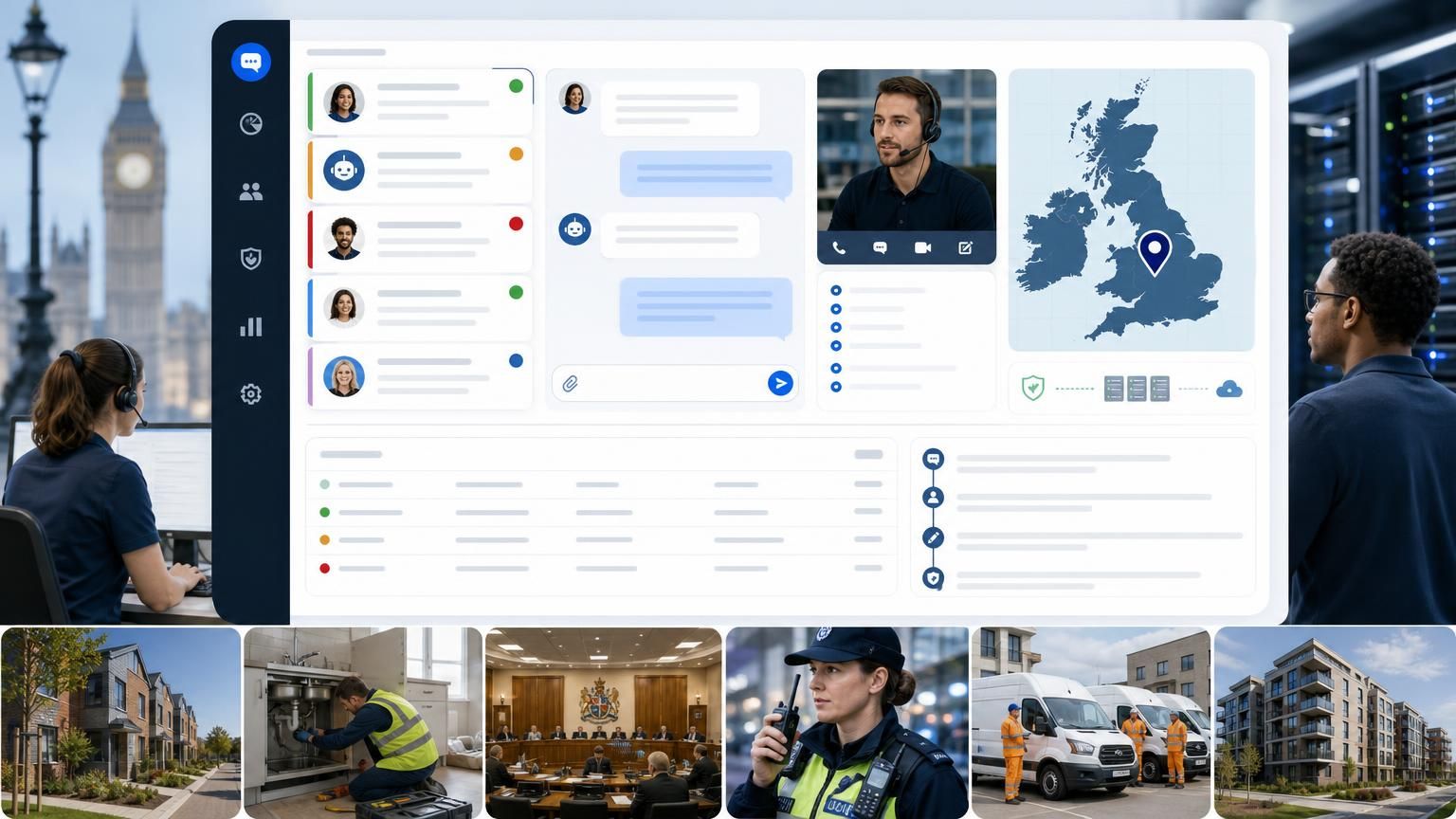
Why housing teams need a UK‑hosted hybrid AI live chat
Housing associations, councils and estate teams handle high volumes of sensitive tenant contacts: repairs, anti‑social behaviour, benefit queries and safeguarding flags. Every missed triage or slow handoff creates extra visits, delayed repairs and increased risk. Hybrid AI live chat—UK‑hosted and designed for public‑sector auditability—lets teams automate first‑contact triage, preserve evidence trails, and escalate to humans when nuance or empathy is required.

Hybrid models cut avoidable steps rather than replace human judgement. Proactive chat workflows can lift engagement and speed resolution — studies show chat engagement improves conversion and contact outcomes in transactional settings. ()
Clear definitions: rule‑based bots, pure LLMs, and hybrid AI
- Rule‑based chatbots: scripted decision trees that follow fixed prompts and rules. Good for simple eligibility checks (e.g. “Is this an emergency repair?”) but brittle for ambiguous tenant language.
- Pure LLM bots: large language models that generate free‑text replies and can improvise responses. They can handle open queries but risk hallucination, unpredictable answers, and data governance issues unless tightly controlled.
- Hybrid AI live chat: the pragmatic middle ground. AI handles triage, suggests answers and pulls from approved knowledge; human agents intervene on edge cases, approvals and emotional or safeguarding scenarios. Hybrid designs also log decisions for audit and can run entirely on UK‑hosted infrastructure to meet data residency requirements.
Four housing‑specific use cases that deliver immediate ROI
- Repair triage and scheduling: AI classifies urgency (emergency vs routine), captures evidence (photo upload), and suggests next‑action SLAs — reducing repeat visits and missed appointments.
- Benefits and tenancy queries: hybrid agents answer standard eligibility checks instantly, escalating complex welfare or legal questions to trained advisors.
- ASB and safeguarding intake: automated structured intake captures time‑stamped details and routes sensitive cases to specialist teams while preserving an audit trail.
- Void and lettings coordination: pre‑move checklists, contractor scheduling and snag‑list automation reduce void days and speed lettings.
Each use case reduces admin time, increases First Contact Resolution and improves tenant satisfaction. Typical live chat engagement multipliers mean the visitors who chat are significantly more likely to reach a resolution on first contact. ()
Why UK hosting and data sovereignty matter for housing teams
- Personal data and sensitive incident records must be managed under UK data protection rules and local procurement expectations.
- The Cabinet Office AI assurance and public‑sector guidance expect teams to document hosting location and data residency to manage risk and support auditability. (architecture.cddo.cabinetoffice.gov.uk)
- ICO guidance on AI and data protection highlights the need for privacy‑by‑design, DPIAs and clear governance when AI processes personal data. That’s non‑negotiable for councils and regulated housing providers. ()
Government service design reviews repeatedly highlight ensuring data sovereignty can be maintained in‑country as a condition for progression. Choosing UK‑hosted hybrid chat avoids cross‑border complications when handling tenant records. (gov.uk)
Practical playbook: 6 steps to deploy hybrid AI chat in a housing context
- Map intents and risk tiers
- Categorise contacts into low, medium and high‑risk buckets (e.g. general repair vs safeguarding). Define handoff rules.
- Start rule‑first for high‑risk paths
- Use rule‑based flows for emergency repairs and safeguarding intake to guarantee consistent capture of required fields.
- Add LLM augmentation in read‑only mode
- Let a vetted LLM suggest article snippets or pre‑written replies pulled from a managed knowledge base; keep it in suggestion mode until accuracy is proven.
- Build hybrid handoff workflows
- Use automatic triggers to route to human teams when sentiment, complexity, or keywords indicate escalation. IMSupporting’s hybrid workflows are built for this pattern. (See feature details.)
- Link: https://imsupporting.com/feature-hybrid-ai-chat-workflows.php
- Embed UK‑hosted controls and audit logs
- Ensure all chat transcripts, attachments and decision logs are stored on UK‑hosted infrastructure and are exportable for DPIA and FOI/complaint responses.
- Measure impact and iterate
- Track time‑to‑triage, FCR, reduction in contractor visits and void days. Use these KPIs to refine triggers and training data.
Security, compliance and procurement notes (for solution architects)
- Insist on evidence: where is the model hosted, who has access to training data, and how are logs retained? The Cabinet Office AI assurance checklist expects hosting and residency details to be explicit in procurement. (architecture.cddo.cabinetoffice.gov.uk)
- DPIA and governance: perform a DPIA before deploying AI for personal data. The ICO’s guidance on AI and data protection sets expectations for explainability, data minimisation and accountability. ()
- Left‑shift security: include secure upload for tenant images, tamper‑resistant timestamps and role‑based access to chat transcripts to limit exposure.
Operational tips for support leaders and teams
- Train agents on the hybrid handoff: make it obvious when the AI handled triage and why the case is routed to them.
- Keep a small golden dataset: capture edge‑case transcripts for continuous improvement and model retraining.
- Use proactive triggers on landlord portal pages and repair booking flows to reduce phone calls and speed job allocation — proactive invites typically outperform passive chat placements. ()
Market context and vendor selection pointers
The live chat market is growing fast — demand for hybrid tooling and integration with case management and CRM systems is increasing as organisations chase the combination of cost savings and better outcomes. Analysts forecast strong market growth over the next decade, underlining the maturity of hybrid approaches for public services. ()
When evaluating suppliers, prioritise:
- UK‑hosted deployments and clear contractual commitments on data residency.
- Built‑in hybrid AI workflows plus simple escalation paths to human teams. See IMSupporting’s AI tool integrations for native connectors. https://imsupporting.com/feature-ai-tool-integrations.php
- Evidence of DPIAs, SOC/ISO attestations and public‑sector reference implementations.
Quick checklist before procurement
- Can the chat platform store data in UK data centres only?
- Are transcripts and attachments exportable in machine‑readable formats?
- Are hybrid handoffs configurable by intent and SLA?
- Is there an audit log suitable for FOI, complaint or safeguarding review?
Next step (what to do this week)
Map one high‑volume use case (e.g. emergency repair triage) and run a 6‑week pilot using hybrid flows with UK hosting. Measure triage time, reduction in contractor revisits and tenant satisfaction. If you want a ready starting point for that pilot, IMSupporting provides UK‑hosted hybrid AI chat workflows designed for housing and public‑sector teams — see their feature pages and contact the team to scope a pilot. https://imsupporting.com/
Strong CTA: If you manage housing services or council support, book a demo of UK‑hosted hybrid AI live chat that preserves data sovereignty and ramps in with human handoffs — visit IMSupporting to start a pilot today. https://imsupporting.com/