Why UK organisations need a new control layer for live chat
Live chat is no longer a low‑cost channel plug‑in. For councils, police, housing associations and regulated teams it’s a primary record of interaction that can create legal obligations, FOI triggers and safety incidents. At the same time, more UK organisations are experimenting with AI: recent ONS data shows AI use in UK businesses is rising — a trend procurement and compliance teams must manage, not ignore. (ons.gov.uk)

Too many projects treat AI as a replacement for policy controls. The result is brittle automation or expensive human rework. The pragmatic alternative: treat the response layer as a first‑class policy artefact — a versioned "Knowledge Contract" enforced at reply time by RAG‑backed hybrid AI, auditable and hosted within UK infrastructure.
What is a Knowledge Contract?
A Knowledge Contract is a small, versioned policy bundle that tells the chat system what it may say, what language to avoid, which data sources to consult, which redaction rules apply, and what handover path to create if a threshold is hit.
Key attributes:
- Versioned: every contract is timestamped and stored for later audit.
- RAG‑aware: the contract selects which internal documents or policy indices the RAG retriever may use to ground answers.
- Ruleable: it includes deterministic checks (e.g. do not provide legal advice; escalate if safety words appear).
- Human handover hooks: prepopulates a "continuity pack" for an agent with summary, evidence links and redaction markers.
Treating policy as a deployable bundle reduces ambiguity in procurement, makes audits simpler, and gives regulated teams the visibility they need.
Why RAG matters to Knowledge Contracts
Retrieval‑Augmented Generation (RAG) is now a canonical pattern for grounding generative models with up‑to‑date internal knowledge — critical for regulated responses where hallucination is unacceptable. Leading practitioners describe RAG as the bridge between static LLM knowledge and a company's live data sources. ()
Applied to Knowledge Contracts, RAG does two jobs:
- Ground replies on the exact policy texts, legislation, or case notes the organisation trusts.
- Produce traceable citations (the evidence packets) that form part of the audit trail.
That combination lets you rely on generative assistance for speed while keeping answers defensible.
Rule‑based vs Pure LLM vs Hybrid AI: a practical rundown
Rule‑based chatbots
- Deterministic workflows and scripted replies.
- Strengths: fully auditable, low risk, predictable.
- Weaknesses: poor scalability for knowledge complexity; brittle when policies change.
Pure LLM bots
- LLM answers with little grounding.
- Strengths: flexible, conversational.
- Weaknesses: hallucinations, unpredictable legal risk, poor evidenceability for regulators.
Hybrid AI live chat (the recommended approach)
- RAG + business logic + human‑in‑the‑loop handover.
- Strengths: fast, grounded answers with a controlled policy layer and defined handover triggers. Ideal where safety, auditability and data sovereignty matter.
If your organisation must prove why a particular answer was given (FOI, complaint or misconduct review), hybrid AI with Knowledge Contracts provides the necessary traceability without sacrificing speed.
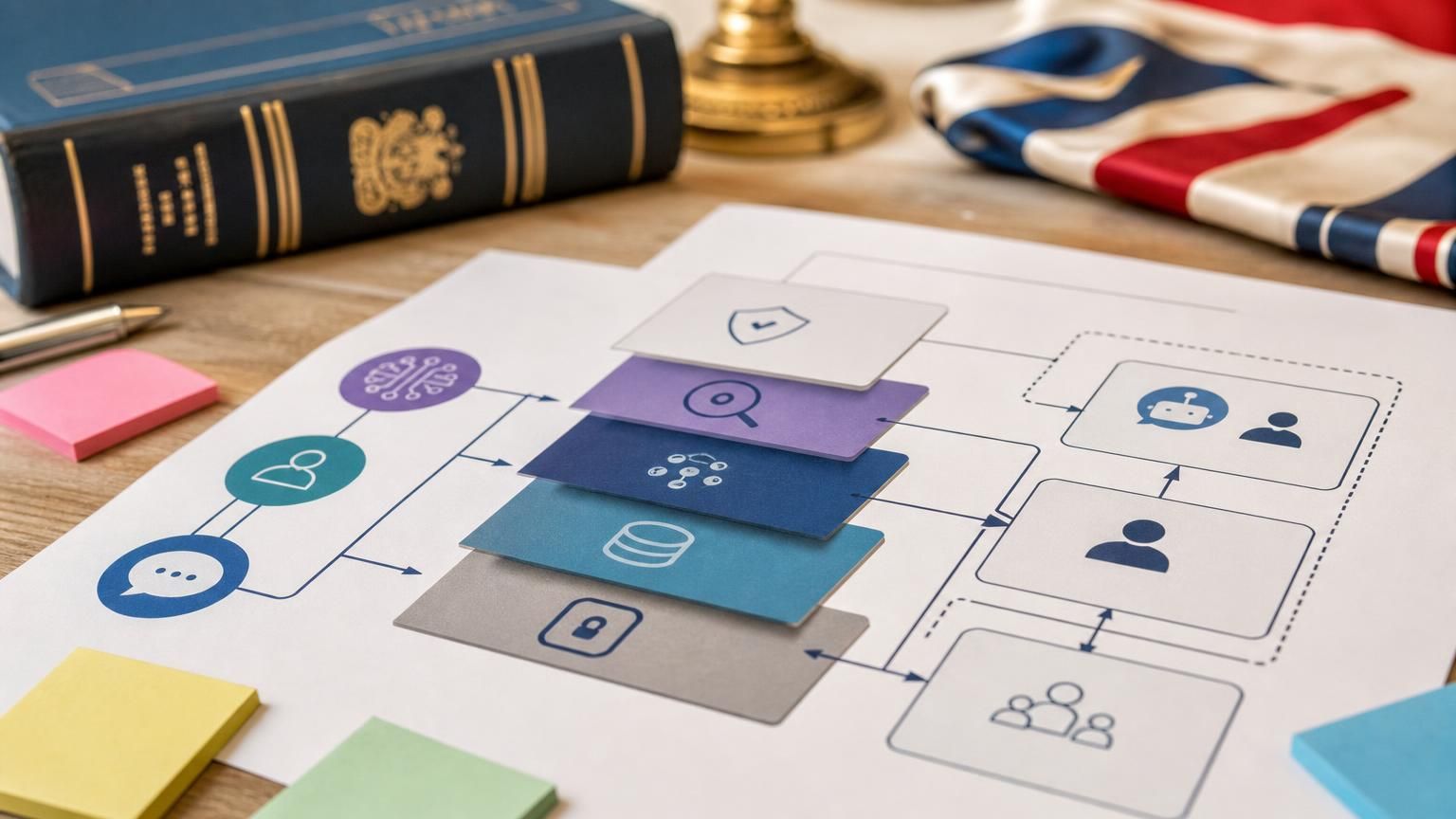
How Knowledge Contracts work in a UK‑hosted Hybrid AI stack (practical flow)
- Author a Knowledge Contract in the control console: scope, allowed sources, redaction rules, escalation thresholds.
- Mint the contract (versioned) and bind it to a chat widget or a cohort of users (e.g., council housing enquiries).
- Incoming message is prechecked by lightweight deterministic rules (PII detection, safety keywords).
- RAG fetches the permitted policy passages and evidence; LLM generates a candidate reply constrained by the contract. ()
- If the contract flags a high‑risk cue, the system prepares a continuity pack (summary + evidence links + redaction markers) and routes to a human agent using the specified hybrid workflow.
- Every reply, evidence set and contract version are stored on UK‑hosted infrastructure to satisfy data sovereignty and audit requirements.
This flow preserves human oversight where it matters, automates the routine, and leaves a defensible trail for compliance teams.
Auditable, privacy‑first controls: what compliance teams will insist on
- UK hosting and data residency for all conversation logs and index shards.
- DPIA and contract‑level purpose limitation built into the deployment process (the ICO expects transparency, purpose limitation and DPIAs when organisations use AI). (ico.org.uk)
- Redaction and data minimisation rules applied automatically before any external model calls.
- Versioned evidence attachments so every reply can be reproduced with the exact policy text that informed it.
These are not optional for UK public bodies — they are procurement essentials.
Quick implementation checklist for councils, police and regulated teams
- Map: identify the policy documents, case notes and statutes that must be indexed.
- Design: write Knowledge Contracts for at‑risk conversation types (e.g., emergency reporting, housing enforcement).
- Deploy: bind contracts to widget segments and test in a UK‑hosted staging environment.
- Audit: run monthly contract audits, test redaction, and perform DPIAs with legal/compliance.
- Train: agents on continuity packs and handover etiquette to avoid duplicated effort.
If you need a technical implementation that already supports RAG knowledge controls and hybrid chat workflows, look at IMSupporting’s feature pages designed for this: their RAG‑based knowledge agent feature and hybrid AI chat workflows explain how these contracts can be applied in practice. RAG‑based AI agent knowledge · Hybrid AI chat workflows.
Measuring success: what to track
- Reduction in average response/resolve time for low‑risk enquiries.
- Escalation rate: the percentage of conversations that hit contract thresholds and require human oversight.
- Audit completeness: percent of conversations with a complete continuity pack attached.
- User satisfaction: quick, grounded replies improve trust; consumers expect choice and fast digital touchpoints. A recent industry survey shows chat remains a preferred channel for many UK customers. ()
A reasonable target for early pilots is to automates 40–60% of common enquiries with hybrid controls in place while keeping escalation rates low and auditability high.
Next steps and recommended pilots (60–90 day plan)
- Run a 60‑day pilot on a single use case (e.g., housing benefits queries) with a one‑contract boundary.
- Validate end‑to‑end: RAG retrieval quality, contract enforcement, continuity pack usefulness for agents.
- Expand to two more verticals, codify contract templates and formalise DPIA updates.
For a UK‑hosted, audited implementation that already supports RAG grounding and configurable hybrid workflows, review IMSupporting’s platform to see real examples and feature details. Explore IMSupporting.
Final takeaway
Knowledge Contracts change the conversation about AI in regulated support: they let you operationalise policy as code, ground answers with RAG, and keep human oversight where it counts — all while keeping data and audit trails inside the UK. That’s the practical balance every council, police force and regulated team needs: speed without losing control.
Ready to pilot a Knowledge Contract approach on UK‑hosted hybrid AI live chat? Review IMSupporting’s RAG and hybrid workflow features and book a discovery session to map a 60‑day pilot that fits your compliance requirements. Start here — IMSupporting.