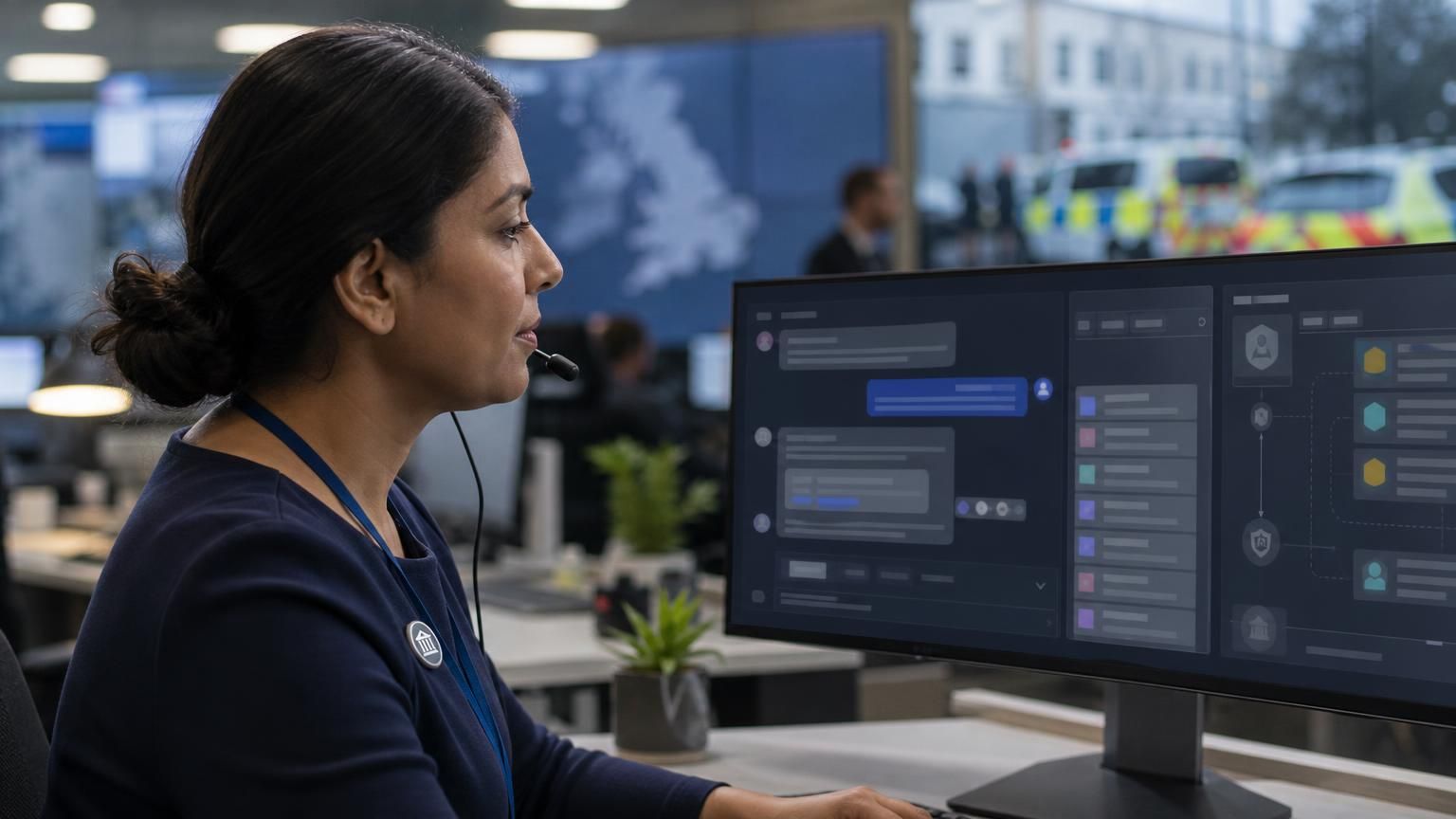
Why multi-agency incidents need a different live chat strategy
When an incident crosses organisational boundaries — think a city‑wide outage that touches police, council services and housing providers — the cost of poor coordination is measurable: duplicated work, inconsistent public messaging and delayed safeguarding. A modern live chat widget can stop being a single‑channel contact tool and become an interoperable incident fabric that carries evidence, audit trails and decision context between agencies.

This isn't theoretical. Over half of adult UK internet users report interacting with GenAI or AI customer service tools in the past 12 months, which changes expectations for how citizens want help and updates. ()
The problem with 'bolt‑on' chat in emergencies
- Separate chat vendors across agencies cause fragmentation and data duplication.
- Rule‑based bots fail when cases are novel or sensitive; they return canned responses and misroute critical cases.
- Pure LLM chat systems can hallucinate facts and lack auditable provenance for evidence or FOI requests.
Those gaps are why a hybrid approach — not rule‑only or LLM‑only — is the pragmatic choice for regulated UK teams.
What 'hybrid AI live chat' actually means
Rule‑based chatbots
Rule‑based bots follow explicit scripts and are reliable for form collection, eligibility checks and policy‑driven routing. They are low risk but brittle when citizens describe edge cases in free text.
Pure LLM bots
LLM bots provide fluent natural language replies and can summarise complex cases, but they often lack deterministic provenance: you cannot always show which document or policy informed an answer. That's a problem for public sector auditability and evidence chains.
Hybrid AI live chat (the sweet spot)
Hybrid systems combine: a) deterministic rule engines for business logic and SLA routing; b) RAG (retrieval‑augmented generation) or vector search so that AI answers are pulled from verifiable, versioned knowledge stores; and c) seamless human handoff workflows when escalation, empathy or legal judgment is required. This preserves speed while retaining auditable sources. See an implementation example of RAG-based agents here: https://imsupporting.com/feature-rag-based-ai-agent-knowledge.php.
Design patterns for multi‑agency incident coordination
1) Federated knowledge + RAG provenance
Keep each agency’s sensitive data in UK‑hosted, access‑controlled stores and allow the chat RAG layer to pull only authorised passages. Every generated summary should link back to the exact document snippet, timestamp and agent ID to create an evidence trail. This matches recommended practice for data protection and model accuracy.
2) Workflow orchestration with hybrid handoffs
Use hybrid AI chat workflows that triage automatically but create a single canonical case record that follows the citizen across agencies. Rules decide when to summon a human: welfare‑risk phrases, legal thresholds, or FOI/recording flags. IMSupporting documents a practical hybrid workflow approach here: https://imsupporting.com/feature-hybrid-ai-chat-workflows.php.
3) Inter‑agency message bus with role‑level segregation
Design an exchange layer that carries case IDs, summaries and attachments but enforces per‑agency role permissions. That lets the council see housing repair info without exposing restricted police notes.
4) Evidence package generation
When incidents require legal review, the system should auto‑compile time‑stamped transcripts, RAG provenance references and human‑agent annotations into a tamper‑evident package for FOI, safeguarding reviews or prosecutions.
Security, compliance and UK‑hosting controls
UK public sector guidance requires careful consideration of data residency and offshoring for sensitive services; follow the cloud and data residency guidance when selecting hosting and third‑party AI components. (gov.uk)
And for AI that processes personal data, the ICO's guidance on using AI and personal data is a must‑read: lawfulness, transparency and distinction between development and deploy phases are central to compliant deployments. (ico.org.uk)
Practical benefits (measurable outcomes)
- Faster co‑ordinated response: shared case summaries cut inter‑agency handover time by minutes per case.
- Better evidence: RAG provenance reduces downstream rework for FOI and legal teams.
- Citizen trust: hybrid routing keeps humans in high‑risk cases, matching strong public preferences against fully automated support. 64% of UK respondents said they would never want entirely AI‑driven customer service. ()
Adoption is accelerating: broader UK AI uptake and growing enterprise AI teams mean the operational case for hybrid chat is commercially compelling. ()
Implementation checklist for UK councils, police and housing teams
- Insist on UK‑hosted data and clear data processing agreements (DPAs).
- Separate training/data pipelines: keep development models and production inference separated and logged.
- Choose RAG with versioned knowledge stores to ensure provenance and repeatability.
- Define human‑handover rules and SLA commitments in the chat workflows upfront.
- Build automated evidence exports and retention policies that meet FOI and disclosure requirements.
Example operational flow (edge to audit in 6 steps)
- Citizen reports incident via a council chat widget. Rule engine captures location and immediate risk factors.
- Hybrid AI runs quick RAG lookup in council guidance and housing knowledge base to draft an evidence‑linked summary.
- If risk flags trigger, the chat workflow elevates the case to police liaison with shared case ID and redacted summary.
- Human officer accepts handover, adds operational notes; the system timestamps and versions each change.
- After resolution, the platform compiles a tamper‑evident evidence package for FOI and retention compliance.
- Analytics surface cross‑agency SLA breaches and policy gaps for continuous improvement.
Procurement and vendor questions to ask
- Where are your AI models and data hosted? Get explicit UK region commitments.
- Do you support RAG with verifiable provenance and versioning of source documents?
- Can the platform export tamper‑evident evidence packages for legal review and FOI requests?
- How does the solution separate rule logic, LLM outputs and human annotations in the audit trail?
- Are hybrid chat workflows configurable so non‑technical teams can update escalation rules without code?
Next steps and where to get started
If your organisation needs a UK‑hosted hybrid AI live chat that treats cross‑agency incidents as first‑class cases — with RAG provenance, auditable handoffs and public‑sector compliance baked in — start with a small pilot focused on a single incident type (for example severe weather or large‑scale power outage). Use the pilot to prove end‑to‑end evidence packaging and SLAs before scaling.
Learn how RAG‑backed agents and hybrid chat workflows can be applied to your incident workflows: see IMSupporting's RAG agent feature and hybrid workflow documentation — https://imsupporting.com/feature-rag-based-ai-agent-knowledge.php and https://imsupporting.com/feature-hybrid-ai-chat-workflows.php.
Ready to pilot? Book a UK‑hosted demo and compliance review with IMSupporting to map a three‑month pilot tailored to police, council and housing workflows: https://imsupporting.com/.
Final note — keep humans where it matters
The evidence is clear: citizens want speed but they trust humans for high‑risk, sensitive and legally consequential cases. Hybrid AI live chat lets UK public services scale routine work while keeping human judgment at the critical decision points — and it does so without compromising data sovereignty or auditability.