
Why regulated teams must treat live chat as a decision-assist layer
Live chat is no longer just first-response triage. For UK councils, police forces, housing associations and regulated businesses, live chat increasingly sits at the front line of high-stakes decisions — data-sensitive queries, fraud flags, safeguarding reports and case escalations. That changes the requirements: audit trails, data sovereignty, explainability and human oversight become central design constraints, not optional features.
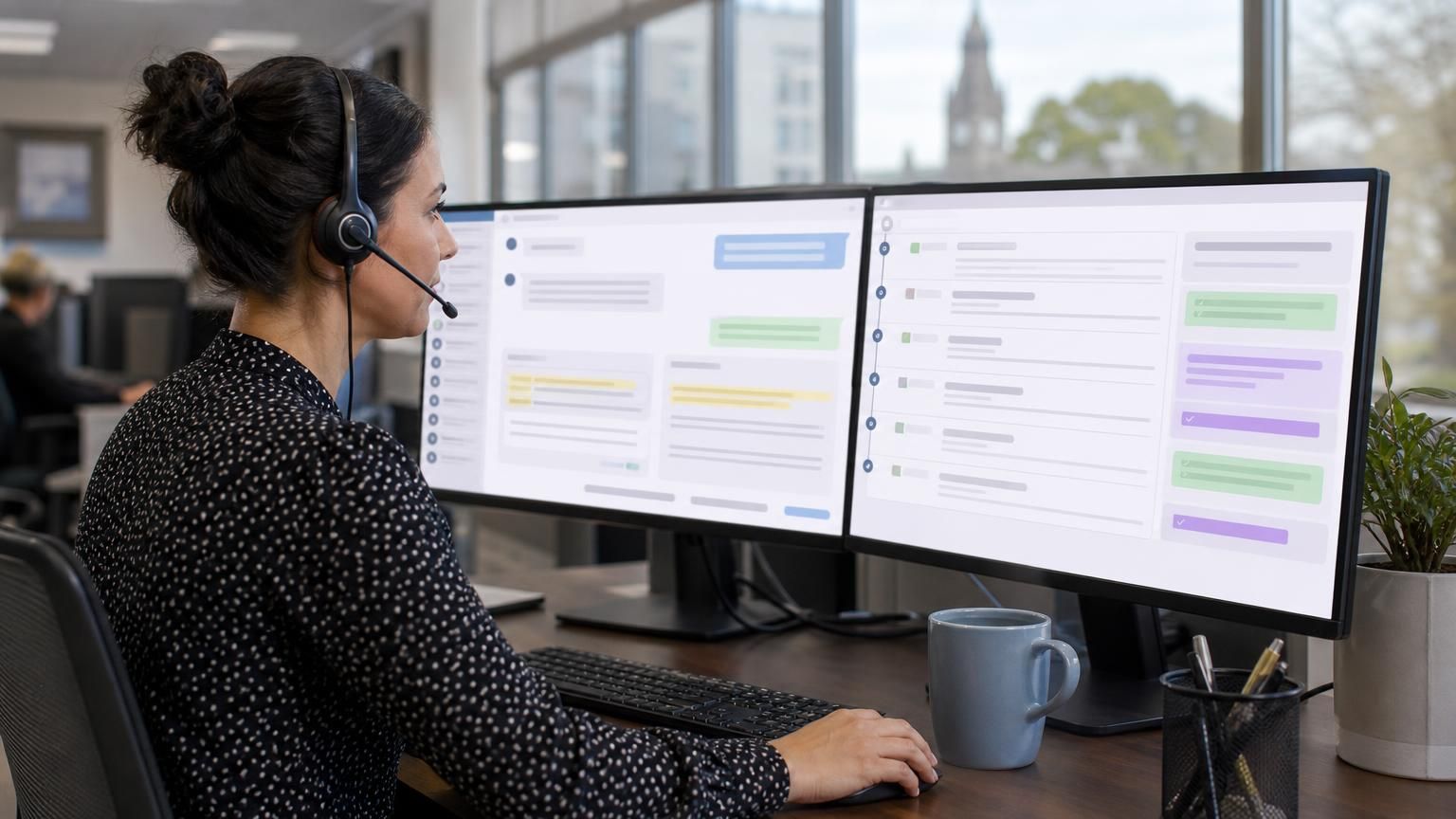
UK business and public bodies are accelerating AI adoption in customer service — more teams now rely on chat automation to reduce friction and speed up decisions. Recent government research and industry surveys show rising usage of AI in customer service and chat functions across the UK public and private sectors. (ons.gov.uk)
This article sets out a practical design pattern: treat hybrid AI live chat as a compliance-first decision-assist layer that augments human judgement for regulated escalations, while keeping data and auditability firmly inside UK-hosted walls.
Clear definitions: rule-based, pure LLM, and hybrid AI
- Rule-based chatbots: deterministic scripts, decision trees and form flows. Reliable for FAQ-style triage but brittle with ambiguous language.
- Pure LLM bots: large language models (LLMs) that generate free-text responses from general knowledge. High fluency, but higher hallucination risk and operational opacity unless carefully controlled.
- Hybrid AI live chat: the practical middle ground. Uses RAG (Retrieval-Augmented Generation), indexed enterprise knowledge and rules to answer routine queries and to triage, then hands off to a human for high-risk, ambiguous or regulated cases. Hybrid systems combine deterministic workflows with LLM assist — preserving explainability and governance while delivering speed and context.
Retrieval-augmented patterns are now the recommended enterprise approach because they let models access up-to-date internal documents without wholesale model retraining. That makes hybrid chat both accurate and controllable. ()
The decision-assist pattern: six practical design rules
- Default to human-in-loop for high-risk triggers
- Define clear escalation flags (personal data, safeguarding words, payment refs, FOI triggers) so the AI only suggests outcomes, never final decisions.
- Use RAG to ground responses in auditable documents
- Answer suggestions must be linked to precise source snippets and timestamps so humans can verify. RAG makes this practical for rapidly changing policy and legislation. ()
- Keep everything UK-hosted and logged
- For regulated organisations, UK hosting reduces cross-border data risk and aligns with procurement and GDPR expectations. Include encrypted audit trails that can be FOI- or disclosure‑ready.
- Provide an explainability panel per conversation
- Each AI suggestion should carry: the retrieved source, confidence score, timestamp and the decision rule that recommended escalation. That supports DPIAs and ICO guidance. (ico.org.uk)
- Automate low-risk actions; gate critical actions
- Let the hybrid chat auto-serve known entitlements (opening hours, form links) while gating account changes, payments or legal advice behind human sign-off.
- Run continuous synthetic testing and red-team prompts
- Regularly measure hallucination, retrieval drift and latency to ensure AI suggestions remain accurate and timely.
Implementation sketch for UK public sector & regulated teams
Data architecture and hosting
- Index policy documents, case law summaries, procurement rules and local bylaws into a private vector store hosted in the UK. Keep PII segregated and only made available when a human agent authorises it.
Workflow orchestration
- Use hybrid AI chat workflows to perform first-pass triage, populate structured case metadata and recommend next steps — but always surface the evidence items used to reach the suggestion. For an example workflow implementation, see IMSupporting’s hybrid chat workflow features. https://imsupporting.com/feature-hybrid-ai-chat-workflows.php
Auditability and compliance
- The ICO expects demonstrable oversight and data protection by design when deploying AI. Map every automated suggestion back to a retrievable evidence trail and a named human approver where applicable. (ico.org.uk)
Two realistic KPIs that matter to procurement teams
- Mean Time to Resolution (MTTR) for high-risk cases: target a 20–40% reduction by removing low-value manual handovers while preserving human approval points. (Benchmarks vary by service.) ()
- First Contact Evidence Rate: percentage of escalations that arrive with evidence links and metadata attached. Aim for 70%+ in first 6 months after RAG indexing.
Common objections and how to answer them
- “LLMs are unreliable/hallucinate.” — Use RAG and deterministic rules to make the model cite exact sources; never let ungrounded LLM text be the decision. ()
- “We can’t host abroad.” — Choose UK-hosted vector stores and LLM endpoints or an architecture that keeps retrieval and logging inside UK infrastructure; this is a procurement ask, not a blocker.
- “This needs legal sign-off.” — Build DPIA, auditing and human-sign-off into the workflow from day one; reference the government AI playbook for public sector deployments. (gov.uk)
Quick checklist for procurement and solution architects
- Require RAG-based knowledge indexing with source links. (See RAG feature details.) https://imsupporting.com/feature-rag-based-ai-agent-knowledge.php
- Mandate UK hosting and encryption at rest and in transit.
- Specify explicit human-in-loop gates for payments, safeguarding and legal advice.
- Ask vendors for synthetic test reports demonstrating low hallucination rates and high source accuracy.
Competitive framing: why hybrid wins for UK regulated buyers
Pure rule-based bots lack nuance; pure LLM bots lack governance. Hybrid AI captures the velocity of modern LLMs while preserving control layers and auditability that regulated UK organisations demand. With national guidance pushing for explainable AI and clear DPIA processes, hybrid architectures offer a procurement-friendly roadmap that satisfies both innovation and compliance. (ico.org.uk)
Next steps and a practical partner route
If you’re responsible for support tech in a council, police force, housing association or regulated business, start by mapping three typical high-risk escalation scenarios and ask your vendor to show: the RAG sources used, the human gate points and how audit logs are stored within UK infrastructure. A vendor that already offers UK-hosted RAG plus workflow orchestration will cut project time and procurement risk.
To see an example of a UK-ready hybrid AI live chat that supports RAG indexing, evidence linking and composable escalation workflows, review IMSupporting’s platform pages and book a demo: https://imsupporting.com/ and specifically their RAG and workflow features at https://imsupporting.com/feature-rag-based-ai-agent-knowledge.php and https://imsupporting.com/feature-hybrid-ai-chat-workflows.php
Ready to design a compliance-first hybrid chat that reduces escalation friction and keeps data in the UK? Talk to a specialist at IMSupporting to map a three-month pilot and procurement pack. https://imsupporting.com/