Why multi‑agency workforces cannot use standard chat

Public services — councils, police liaison teams, housing associations and health‑related regulated teams — are not just answering generic queries. They must gather case evidence, selectively share it with partner agencies, and preserve auditable chains of custody while complying with UK data protection expectations. A live chat implementation that treats every conversation as a single stream risks data sprawl, excessive manual triage and slow inter‑agency handoffs.
This article outlines a practical, procurement‑ready architecture that uses UK‑hosted hybrid AI live chat, RAG knowledge partitioning and controlled handoffs to make web chat a secure multi‑agency gateway.
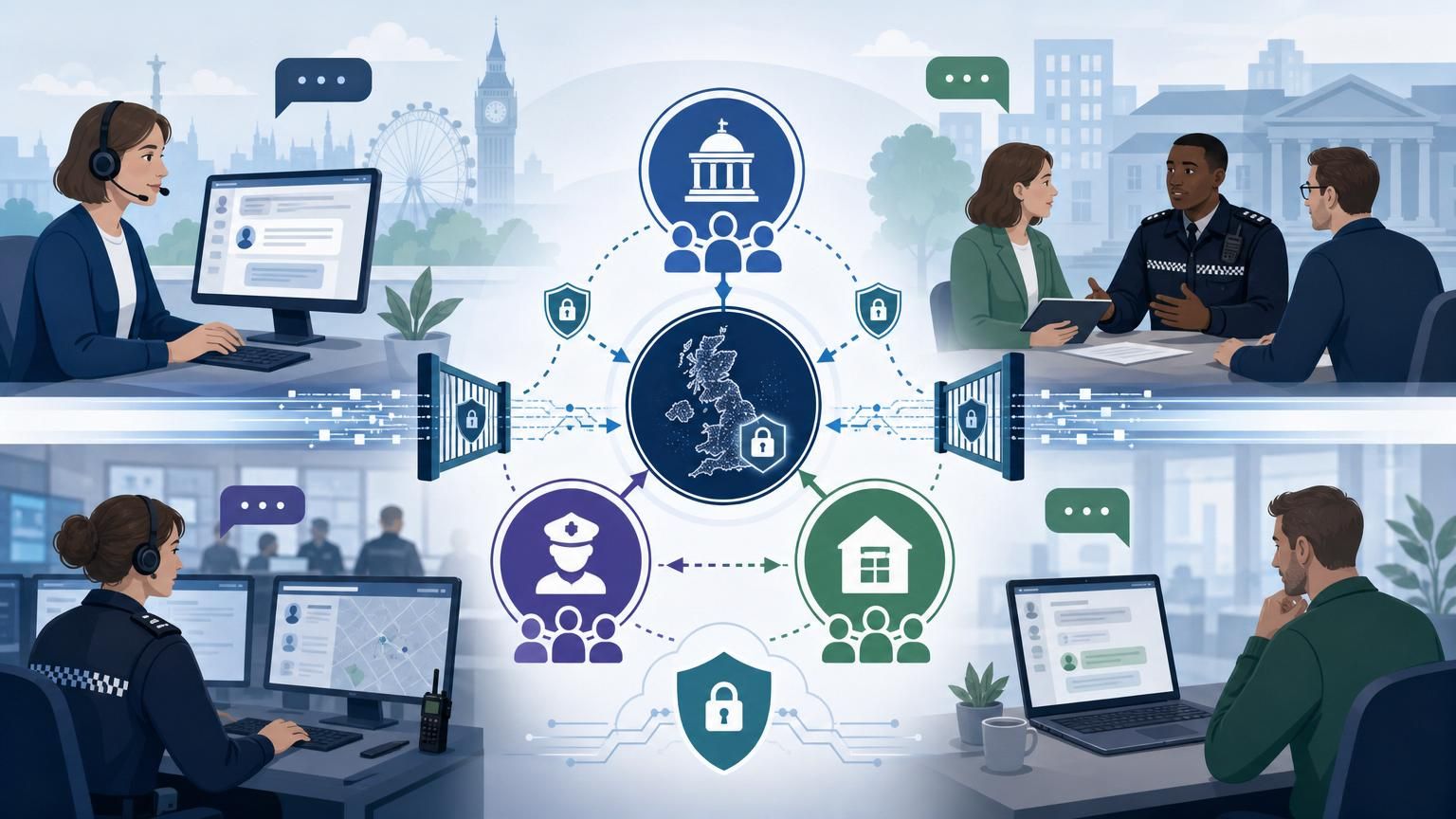
The operational problem to solve
- Different agencies require different visibility into case data.
- Regulated teams need auditable, policy‑driven redaction and selective sharing.
- Citizens expect fast answers: many expect replies within minutes, and a significant share prefer live chat for support. ()
Convert these constraints into requirements: UK data residency, per‑agency knowledge scoping, automated triage that escalates to humans when judgement is required, and auditable, exportable case records.
Three chat architectures — clear, different outcomes
Rule‑based chatbots
- Deterministic flows: button trees, if/then routing, basic form capture.
- Strengths: predictable, easy to certify for policy compliance.
- Weaknesses: brittle for free‑text, high maintenance when knowledge changes.
Pure LLM bots
- Open responses from large language models, often with broad knowledge and fluent language.
- Strengths: conversational, fast to deploy for general answers.
- Weaknesses: hallucination risk, difficult to confine to agency‑specific policy, and problematic for evidentiary accuracy without retrieval controls.
Hybrid AI live chat (the pragmatic middle path)
Hybrid AI combines automated retrieval from your verified documents (RAG) with LLM generation and explicit handoff rules to humans. This model gives the speed and natural language of LLMs while keeping responses anchored to auditable source documents and policy pipelines.
IMSupporting implements RAG‑backed agent knowledge and policy‑aware chat workflows that let organisations control what the AI can cite and when it must escalate. See RAG knowledge agent features and hybrid workflow modules. (imsupporting.com)
Architecture: partitioned RAG + policy gates
Design the system as layered components:
- Ingest and partition: ingest documents, policies and case notes into separate, labelled RAG stores per agency or domain (council‑only, police‑only, housing‑only).
- Retrieval rules: apply retrieval filters so the hybrid AI only draws from permitted partition(s) depending on user intent, authentication and consent.
- Policy gates: build low‑code workflow nodes that enforce redaction, consent capture and handoff contracts — the AI can suggest but the human agent signs off for disclosure.
- Audit trails: every retrieval, prompt, AI response and handoff must be logged with timestamp, operator ID and source doc IDs for evidentiary export.
This architecture reduces cross‑pollination of sensitive data and produces exportable, structured case files ready for secure inter‑agency transfer.
Practical playbook for UK councils, police and regulated teams
- Start with a risk map: list data classes, likely partners and minimum required disclosures.
- Build per‑agency RAG indexes so the AI can only cite the documents it’s permitted to. Use a UK‑hosted platform to keep data residency tight. (imsupporting.com)
- Create workflow templates: triage → consent capture → limited automated answer → human verify → structured case creation. Use hybrid AI chat workflows to encode these templates as reusable modules. (imsupporting.com)
- Define escalation contracts: when the AI must hand off (legal wording, safeguarding flags, ambiguous identity, or requests for PII transfer).
- Test with red‑team scenarios: attempted data exfiltration, ambiguous requests, and multi‑party disclosure.
- Publish a public transparency statement detailing how chat is used and when data is shared.
Governance and UK data protection
UK public and regulated organisations must demonstrate lawful bases, data minimisation, and technical controls. The ICO’s guidance on AI and data protection sets expectations for transparency, DPIAs and risk controls when using AI systems. Build DPIAs that cover RAG retrieval, retention and the human oversight mechanisms you’ve implemented. (ico.org.uk)
Public confidence matters: recent UK tracker data show rising use and awareness of chatbots, but citizens still expect clear governance when public services use AI. Design for transparency and manual oversight to maintain trust. (gov.uk)
Performance and hard numbers to justify procurement
- Web chat often costs a fraction of a phone call for inbound handling — contact centre studies show inbound call handling remains significantly costlier than web chat. Use these delta figures in your TCO and procurement justification. ()
- Hybrid AI reduces routine caseload by letting the platform answer verified, repeatable queries and routing complex cases to agents, which can cut average handling time and backlog. Measure baseline AHT, deflection and escalation rates in pilot projects.
Implementation checklist — low‑risk rollout
- Phase 1 (30 days): UK‑hosted RAG ingestion for one service area, basic triage workflow, human verification node.
- Phase 2 (60 days): Add partner RAG partitions, automated redaction, formal handoff contracts and audit exports.
- Phase 3 (90 days): Full multi‑agency routing, SLAs for inter‑agency transfer, and public transparency documentation.
IMSupporting’s RAG agent knowledge and hybrid workflow builder let you move from Phase 1 to Phase 3 without heavy bespoke development. See how RAG knowledge and workflow modules work. (imsupporting.com)
Procurement and stakeholder messaging
- For procurement teams: specify UK hosting, per‑agency data partitions, auditable retrieval IDs and exportable case records.
- For IT/security: insist on encryption at rest and in transit, role‑based retrieval scopes and regular DPIA reviews.
- For service leads: set measurable KPIs: deflection rate, time to case creation, inter‑agency transfer SLA.
Next steps — practical pilot and CTA
If you manage a council team, police liaison unit or a regulated support function, start with a single service line pilot (benefits claims, ASB reporting, housing repairs) to lock in architecture, policy and reporting. A tightly controlled hybrid AI approach gives the speed of automation without sacrificing compliance or inter‑agency control.
Explore IMSupporting’s RAG knowledge agent and hybrid AI chat workflow features to build a UK‑hosted, audit‑first multi‑agency chat service: https://imsupporting.com/feature-rag-based-ai-agent-knowledge.php and https://imsupporting.com/feature-hybrid-ai-chat-workflows.php. Then talk to a specialist about a pilot at https://imsupporting.com/.
Strong CTA: Book a pilot with a UK‑hosted hybrid AI live chat team to run a secure multi‑agency proof‑of‑concept and produce procurement‑ready evidence in 60 days. https://imsupporting.com/