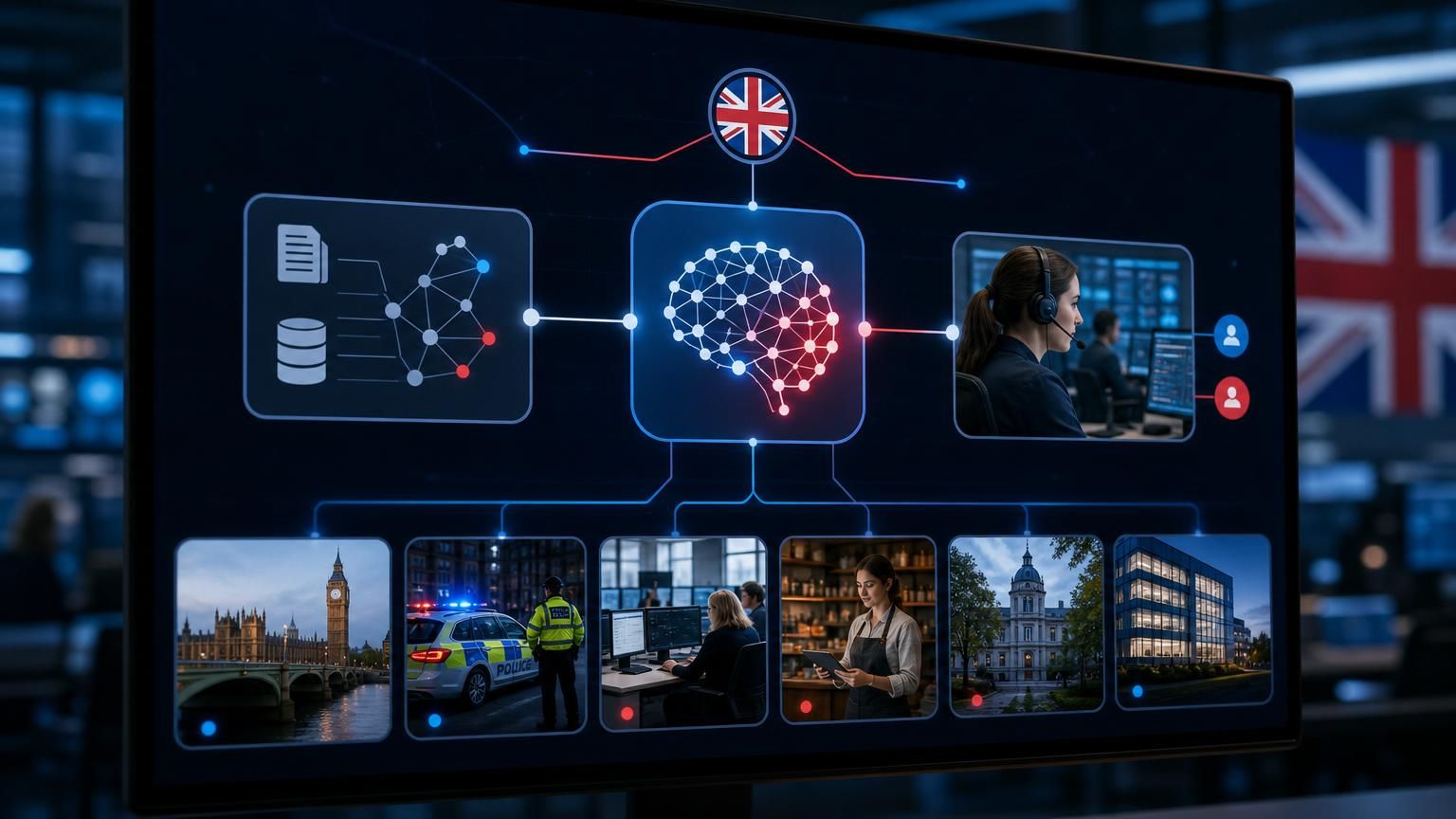
Why incident response should start with live chat
When an incident surfaces — a localised power outage, a housing emergency, or a public-safety tip — the first contact is increasingly digital. Live chat sits on web properties, reporting portals and intranets; it is the fastest route to collect facts and deliver direction. Embedding hybrid AI into that channel converts ad-hoc enquiries into structured incident data, triage decisions and an auditable trail that regulated teams can trust.

Live chat already drives outcomes beyond support: it increases conversions and satisfaction, and customers expect it as a primary contact point. For example, 63% of customers are more likely to buy from sites with live chat and digital channels consistently rank highly for satisfaction. ()
What makes an incident-ready hybrid chat different
A support chatbot alone cannot meet incident needs. You need three capabilities working together:
- Fast, retrieval-grounded answers that cite internal policy and live status.
- Deterministic workflows that escalate high-risk incidents to humans with the right context.
- An auditable, UK‑hosted record that meets data‑sovereignty and regulatory requirements.
This is where hybrid AI live chat (RAG-grounded retrieval + LLM reasoning + human orchestration) wins: it reduces noise, accelerates decisions and preserves evidence for audits.
Rule-based bots vs pure LLM bots vs hybrid AI — clear distinctions
- Rule-based chatbots: predefined menu trees and scripted replies. Reliable for simple flows, but brittle when incidents deviate from known patterns.
- Pure LLM bots: generative models that craft fluent replies from patterns in training data. Good for broad conversation, but prone to hallucination and unstable for high-trust incident guidance.
- Hybrid AI live chat: retrieval-augmented answers (RAG) plus model reasoning for synthesis, wrapped in deterministic handoff workflows and human audit trails. This approach grounds responses in your documents and lets humans intervene where judgement, empathy or legal responsibility is required.
Retrieval-grounding and tight handoffs are critical: enterprises planning RAG-enabled customer service deployments are moving quickly to make responses verifiable and auditable. Around 44% of organisations report near-term plans for generative AI in customer service, frequently paired with retrieval tooling to reduce hallucination. ()
How a UK-focused incident workflow actually runs (practical flow)
- Visitor opens chat and types the issue.
- Hybrid AI runs a fast retrieval against UK-hosted policies, live status pages and local records to assemble a short, citation-backed triage. (RAG reduces hallucination and speeds resolution.) (en.wikipedia.org)
- If the case meets a severity or compliance trigger, the system runs a deterministic chatflow that:
- tags the incident (crime, health & safety, infrastructure),
- attaches evidence (screenshots, form fields, geo-tags),
- and escalates to a named duty officer with full context.
- Human agent reviews, validates and closes the loop — every step is recorded and stored on UK infrastructure for audit.
Modern RAG stacks and vector stores are scaling fast to meet these needs; some industry data shows explosive growth in vector tooling as retrieval becomes central to enterprise AI infrastructures. ()
Compliance, data sovereignty and legal safety — what UK teams must check
- Host data in the UK: regulated organisations (local authorities, police, housing associations) must keep citizen data within jurisdictional control.
- Ground answers to documents: use RAG-style retrieval from your policies and logs so replies can be traced to a source.
- Keep a human‑in‑the‑loop with audit flags for sensitive categories (safeguarding, criminal reports, health incidents).
The ICO is actively updating guidance on AI and data protection; teams need to treat AI outputs as processing activities and maintain evidence of lawful basis and transparency. Design technical controls now to match the guidance and upcoming regulations. (ico.org.uk)
Real use cases for UK public and regulated services
- Police non-emergency triage: capture precise incident details, attach evidence and escalate to the right neighbourhood team while preserving timestamps and audit trails.
- Councils during localised incidents: rapidly distribute safe next steps, update residents on service status and flag emergency work orders.
- Housing associations: intake urgent repairs, verify tenancy details from verified sources and timetable human visits with full context.
- Regulated teams (health, social care): hybrid chat can enforce mandatory human review on safeguarding keywords while providing immediate, grounded guidance to users.
These scenarios demand a platform that supports RAG-based knowledge, hybrid chat workflows and strict hosting controls. IMSupporting offers RAG-based agent knowledge and hybrid workflow features designed for these exact use cases. See their RAG knowledge approach and hybrid workflows for public-sector scenarios. RAG-based agent knowledge | Hybrid AI chat workflows.
Operational checklist before you deploy
- Confirm UK hosting and data residency SLA.
- Map incident categories and define deterministic escalation rules.
- Create a single-source knowledge index for retrieval (policies, status pages, case notes).
- Require named human approval for any action affecting legal or safeguarding outcomes.
- Test at scale — incident traffic patterns differ from standard support queries and must be load-tested.
Enterprises are rethinking retrieval architectures because large-scale RAG deployments reveal operational trade-offs; expect to iterate on retrieval and routing as real incidents expose corner cases. ()
Measuring success: resilience metrics that matter
- Mean time to triage (MTT): how quickly an incident is given a severity and owner.
- Human handoff rate for high-risk cases: lower is good if triage quality is high, but never eliminate mandatory handoff for regulated categories.
- Audit completeness: percent of incidents with full provenance stored in UK infrastructure.
- Quantified cost avoidance: fewer unnecessary emergency callouts, faster closure of repeat incidents.
A well-implemented hybrid chat system reduces manual intake time and increases first-contact routing accuracy — and in many organisations the business case is clear when factoring reduced officer visits and faster triage.
Next steps and a recommended partner path
If you support UK public services or regulated teams, treat live chat as an incident response layer, not just a contact form. Start by mapping 3–5 incident types, identify the legal triggers for human review, and pilot a hybrid workflow with a UK‑hosted vendor that offers RAG grounding and auditable handoffs.
Explore how IMSupporting implements RAG-based knowledge and hybrid chat workflows for UK organisations at https://imsupporting.com/ and review their feature pages for technical fit: https://imsupporting.com/feature-rag-based-ai-agent-knowledge.php and https://imsupporting.com/feature-hybrid-ai-chat-workflows.php.
Ready to move from reactive support to resilient incident response? Book a demo or start a UK‑hosted pilot with IMSupporting to build auditable, hybrid AI live chat flows for your teams. Visit https://imsupporting.com/ to get started.