Why UK public sector teams must rethink live chat now
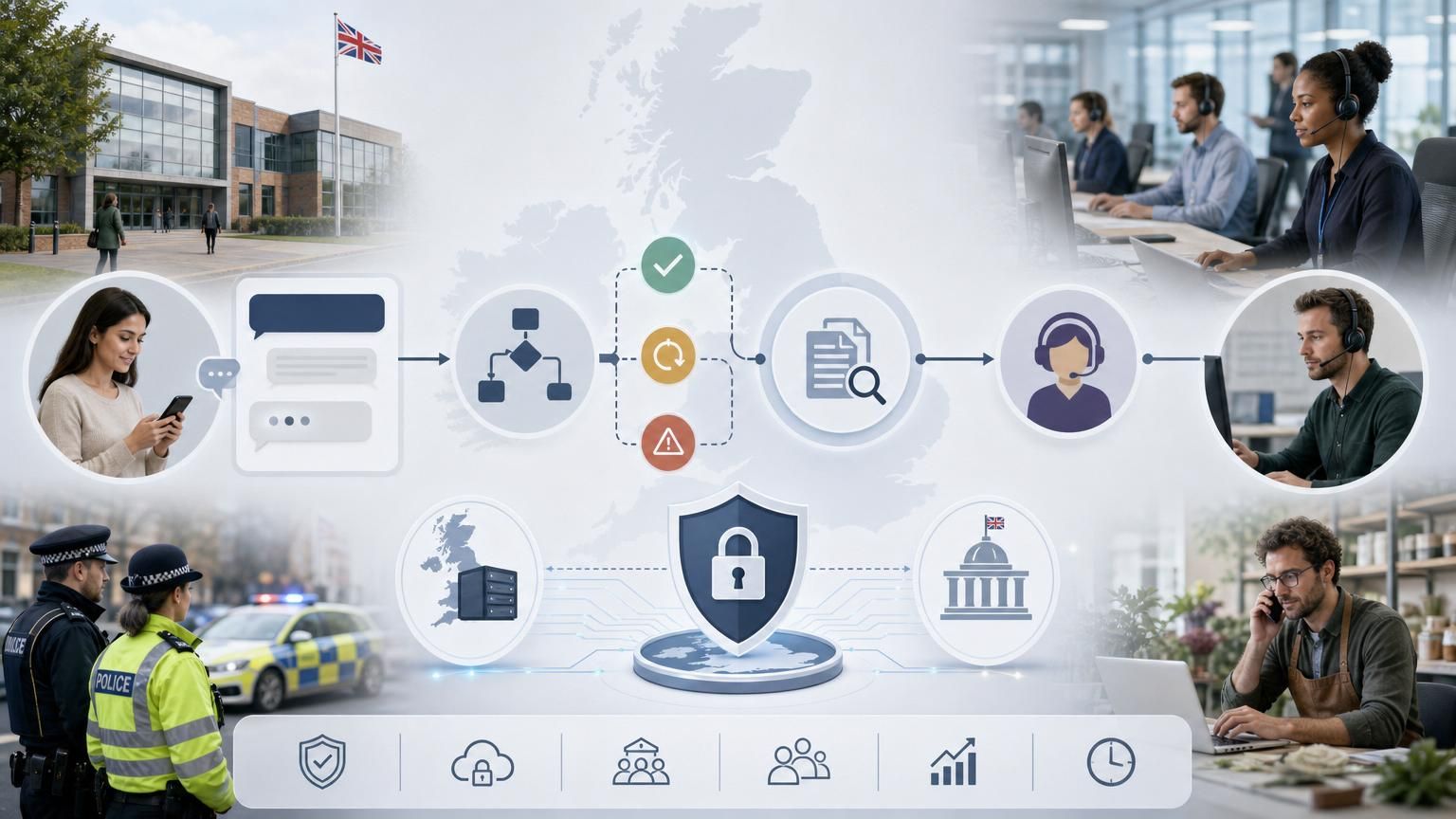
Public services and regulated organisations can no longer treat live chat as an add‑on. Citizens expect instant, accurate answers — but public bodies must also meet procurement rules, GDPR, and internal audit trails. A UK‑hosted Hybrid AI live chat delivers both: automated triage for the simple, rapid handover to human experts for the complex, and clear data residency and audit controls for compliance. (imsupporting.com)
The new vertical problem set: what councils, police and housing associations actually need
- Fast, authenticated triage for enquiries about benefits, reporting, tenancy and safeguarding.
- Audit-ready transcripts and role-based access for FOI or complaint investigations.
- Data never leaving UK infrastructure to meet procurement and data sovereignty policies.
Delivering those three reliably is where generic chat widgets fail. The answer is a workflow‑first, UK‑hosted hybrid AI system that integrates into back‑office case systems, identity stores, and document repositories. (imsupporting.com)
What ‘hybrid AI live chat’ actually means (short, practical definitions)
Rule‑based chatbots
Rule‑based bots follow decision trees (if X then Y). They’re predictable, cheap to audit, and good for forms, opening hours, or routing. They struggle with ambiguous language and exceptions.
Pure LLM bots
Large language models can generate fluent answers from broad context but can hallucinate, leak sensitive data, and are harder to control unless tightly constrained. They’re useful for drafting text or summarising, but alone they’re high‑risk for regulated use.
Hybrid AI live chat (the practical compromise)
Hybrid AI combines rule logic, retrieval‑augmented generation (RAG) over approved documents, and a live, seamless human hand‑over when confidence or policy thresholds are crossed. That means: instant answers where safe, and a recorded, context‑rich pass to a human when things are sensitive or ambiguous. This is the pattern we recommend for councils, housing associations, and police contact points. (imsupporting.com)
Five concrete use cases that show the commercial and civic value
- Rapid benefits eligibility triage — reduce call volumes by routing straightforward queries to AI while escalating complex claims to caseworkers.
- Neighbourhood policing enquiries — use AI for report intake and evidence collection, with human officers managing investigations and escalation.
- Housing repairs & ASB reporting — capture verified addresses, photos, and priority codes in the chat, then push to the housing CRM with a full audit trail.
- Regulated complaints handling — automate acknowledgement, provide statutory timescale notices, and ensure transcripts are archived for FOI or audit.
- SaaS and service desk onboarding for council partners — use AI to streamline common admin tasks while human agents handle sensitive access approvals.
Each use case reduces manual load, improves response times, and protects compliance by keeping data within UK hosting and auditable workflows. A well‑implemented live chat can increase conversion and successful resolution rates by meaningful margins in both commercial and civic contexts. ()
Integration checklist for procurement and security teams
- UK‑only data hosting and clear data processing agreement.
- RAG or document‑store connectors limited to approved sources.
- Visual, auditable workflow builder for policy‑driven handoffs.
- Role‑based access, encryption in transit and at rest, and long‑term archival for FOI.
- API connectors to core case systems and identity providers to allow verified transactions.
IMSupporting’s platform exposes tool integrations and a flow widget that matches these checklist items — it’s specifically designed to let you keep data and compute under UK control while still calling external tools where policy allows. (imsupporting.com)
Designing for auditability and “hand‑over first” safety
- Always capture the full conversation state and decision trigger when AI responds.
- Set clear confidence thresholds: below a set score, automatically escalate to human agents.
- Keep a layered policy: rule‑based for identity forms, RAG for document queries, human review for anything flagged as personal data or vulnerable.
These patterns preserve the speed benefits of automation while removing the single biggest risk: untraceable, uncontrolled AI decisions.
Operational KPIs that matter (not vanity metrics)
- First‑contact resolution for regulated enquiries.
- Time to validated handover (how long between AI triage and human pickup).
- Percentage of chats completed without human touch (target only where safe).
- Audit query turnaround and transcript retrieval time.
Measure these alongside cost per contact and citizen satisfaction scores. Recent analyses show chat users are significantly more likely to complete transactions when supported in real time, translating into faster case closures and lower operational cost per outcome. ()
Procurement red flags to avoid
- Vendors that can’t demonstrate UK data residency and DPA clauses.
- Black‑box LLM-only solutions with no RAG or document provenance.
- Platforms that don’t expose workflow logic for audit or don’t offer secure API connectors for your case systems.
Prefer vendors with a hybrid approach and a visible audit trail — this reduces risk during both procurement evaluation and later regulatory checks. ICO guidance on responsible data sharing remains the baseline for public sector projects. (ico.org.uk)
Quick deployment pattern for a 90‑day pilot
Week 1–2: Define two high‑value intents (eg, benefit eligibility and housing repairs) and map data flows. Week 3–6: Build rule flows, connect verified document stores, and configure RAG policies. Week 7–10: Run shadow mode (AI suggests, humans respond) and tune thresholds. Week 11–12: Go live with monitored hand‑over and performance dashboarding.
This phased approach keeps procurement comfortable and gives clear, measurable wins for stakeholders.
Where to start next
If you’re a UK council, housing provider, police contact team, or regulated service owner looking to adopt Hybrid AI live chat with UK hosting and auditable workflows, start with a short technical assessment and a pilot scoped around one high‑impact process. IMSupporting’s documentation on hybrid AI chat workflows and AI tool integrations explains the exact connectors and options available for UK deployments. (imsupporting.com)
For a fast, procurement‑friendly demo and to see a UK‑hosted hybrid AI flow in action, request a trial or speak to an architect at IMSupporting now: https://imsupporting.com/.
Strong CTA: Book a 10‑minute demo to see UK‑hosted Hybrid AI live chat workflows, audit trails and RAG controls applied to a council or housing process — faster responses, lower risk, no data leaving the UK. https://imsupporting.com/