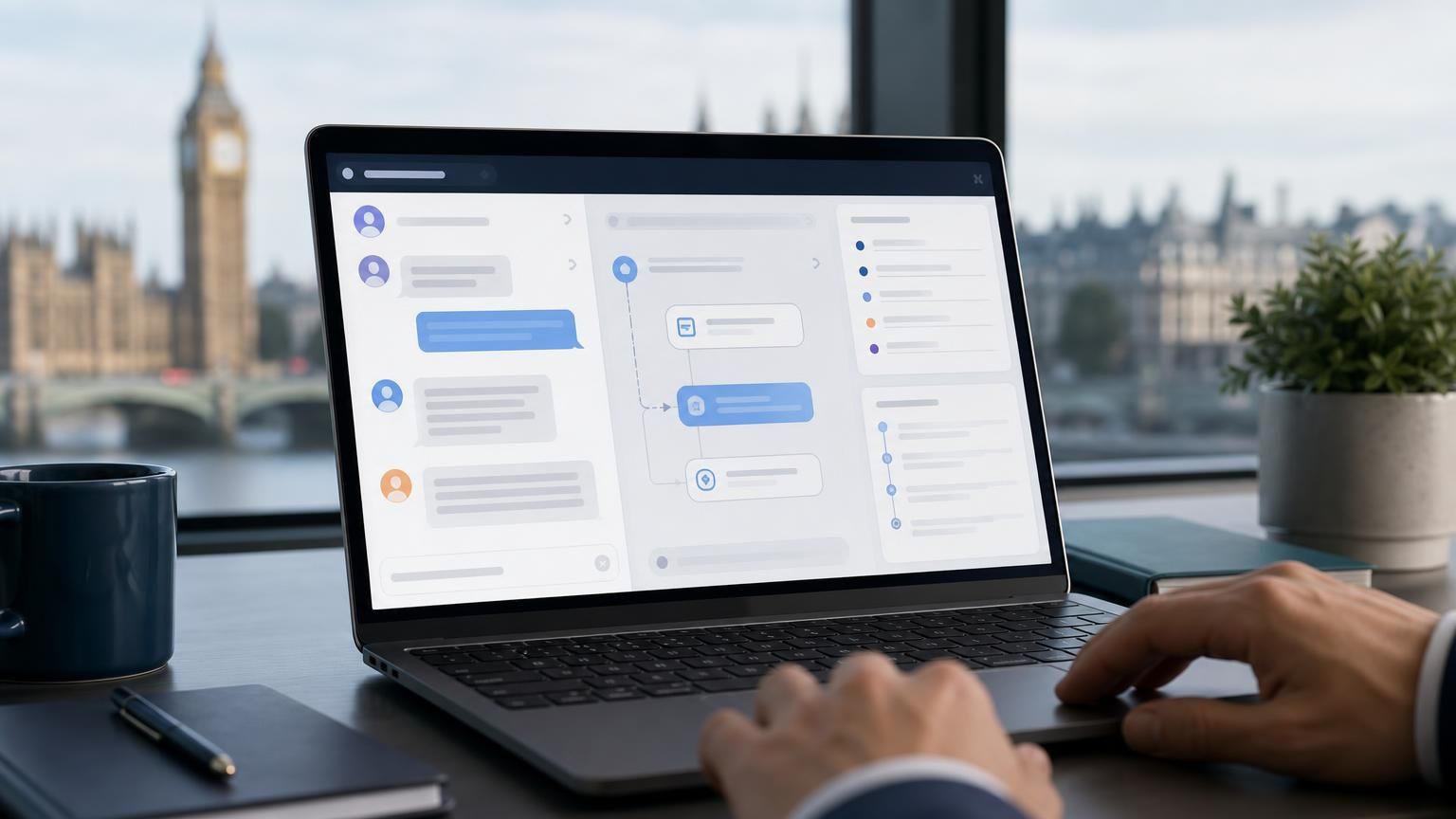
Why think of live chat as an orchestration layer — not just a widget
Live chat is no longer only about short Q&A. For UK councils, police non‑emergency desks, housing associations and regulated firms, the next step is to use hybrid AI live chat as an operational orchestration layer: a conversation becomes a verifiable task, a routed job, or an audit‑ready case — automatically. This reduces repetitive handoffs, shortens resolution time, and keeps sensitive data inside the UK when required. (imsupporting.com)

The practical difference: three chatbot archetypes explained
- Rule‑based chatbots: preprogrammed flows and scripts. Good for deterministic forms and simple FAQs but brittle when context or policy changes. They can't reason across documents.
- Pure LLM bots: powerful generative models that can draft nuanced replies but often risk hallucination, lack source traceability, and can expose data if not constrained. They’re fast but need careful guardrails.
- Hybrid AI live chat: combines RAG (retrieval‑augmented generation) with explicit workflow logic and human handoff. It retrieves exact policy or document snippets, generates user‑friendly answers, and routes tasks to teams when authority or empathy is required. This is the operational model most public and regulated organisations are piloting today. (imsupporting.com)
Why orchestration matters for UK public and regulated services
- Data sovereignty and auditability: Public bodies must be able to show the provenance of every answer and task assignment. Grounding AI responses in your documents (RAG) and keeping systems UK‑hosted meets that need. (imsupporting.com)
- Consistent decisioning: Workflows enforce the same eligibility checks, scripts, or risk scores across every channel so outcomes are reproducible and fair.
- Faster case progression: Convert a chat into a calendared follow‑up, an internal ticket, or a multi‑step case with required evidence attached — without manual copying between systems.
The GOV.UK pilots and AI playbook demonstrate this approach at scale: government teams have explicitly tested RAG-based chat prototypes to ground answers in official content and reduce risk of misinformation. These pilots have been a key rationale for cautious, auditable deployments across public services. (insidegovuk.blog.gov.uk)
Four orchestration patterns that deliver commercial and civic value
1) Intent → Task conversion
A user asks a policy question; the hybrid AI confirms intent, retrieves the exact policy excerpt, then creates a prefilled back‑office task (with attachments and consent logs) for a caseworker when needed. This eliminates duplicate intake steps and preserves an audit trail. See a practical implementation in IMSupporting’s workflow builder. (imsupporting.com)
2) Conditional authority escalation
Low‑risk requests (e.g., information lookup) are handled end‑to‑end by the AI. High‑risk actions (sensitive data access, financial authorisations) trigger a conditional human approval step with clear authority levels recorded in the workflow. This reduces human workload while protecting regulated functions.
3) Context‑aware multi‑step journeys
Complex cases (housing disrepair, multi‑agency safeguarding) require staged evidence collection. An orchestration layer can prompt for documents, schedule appointments, and generate a case summary for downstream stakeholders — all from the original chat thread.
4) Closed‑loop quality & learning
Successful human resolutions feed back into the RAG knowledge base: the system indexes high‑quality agent answers so the AI learns best practice over time. IMSupporting describes human‑in‑the‑loop learning that refines AI replies based on high‑satisfaction interactions. (imsupporting.com)
Operational controls you must design from day one
- UK hosting and data residency: insist on UK‑hosted infrastructure and clear data export controls when procurement requires it. IMSupporting lists UK hosting as standard for its workflow product. (imsupporting.com)
- Provenance and source linking: every AI reply that cites a policy should include the original document reference and a timestamp for audit purposes.
- Escalation rules and SLAs: define when a chat becomes a regulated transaction that needs human sign‑off and set clear SLAs for those handoffs.
- Redaction and minimisation: workflows should identify and redact PII before long‑term storage unless retention is mandated by policy.
A short reality check: what automation can and cannot do
Automation can reliably handle intake, FAQs, document retrieval and low‑risk task creation — cutting repetitive work and improving throughput. In one IMSupporting example, AI guidance resolved 40% of basic IT support tickets automatically after knowledge training. That’s the kind of operational uplift to expect when you combine RAG with workflow logic. (imsupporting.com)
But do not hand regulated decision authority to any autonomous model. Pure LLM bots lack verifiable source linking and can hallucinate; rule‑based bots lack the nuance for multi‑step cases. Hybrid AI with human gates is the only safe path for regulated UK services. (insidegovuk.blog.gov.uk)
How to run a low‑risk pilot that proves ROI
- Start with a high‑volume, low‑risk flow (password resets, document requests, council tax FAQs) and instrument every step for measurement.
- Build a visual workflow that captures consent, retrieves exact policy excerpts, and creates a back‑office ticket on escalation. IMSupporting’s visual drag‑and‑drop workflows let teams prototype quickly and keep everything UK‑hosted. (imsupporting.com)
- Measure: deflection rate, time‑to‑task‑creation, human handle time, and downstream resolution time.
- Iterate: use agent feedback to refine retrieval quality and add selective rerouting for tricky topics.
Procurement and compliance notes for UK buyers
- Require RAG provenance, exportable audit logs, and a human‑in‑the‑loop learning policy in contracts. The UK Government’s AI playbook highlights grounded, auditable approaches to conversational AI as good practice. (gov.uk)
- Insist on staged rollouts and third‑party assurance for any ML components, especially when integrating with CCTV, safeguarding, or finance systems.
Quick implementation checklist for support leaders
- Map three candidate flows for orchestration (intake, payments‑free authorisation, complex casework).
- Confirm UK hosting and data retention policies. (imsupporting.com)
- Choose RAG‑first training: upload canonical documents, then supervise AI outputs through human reviews. (imsupporting.com)
- Define clear handoff and escalation rules with SLAs.
Conclusion — convert chat into controlled operational throughput
Treat hybrid AI live chat as an orchestration layer, not a novelty. For UK public and regulated organisations this model delivers measurable gains: fewer repetitive tasks, traceable decisions, and faster case progression — while keeping sensitive data in‑country and under control. Practical pilots begin with RAG‑grounded answers, visual workflows, and human gates. See how IMSupporting combines RAG knowledge and hybrid workflows to turn conversations into governed tasks and measurable outcomes. (imsupporting.com)
Looking to pilot an orchestration workflow that meets UK hosting and audit requirements? Start a free trial or book a demo at IMSupporting to see workflow examples and RAG training in action: https://imsupporting.com/ .