
The new commercial play: a support workflow marketplace
UK councils, police teams and regulated organisations already run dozens of support processes that repeat the same patterns: benefits queries, housing repairs triage, council tax appeals, licensing checks. Instead of building one-off chatbots or bespoke automations, imagine a low-code marketplace of pre‑approved hybrid AI live chat workflows — each template RAG‑grounded, DPIA‑cleared and ready to deploy with human handoff rules, audit logging and UK hosting.
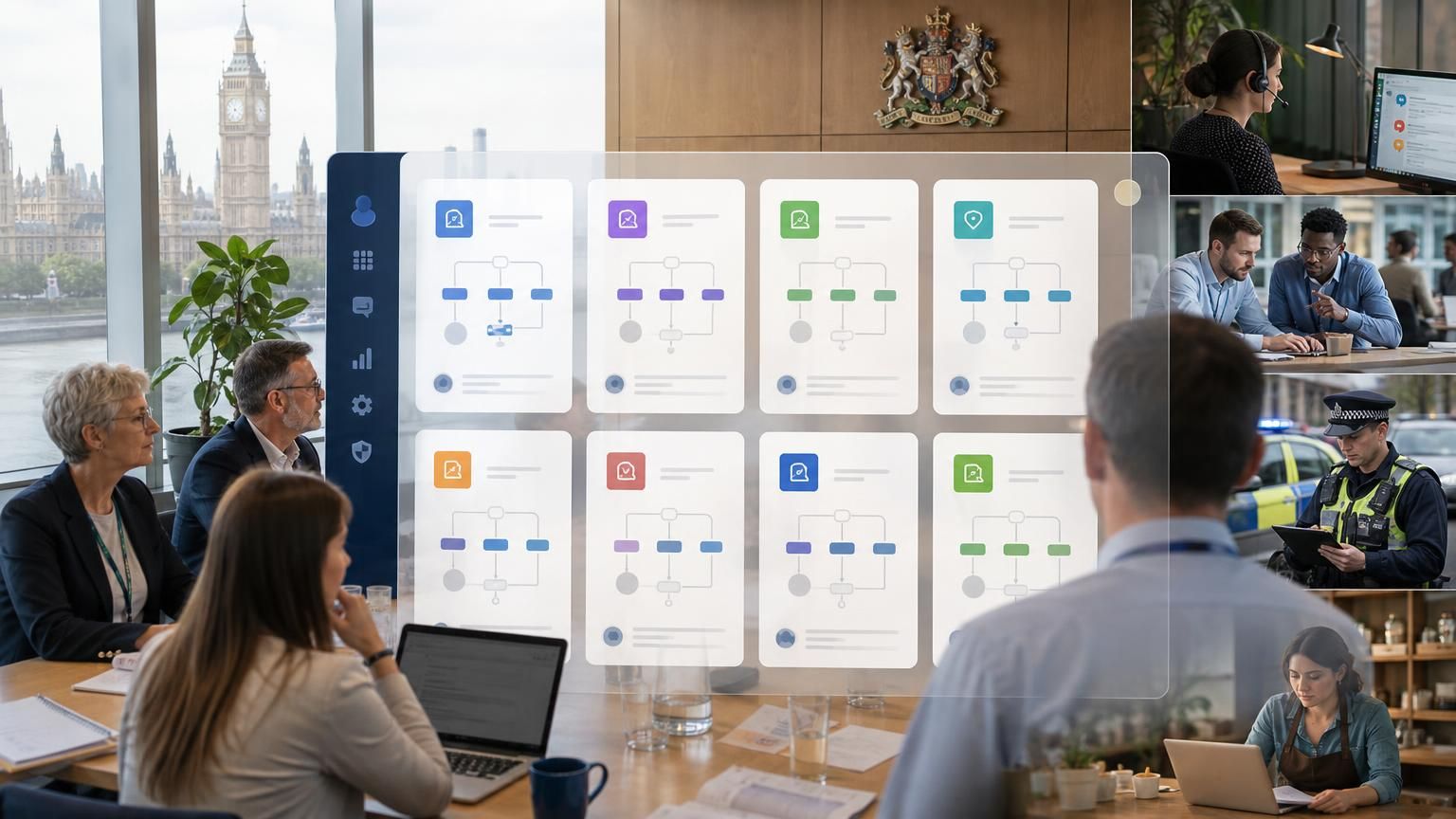
This is not theory. The idea converts three commercial problems into a single product capability:
- Faster procurement and pilots (reuse approved templates instead of reopening procurement every time).
- Predictable governance (templates carry the approvals and audit chains required for regulated services).
- Lower dev overhead (low-code templates reduce specialist AI engineering demand).
Why a marketplace matters now
UK public-sector teams are under pressure to deliver digital access while protecting sensitive data and meeting strict audit requirements. The Government’s AI Playbook and related public‑sector guidance emphasise proportionate governance, documented decision paths and safe experimentation when deploying AI in citizen‑facing services. (gov.uk)
At the same time, awareness of digital channels is rising but actual live‑chat usage with high‑trust services remains low: HMRC’s research found only 14% of respondents had used an online support function such as live webchat with a HMRC representative, highlighting the need for reassurance, accuracy and auditable channels when citizens interact online. That gap is exactly the opportunity a curated workflow marketplace must close. (gov.uk)
What a template in the marketplace looks like
A single marketplace template should include:
- A RAG‑grounded knowledge connector that pulls approved documents and local policy snippets to ground answers.
- A hybrid triage layer: AI handles routine verification and FAQs, and hands off to a named human queue when complexity, emotion, or regulated decisions are detected.
- Preconfigured data‑processing rules and retention windows (to satisfy UK‑in‑country hosting and DPIA needs).
- An audit trail and versioned change log so every answer can be traced back to the knowledge source and model prompt used.
- Low‑code configuration for mapping internal systems, SLAs and escalation rules.
Technically, the RAG (retrieval‑augmented generation) layer pulls relevant documents into the model’s context so answers are evidence‑backed rather than purely hallucinated — a key control when citizens rely on factual outcomes. (en.wikipedia.org)
Rule‑based bots, pure LLMs and hybrid AI: clear differences
- Rule‑based chatbots: deterministic scripts and decision trees. Excellent for narrow, regulatory checklists but brittle and maintenance-heavy when policies change.
- Pure LLM bots: powerful at freeform language but risky for regulated services because outputs are not inherently linked to authoritative documents and can hallucinate.
- Hybrid AI live chat: the practical sweet spot. Use RAG to ground LLM responses in your corpus, add deterministic business rules for eligibility/decision points, and keep human agents in the loop for judgement calls and empathy. The marketplace templates should enforce this hybrid pattern as the default.
Governance and data protection — UK‑first design
Start with the ICO’s AI and data protection guidance: treat any generative layer as processing personal data, run proportionate DPIAs, and ensure human oversight where necessary. The ICO expects organisations to document how they mitigate risks around personal data when using AI. (ico.org.uk)
Practical governance checks for templates:
- UK hosting and data residency baked into every template (no cross‑border escapes by default).
- Preapproved knowledge sources and automatic provenance tags per reply.
- Built‑in escalation triggers for regulated outcomes that must be human‑signed.
- Automated reporting for audit windows and retention policies so internal auditors can inspect decisions across versions.
How to pilot: five pragmatic steps for councils and regulated teams
- Pick two high‑volume, low‑risk processes (e.g., appointment booking and basic eligibility checks).
- Build or adopt marketplace templates that include RAG connectors to your document store and a visible provenance header on every response.
- Run a co‑design lab with front‑line agents to tune handoff thresholds and SLA triggers.
- Conduct a short DPIA and public‑facing transparency statement; log both to the template metadata.
- Measure outcomes: average handle time, first contact resolution, and number of human escalations avoided.
The goal of the pilot isn’t to replace humans — it’s to standardise repeatable tasks so agents can focus on complex, high‑value interactions.
Commercial benefits that decision‑makers care about
- Procurement velocity: reuse approved templates to reduce buying cycles and speed rollout across departments.
- Cost predictability: templates reduce bespoke build time and make supplier costs predictable for SROs.
- Risk reduction: RAG grounding plus human handoff dramatically reduces material risk of incorrect, unverified answers.
- Citizen confidence: transparency labels, UK hosting and auditable trails improve trust for sensitive services.
How IMSupporting fits this model
IMSsupporting already exposes the exact building blocks a marketplace needs — RAG‑based agent knowledge that keeps answers evidence‑backed, and configurable hybrid AI chat workflows that manage AI triage and agent handoff. Review how RAG grounding and workflow templates can be used as the enforcement layer for governance and auditability. ()
Read IMSupporting’s detailed features on RAG‑based knowledge and hybrid chat workflows to see how prebuilt connectors and governance controls map to a marketplace approach: https://imsupporting.com/feature-rag-based-ai-agent-knowledge.php and https://imsupporting.com/feature-hybrid-ai-chat-workflows.php
Quick checklist before you buy or build
- Is the service UK‑hosted and can you keep data in‑country? (non‑negotiable for many councils and regulated teams)
- Do templates include an auditable provenance header per reply?
- Are handoff conditions explicit and configurable by non‑engineers?
- Can the template library be versioned and approved by legal/compliance?
- Does the vendor provide a low‑code builder so teams can craft new templates without heavy dev resources?
Next step — pilot a template from a marketplace
If you’re designing hybrid AI support at scale, pilot with a marketplace approach not a single bot. Start with one or two templates, document the DPIA and governance decisions inside the template metadata, and iterate with front‑line teams.
Explore how a UK‑hosted hybrid AI platform can deliver these marketplace capabilities and reduce procurement friction — start with IMSupporting’s platform overview and feature pages to map templates to your governance needs: https://imsupporting.com/ and https://imsupporting.com/feature-hybrid-ai-chat-workflows.php
If you want a practical partner to run a 60‑day pilot and deliver an approved template library, book a demo with IMSupporting and ask to see a working RAG‑grounded, human‑handoff template for a council use case. (CTA) https://imsupporting.com/