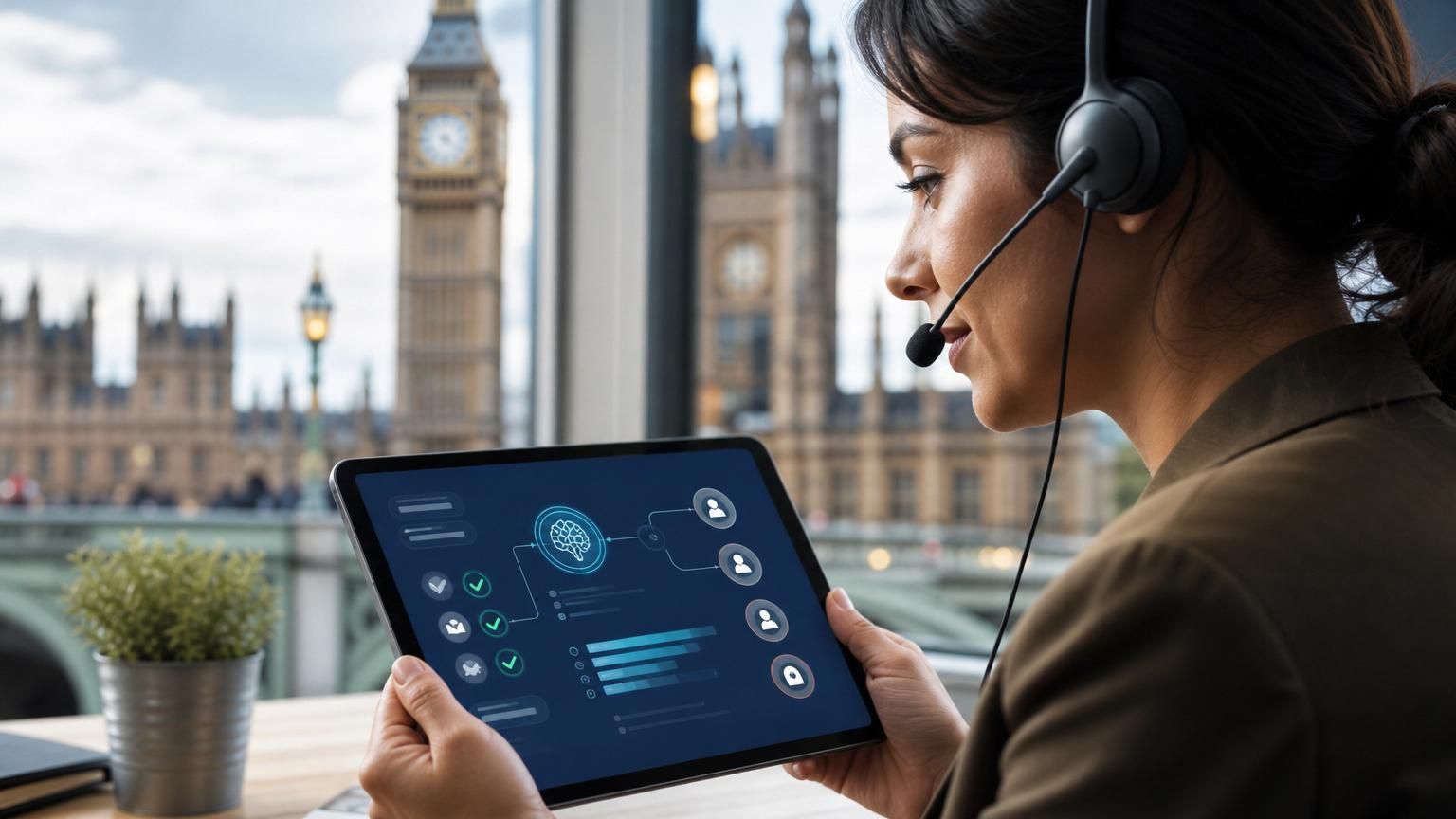
Why triage-first hybrid AI matters for UK support
Case backlogs are the silent performance tax for councils, housing associations, police contact centres and regulated teams. Hybrid AI live chat — not just another bot — can act as a clinical triage layer that reduces unnecessary referrals, speeds up resolution for routine demand and primes human agents for complex work.

This isn’t about replacing people: it’s about rerouting the right work to the right handler, faster. Gartner predicts agentic AI will autonomously resolve a large share of common customer service issues in the coming years, which means triage strategies need to be pragmatic, auditable and safely governed. ()
What a triage-first approach looks like (practical)
- Instant prioritisation: chat detects urgency and flags high‑risk cases (safeguarding, homelessness, hate-crime reports) for immediate human pickup.
- Evidence-rich handoff: AI compiles a short, sourced briefing plus relevant documents for the agent.
- SLA-aware routing: the system applies SLA windows and routes based on complexity, location and job role.
- Continuous learning: closed-loop feedback updates the knowledge retriever so future triage is smarter.
This is the difference between a chatbot that answers and a triage layer that reduces backlog.
Rule‑based bots, pure LLMs, and hybrid AI — clear differences
- Rule‑based chatbots: predictable, script‑driven, excellent for simple forms and static FAQs. They fail when questions are off‑script and generate handoffs that flood agents.
- Pure LLM bots: fluent, generative and broad in scope but prone to inventing facts and leaking sensitive context unless tightly controlled.
- Hybrid AI live chat: combines a retriever (RAG) tied to your internal knowledge, deterministic business rules, and an LLM kept behind strict guardrails — with automatic escalation to humans. It gives the speed of LLMs, the accuracy of your documents, and the governance of rules-based systems.
Hybrid is the only practical pattern for UK public and regulated teams that need audit trails, accuracy and data residency.
Why RAG and structured knowledge are the triage backbone
Retrieval‑Augmented Generation (RAG) means the AI answers from your documents, not the web. For triage you want:
- precise, sourced snippets for agent briefings;
- recent policy sections surfaced in context;
- the ticket history attached so human handlers see what’s been tried.
Recent engineering and enterprise surveys show RAG remains the leading approach for accurate, enterprise-grade Q&A and support automation — it’s where hybrid chat stops hallucination and starts reliable triage. ()
For a concrete implementation example, see how RAG-powered knowledge agents gather context and prepare human handoffs in IMSupporting’s RAG feature. Read the feature brief.
Operational playbook: reduce backlog in six steps
- Map demand: classify incoming chat into low, medium, high complexity using intent scoring.
- Build RAG indexes for policy, case notes and local guidance so answers are evidence‑linked.
- Configure escalation curves: immediate human pickup for safety/legally significant intents; otherwise AI triage with SLA timers.
- Implement audit logging and DPIA-ready controls for every automated decision (data minimisation, purpose-limited access).
- Train agents on AI briefings and micro‑workflows — the handoff must feel like handing an already‑prepared case.
- Measure and iterate: track backlog size, one-touch resolution, average time to human pickup and audit trail completeness.
A practical hybrid AI workflow example is available in IMSupporting’s hybrid chat workflows documentation. See the workflow capabilities.
Meeting UK public‑sector rules, data protection and procurement expectations
UK teams must treat AI triage as a regulated system: document your risk assessment, keep processing UK‑hosted where required, and align controls to ICO and government playbooks. The ICO’s guidance on AI and data protection is explicit about lifecycle risk management and auditability; use it to shape DPIAs and consent strategies. (ico.org.uk)
The UK Government’s AI Playbook and data ethics framework also recommend PETs, clear procurement evidence and technical controls for government services — all of which map directly to hybrid triage implementations. (gov.uk)
Ofcom and safety regulators additionally highlight the need to manage harmful outputs and platform responsibilities for generative systems used by online services in the UK. Design triage rules to detect and escalate abuse, safeguarding concerns and live threats. ()
KPIs that matter (and how to measure them)
Focus on operational KPIs that correlate to backlog reduction and public‑service outcomes:
- Backlog volume reduction (% change month-on-month)
- Time to first human action for high‑risk intents
- One‑touch closure rate for low‑complexity cases
- Audit completeness (percentage of handoffs with RAG-sourced briefings attached)
- False escalation rate (cases escalated unnecessarily)
A single statistic-style goal gives a team clarity: aim to reduce actionable backlog by 30–50% in the first six months of hybrid triage deployment depending on baseline demand.
Practical pitfalls and how to avoid them
- Treating LLMs as policies. Use deterministic rules for legal or safety decisions and RAG to source policy language.
- Over‑automation. If your triage curve is too aggressive you’ll miss nuance; always include a low-friction human override.
- Data residency mismatches. Keep PII and case files on UK-hosted infrastructure to satisfy procurement and GDPR expectations.
- Poor handoff UX. Agents must receive concise, structured briefs with links to source documents.
Final checklist for procurement and pilots
- Confirm UK hosting and data‑sovereignty guarantees in contracts.
- Request RAG indexing and exportable audit logs as mandatory features.
- Insist on configurable escalation curves and SLA-aware routing.
- Run a 12‑week pilot: 4 weeks baseline, 4 weeks phased triage, 4 weeks optimisation.
Next steps — a real starting point
If you run UK support for a council, housing association, police contact centre or regulated team, start with a single use case: safeguarding triage, homelessness reports, or benefit enquiries. Build a RAG index for the related policies and launch a hybrid triage path with SLA timers and live agent handoff.
See how IMSupporting implements RAG knowledge agents and hybrid workflows to create auditable, UK‑hosted triage paths: RAG feature and Hybrid chat workflows.
For a practical demo and to discuss a procurement‑ready pilot built for UK public services, contact the IMSupporting team. Start reducing backlog while keeping data in the UK — book a conversation at https://imsupporting.com/ today.