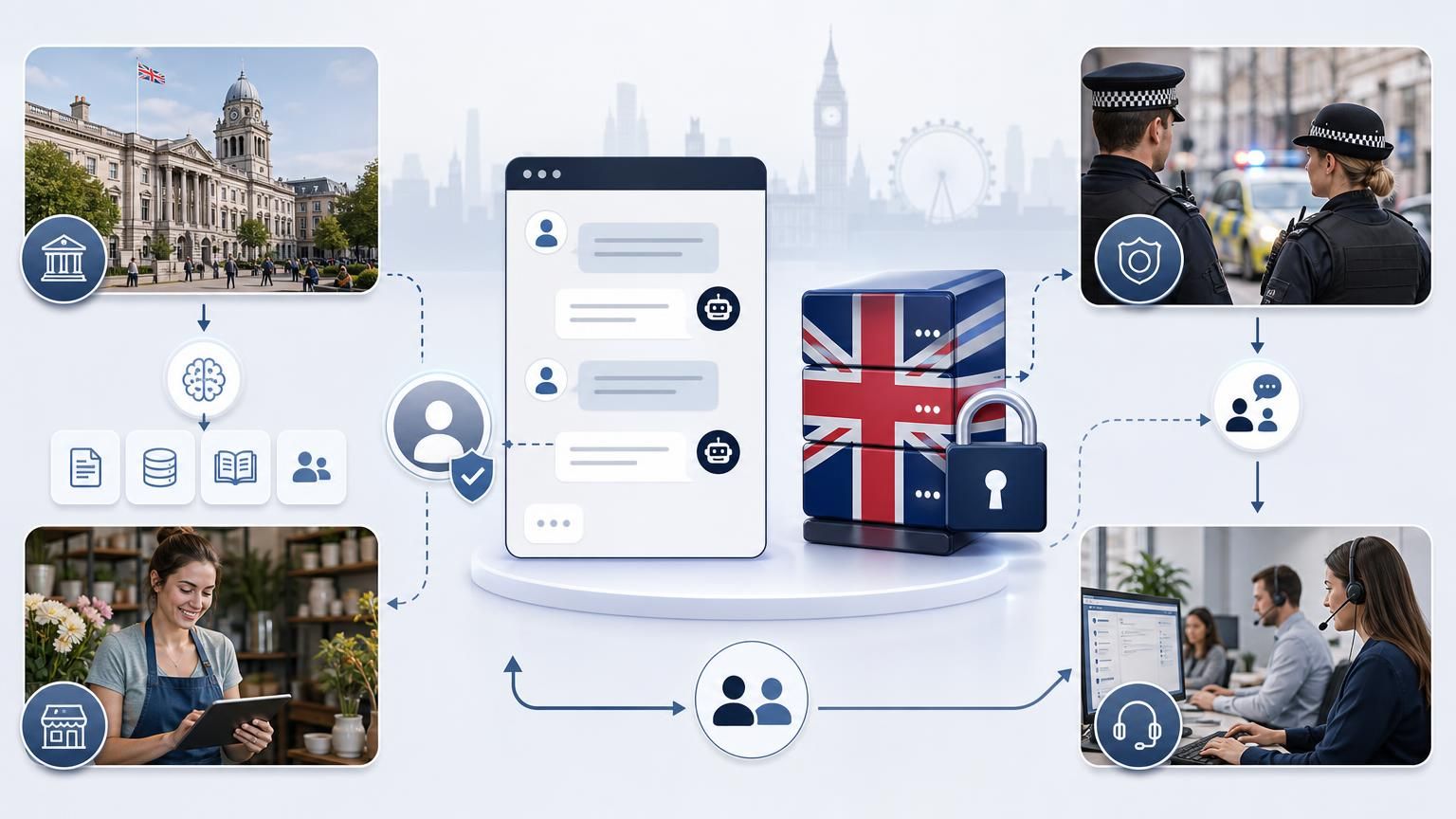
Why identity-first live chat matters for UK organisations
Most UK public bodies and regulated businesses already accept that live chat reduces friction and speeds outcomes — but the next commercial step is making those conversations identity-aware and audit-ready without exposing sensitive data overseas.
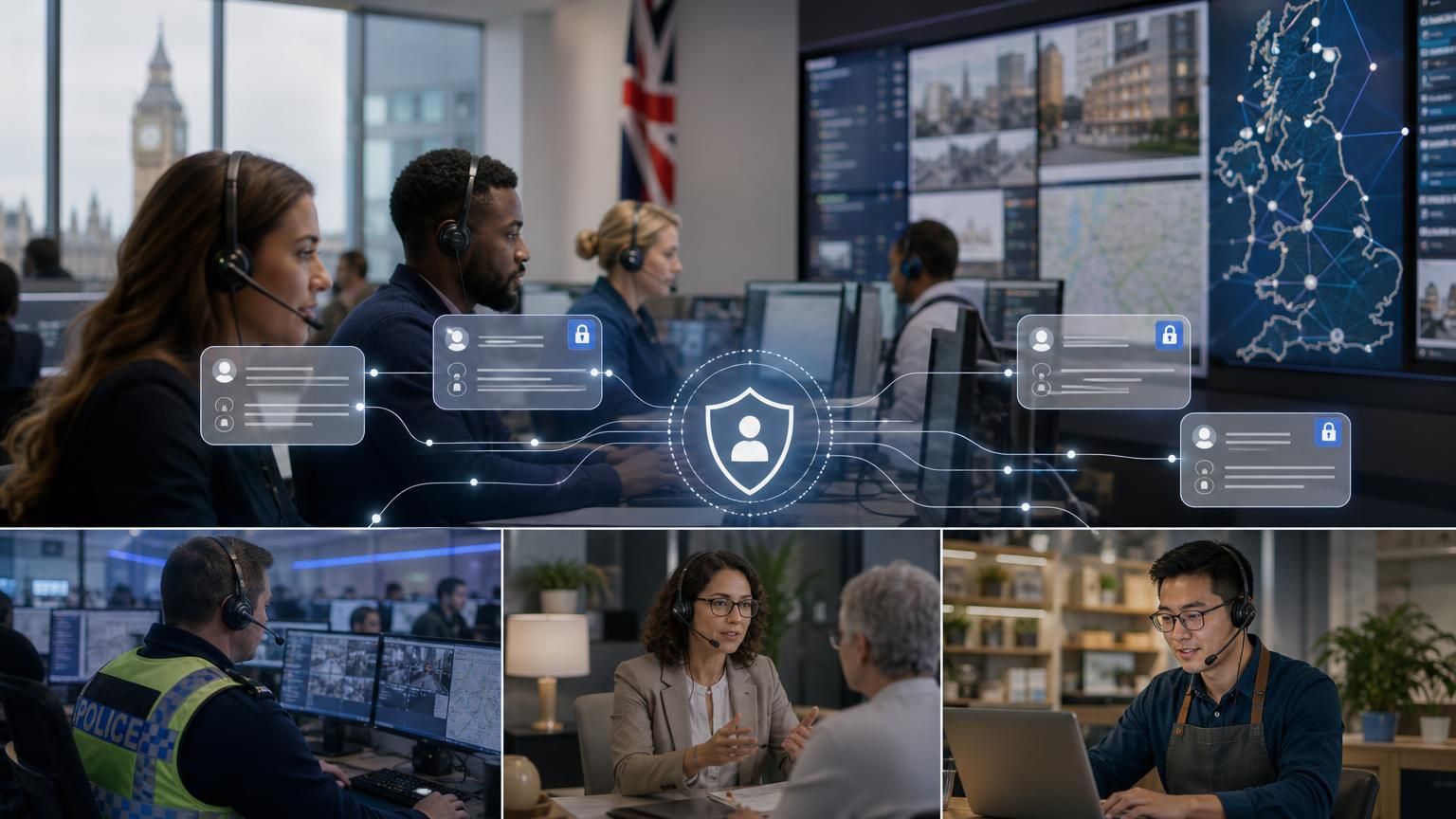
Integrating identity verification into the front-end of live chat converts queries into authorised actions (case updates, payments, access to records) while preserving compliance and data sovereignty. Implemented correctly, this reduces case lifecycle time, lowers manual verification costs and prevents unnecessary escalations.
Industry studies commonly report that adding live chat can lift conversion or completion rates by around 20% — the same immediacy that drives sales lifts is what public services can use to move casework faster. ()
The three bot families — why the difference matters for identity and compliance
- Rule-based chatbots: deterministic scripts and decision trees. Good for simple FAQs and fixed eligibility checks. Low risk, but brittle for record-level queries.
- Pure LLM bots: generative models that compose replies from patterns in training data. They are conversationally fluent but can hallucinate and make unsafe data inferences when asked about individual records.
- Hybrid AI live chat: the practical middle way. A retrieval-backed (RAG) or workflow-driven system uses secure knowledge retrieval, deterministic rule checks and an LLM for natural language. Crucially, it routes to human agents when policy, identity or judgement is required.
Hybrid AI is the only architecture that can combine natural conversation with deterministic identity checks and auditable handoffs — a must for councils, housing associations and police contact points.
Why RAG + identity checks is non-negotiable for enterprise trust
Retrieval-augmented generation (RAG) lets a chat system fetch the exact policy, case note or document and use it as grounding — dramatically reducing hallucinations and enabling authoritative answers at scale. Analysts now call RAG a core capability for enterprise generative AI and organisations increasingly augment LLMs with retrieval to make them safe for operational use. ()
That grounding matters for identity workflows because you must:
- verify who the user is before retrieving personal records;
- ensure the retrieval layer enforces metadata rules (sensitivity, retention, audit tags);
- retain cryptographic or tamper-evident trails of who accessed what and why.
Architecture blueprint: identity-first hybrid AI live chat
Step 1 — friction-light identity capture
Start with progressive identity capture in the chat widget: partial identifiers (case reference / postcode / DOB) that trigger risk-based verification only when needed. Keep low-sensitivity FAQ queries anonymous to maximise accessibility.
Step 2 — policy gating and rule validation
Before any record fetch, a policy engine evaluates necessity and lawful basis under UK GDPR and local public sector rules. If the request passes, the system proceeds; if not, escalate to a human operator.
Step 3 — RAG-backed retrieval with metadata enforcement
Use a RAG layer to fetch matched documents, case notes or legislation. The retrieval index must include metadata to prevent accidental exposure of OFFICIAL-SENSITIVE material and to mark provenance for audit. RAG reduces hallucinations and provides traceable evidence of the source used to answer.
Step 4 — LLM for natural language + transparent handoff
An LLM composes the response using retrieved sources, but the interface flags when the answer is machine-sourced and provides the retrieved references for the agent. If the query crosses defined thresholds (complexity, legal risk, verification failure) the system performs a seamless live handover to a human with the full transcript and retrieval context.
Operational controls UK teams must demand
- UK data residency and hosting guarantees: public bodies should keep PII and indexes on UK-hosted infrastructure to limit cross-border legal exposure. GOV.UK guidance requires risk-based judgements for data residency and offshoring. (gov.uk)
- ICO-ready AI processing: follow ICO guidance on AI and data protection — document lawful bases, DPIAs, and explainability measures for automated decisions. (ico.org.uk)
- Technical resilience & key management: apply NCSC cloud security principles for asset protection and resilience when choosing cloud infrastructure. (ncsc.gov.uk)
Practical checklist for procurement and pilots
- Demand explicit UK-hosted deployments for PII and RAG vector stores.
- Insist on toggleable ‘human-first’ thresholds so agents can override AI outputs.
- Require cryptographic audit trails (who, when, why) for every record fetch.
- Test worst-case flows: failed verification, ambiguous requests, malicious inputs.
- Run a small, live pilot on a high-volume use case (housing repairs triage, licence checks, or custody visit booking) for 6–8 weeks.
Commercial outcomes and performance metrics to track
Measure these alongside standard service KPIs:
- verification-to-resolution time (target: reduce by 30–50% on pilot use cases);
- proportion of queries resolved without human escalation (aim for safe deflection, not 100% automation);
- audit churn (time saved per case thanks to automated retrieval and agent context);
- user satisfaction and completion rates — remember, live chat implementations often deliver ~20% higher completion/conversion on transactional journeys. ()
Typical public sector use cases
- Councils: secure benefits or housing queries where identity confirmation unlocks personalised advice.
- Housing associations: tenancy changes, repairs prioritisation and evidence capture with verifiable handoffs.
- Police and custody suites: appointment or disclosure requests that need strong provenance and restricted access controls.
Each use case benefits from a hybrid approach where an automated triage reduces mundane workload and a human agent handles judgement-intensive steps.
How IMSupporting maps to this architecture
IMSupporting provides RAG-based agent knowledge and governance features that support UK-hosted hybrid AI workflows — a practical fit for public sector pilots. See their RAG feature and how hybrid workflows orchestrate handoffs and audits: RAG-based AI agent knowledge and Hybrid AI chat workflows.
If you prioritise UK-hosted deployments and turnkey audit trails, review IMSupporting's platform for a demo and deployment options. Visit https://imsupporting.com/ to book a conversation.
Final takeaways — design for safe speed, not blind automation
Hybrid AI live chat is the operational pattern that lets UK organisations deliver faster outcomes while maintaining legal and reputational control. RAG grounding plus policy gating turns conversational convenience into authorised action, and identity-first design prevents the most costly errors.
Start with a narrowly scoped pilot: a single transactional use case, UK-hosted RAG indexes, clear escalation rules and an operator override. Track time-to-resolution, safe deflection rates and audit completeness — those metrics prove the commercial and compliance case.
Ready to pilot a UK-hosted, identity-first hybrid AI live chat that preserves data sovereignty and speeds casework? Book a demo at IMSupporting and see a working RAG + hybrid workflow built for councils, police and regulated teams: https://imsupporting.com/.