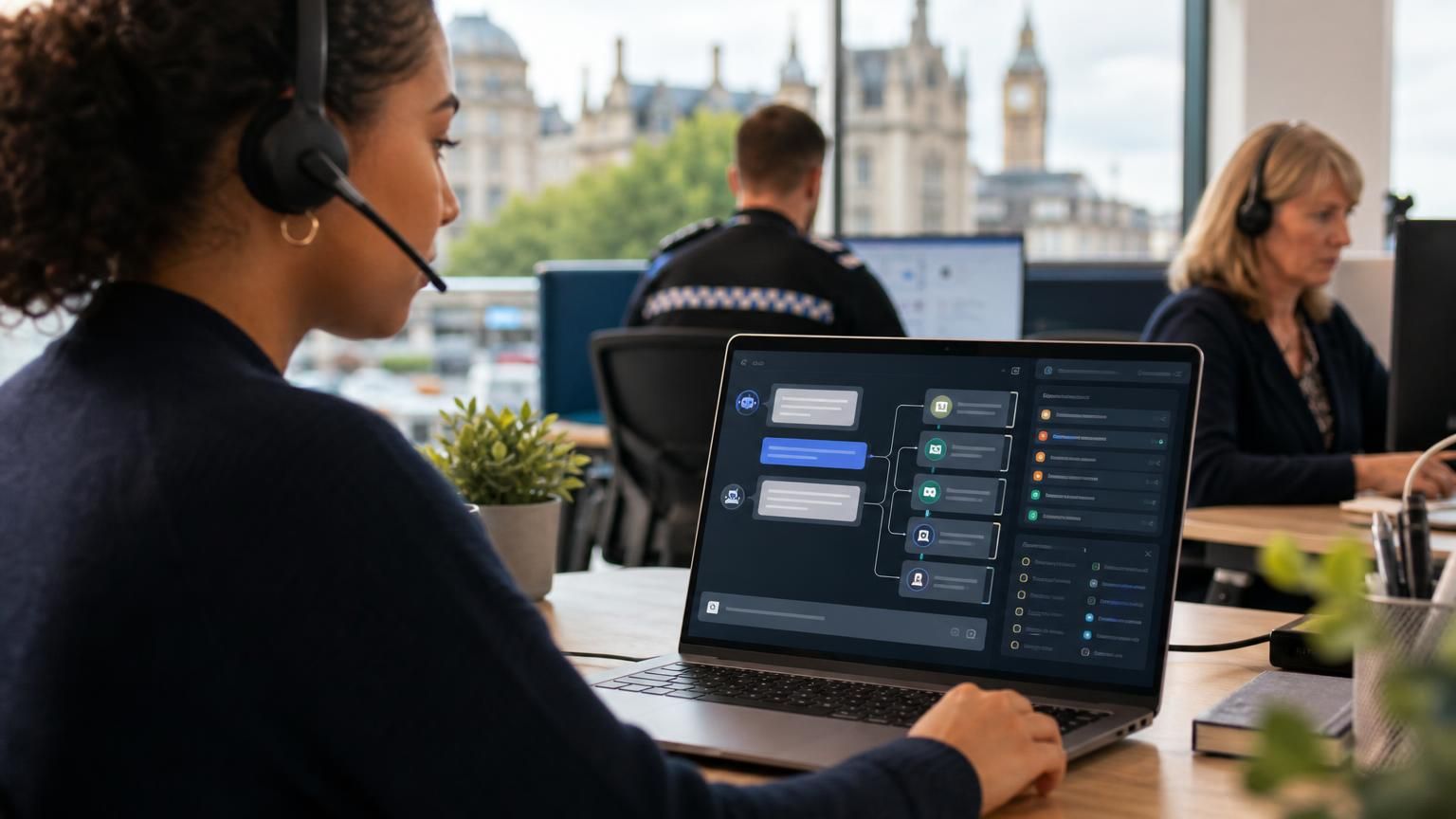
The orchestration opportunity: live chat as the control plane
Treat live chat as more than a messaging widget. For UK councils, police contact centres, housing associations and regulated teams, live chat can be the orchestration layer that ties together web intake, case systems, document stores and human experts — while keeping data in the UK and audit trails intact.

This is not theoretical. Public-sector teams are already piloting AI across services; in one sector survey 70% of government bodies reported piloting or planning AI tools. ()
Why orchestration matters for UK public and regulated services
- Single conversational surface: citizens start in the same chat UI whether they need a simple FAQ or a complex safeguarding referral.
- Context stitched to systems: the chat pulls records, shows case history and posts structured data into ticketing or CRM without manual copy/paste.
- Audit-ready handovers: every AI answer, tool call and human handoff is recorded so teams can demonstrate compliance and review decisions.
Make-or-break requirements for this approach: UK hosting, auditable logs, RAG-grounded answers, and workflow-level controls that enforce policy and consent.
What rule-based bots, pure LLMs and hybrid AI actually look like in production
Rule-based chatbots
- Logic-driven scripts and fixed decision trees.
- Best for straightforward, repetitive tasks (opening hours, form links).
- Strength: predictable, auditable. Weakness: brittle and poor at free-text understanding.
Pure LLM chatbots
- Use large language models to generate free-text replies from patterns learned in training data.
- Strength: fluent language and broad general knowledge. Weakness: hallucination risk, unpredictable outputs, and limited regulatory trust without grounding.
Hybrid AI live chat (the orchestration sweet spot)
- RAG (retrieval-augmented generation) grounds responses in your documents and case data, reducing hallucination and enabling citations. (imsupporting.com)
- A workflow engine controls when AI can act, when to call APIs, and when to escalate to human operators. (imsupporting.com)
- Result: instant, accurate answers for common queries plus auditable human escalation for complex or sensitive cases.
Hybrid is the only pattern that reliably balances speed, accuracy and regulatory traceability for UK public services.
Orchestration patterns that cut time and increase trust
Use cases and practical patterns that deliver measurable benefits:
1) API-augmented triage
- Flow starts with an AI-first intake that asks clarifying questions conversationally, then calls an API to fetch eligibility or case history.
- Outcome: fewer repeats, faster decisioning, higher first-contact resolution. This is ideal for housing repairs, benefits enquiries and custody records checks.
2) Document-backed answers with citations
- RAG retrieves the relevant policy excerpt, then the AI composes a response that includes the supporting clause or reference. This reduces disputes and increases transparency. (imsupporting.com)
3) Conditional handoff and role-aware routing
- Workflows check for online specialist teams (safeguarding, legal, estates) and route automatically. If no specialist is available, the chat converts the interaction into a fully populated ticket with priority flags and source documents.
4) Tooling and actions from chat
- Let the AI trigger secure server-side actions: create a ticket, book an appointment, send a secure link or redact PII before export. The workflow records every step for audit.
Procurement and compliance: what buyers must insist on
When buying an orchestration-capable hybrid chat platform, insist on:
- UK data residency and processing to avoid cross-border complexity and to meet public-sector risk registers. (This is non-negotiable for many councils and regulated bodies.)
- RAG grounding so AI answers are traceable to source documents, not model guesswork. (imsupporting.com)
- A visible decision log: every retrieval, API call and human edit must be exportable for audits and freedom-of-information requests.
- Workflow-level policy enforcement (consent, escalation thresholds, data minimisation) so compliance is enacted by design. (imsupporting.com)
- Alignment with ICO and government AI guidance — document the AI’s scope, risk assessment and monitoring plan. The ICO provides practical guidance on AI and data protection that should feed procurement requirements. (ico.org.uk)
Operational playbook: deploy in three sprints
Sprint 1 — Safe sandbox and RAG knowledge build
- Upload policy documents, SOPs and FAQs into a RAG index.
- Test answers in a closed environment and validate citations against source pages. (imsupporting.com)
Sprint 2 — Workflow orchestration and system integrations
- Build a small set of orchestration flows: triage, ticket creation, and specialist routing. Use conditional branches to enforce business rules. (imsupporting.com)
Sprint 3 — Controlled public roll-out and audit bake-in
- Start with low-risk services (general enquiries, appointments) and expand after three weeks of monitored metrics and policy reviews. Capture feedback loops so the AI learns from your best agents.
Measuring success: KPIs that matter to UK buyers
- First-contact resolution and time-to-handoff.
- Accuracy of RAG citations and human override rates.
- Reduction in mean handling time and agent workload.
- Auditability: percent of interactions with full system logs and evidence exports.
Real constraints and how to mitigate them
- Data sprawl: mitigate with clear content ownership for RAG indices.
- Over-trust in AI: use confidence thresholds and mandatory human review for high-risk decisions.
- Procurement hurdles: include trial clauses, security questionnaires and demonstrable compliance artefacts to satisfy buyers.
Where to start tomorrow (practical next steps)
- Map three back-office systems you need the chat to call (ticketing, CRM, case DB).
- Identify 10 policies and FAQs to seed a RAG index and test citation accuracy. (imsupporting.com)
- Build one workflow that starts AI-first and has a clear, auditable human escalation path. (imsupporting.com)
For UK teams that must prove control, keep data in-region, and show auditable decision trails, this orchestration approach is the practical future of support.
Ready to design an orchestration-ready hybrid AI chat that keeps data in the UK and hands complex cases to humans with full audit trails? See how IMSupporting uses RAG-based AI knowledge and visual hybrid workflows to deliver exactly this capability: https://imsupporting.com/feature-rag-based-ai-agent-knowledge.php and https://imsupporting.com/feature-hybrid-ai-chat-workflows.php. (imsupporting.com)
If you want a fast pilot that integrates with ticketing, has UK hosting and auditable handovers, start a trial or talk to their team: https://imsupporting.com/.