Start with the outcome: faster, auditable resolutions for UK-regulated teams without shipping sensitive data offshore.

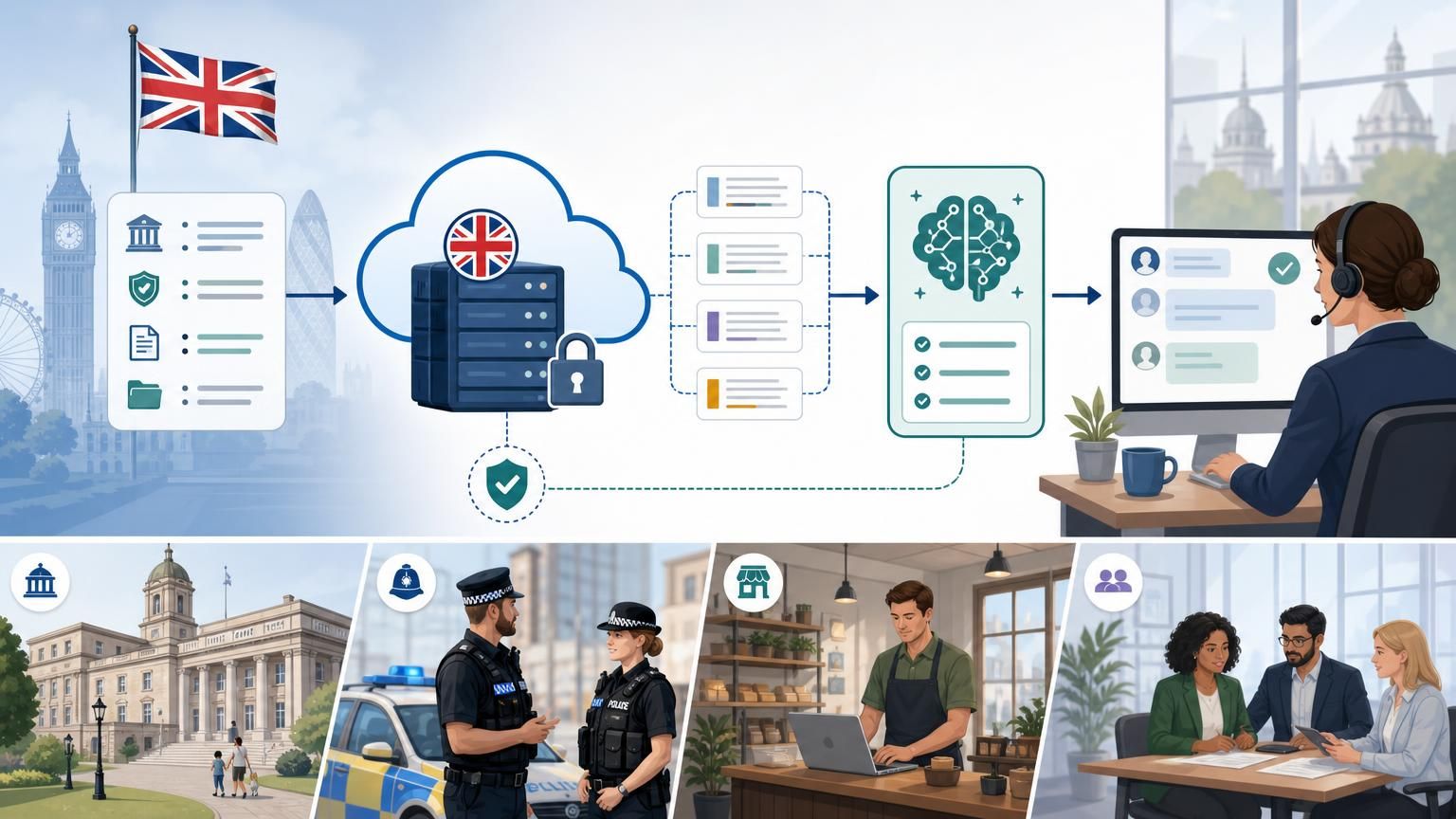
Why "local-first" hybrid AI matters now
Public-sector and regulated teams face two simultaneous pressures: rising case volumes and stricter data residency expectations. Hybrid AI live chat — where AI handles triage and routine answers but humans take over for complexity or empathy — is the practical answer. Gartner found a large majority of service leaders are actively exploring or piloting customer-facing conversational GenAI capabilities, making now the time to define how you embed them safely. ()
A local-first strategy means: prioritise UK-hosted knowledge stores, short-lived RAG contexts, and explicit handoffs to human agents that preserve audit trails and control. The UK Business Data Survey and recent UK studies also show a meaningful uplift in AI use among businesses and integrations into business systems — but adoption is uneven and risk-sensitive when data crosses borders. (gov.uk)
The three chat architectures explained — and why it matters for councils and police
Rule-based chatbots
- Deterministic scripts, if/then trees, basic form capture.
- Low risk, easy to audit, but brittle and poor at handling novel queries.
- Good for simple FAQs (opening hours, forms) in council microsites.
Pure LLM chatbots
- Large language models generate fluent replies from a model’s internal knowledge.
- Fast and flexible but can hallucinate and are hard to fully audit unless paired with evidence retrieval.
- Risk: sending sensitive case details into an external model without retrieval controls or UK hosting.
Hybrid AI live chat (the practical middle path)
- Uses RAG (Retrieval-Augmented Generation) to pull factual chunks from a controllable, UK-hosted knowledge base, then uses an LLM or assistant to generate coherent replies.
- Includes explicit human-in-loop rules and seamless handoffs when escalation or judgement is needed.
- Best for regulated teams because it combines speed, accuracy and traceability. For a technical primer on RAG-based agent knowledge, see the RAG feature explainer. ()
Market context that matters to UK support leaders
- UK service teams expect rising volumes and complexity; 72% of UK service organisations told a major vendor they expect higher case volumes in the near term, increasing the need for automated triage. ()
- At the same time, UK regulators demand clarity about where personal data is processed and what safeguards are in place; ICO guidance and government cloud guidance make data residency and transfer safeguards explicit for public bodies. That makes UK-hosted RAG and short-lived context caches critical. (ico.org.uk)
These forces create a sweet spot: hybrid AI systems that keep sensitive data within UK-controlled storage, yet give agents AI-powered context to work faster.
Practical design principles for local-first hybrid live chat
- Keep the knowledge where the law expects it. Host your vector stores, transcripts and RAG indexes on UK infrastructure and document the processing flow for audit. (See ICO and GOV.UK guidance for public sector cloud and transfers.) (ico.org.uk)
- Use short-lived RAG contexts. Retrieve only the minimal, relevant chunks needed to answer a query and discard or anonymise contexts immediately after use.
- Clear handoff rules: tag conversations as automated/AI-handled, and surface a single-click human takeover for cases flagged by policy, sentiment, or content sensitivity.
- Conversation provenance: store the exact evidence snippets used by the AI plus a timestamped decision log so auditors can reconstruct every answer.
- Role-based UI for agents: present AI-suggested replies as editable suggestions (not auto-sends), with visibility of the source documents.
- SLA-aware escalation: embed policies that escalate if resolution time or complexity thresholds are hit — crucial for regulated SLAs.
Technology checklist (what to insist on when you evaluate vendors)
- UK data residency and export controls documented in contract.
- RAG-capable agent knowledge with citation trails and configurable retention.
- Hybrid AI chat workflows that let you define AI triage, conditional handoff, and human-overrides. See an example of hybrid AI chat workflows.
- Audit logs that meet public-sector recordkeeping expectations.
- Clear SLA and incident reporting for model errors or data breaches.
If you want a RAG-backed knowledge layer that’s auditable and configurable for UK teams, review RAG feature details and hybrid chat workflow examples.
A simple implementation roadmap for councils and regulated teams
- Map use cases (top 20 queries by volume and complexity).
- Classify data sensitivity and define retention rules — apply strict controls to OFFICIAL SENSITIVE data.
- Stand up a UK-hosted vector store and ingest policy documents, FAQs, forms and anonymised transcripts. Use RAG to surface evidence-based snippets. ()
- Build hybrid chat flows: automated triage -> suggested answer -> human review -> resolution. Link handoffs to case management.
- Run a shadow pilot with agents reviewing AI suggestions (no customer-facing send) for 4–6 weeks. Measure resolution time, escalation rate and accuracy.
- Publish an internal data-flow diagram and DPIA for stakeholders and procurement.
This phased approach lowers risk while delivering measurable improvements in resolution velocity.
The numbers that sell the business case
- Faster triage: where AI handles routine triage, first-response times drop sharply and agents focus on high-value work. One vendor study noted UK teams expect rising case volumes; automating repeat triage protects capacity. ()
- Auditability reduces procurement friction: public bodies prioritise suppliers who can demonstrate UK processing and clear transfer safeguards under ICO and government guidance. (ico.org.uk)
Use these metrics in procurement briefs: reduced average handling time, percentage of automated triage success, escalation rate, and audit completeness.
Quick wins and long-term bets
Quick wins
- Deploy hybrid workflows for 3 high-volume queries (benefit: instant wins without large training costs).
- Add evidence citations to every AI reply so agents and auditors can see sources.
Long-term bets
- Move beyond FAQ retrieval to structured RAG that mixes policy tables, relational data and documents for authoritative responses. Recent research into hybrid RAG architectures shows this improves accuracy for complex queries. ()
Closing: what procurement and support leaders should ask for tomorrow
- Can the vendor host vector indexes and transcripts in the UK? (If yes, demand contract clauses and incident reporting.)
- Do AI answers include the evidence chunks and a timestamped audit trail?
- Are handoffs configurable and seamless, with agent-editable suggested replies?
If you want a UK-hosted hybrid AI live chat platform with RAG-based agent knowledge and workflow controls, review the feature pages for RAG-based AI agent knowledge and Hybrid AI chat workflows, then book a conversation to map your use cases. Visit https://imsupporting.com/ for platform details and procurement-ready documentation.
Start small, prove value, and lock the data down at the same time — that’s how UK-regulated teams win with hybrid AI.