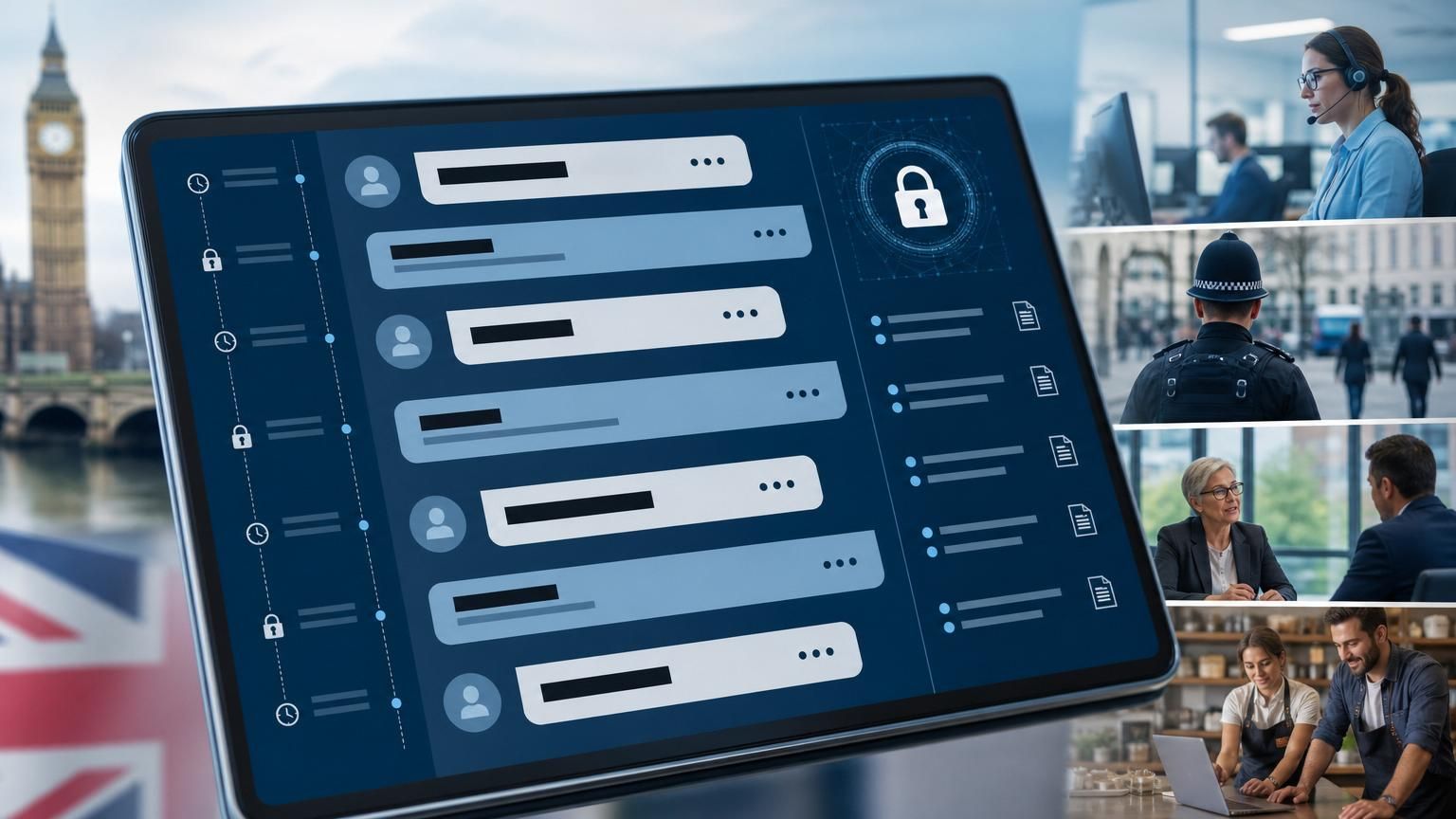
Why ‘evidentiary’ chat is the next support priority for UK regulated teams
Regulated organisations — police forces, councils, housing associations and NHS trusts — already treat case notes, emails and forms as potential evidence. Live chat is now the missing piece: it can capture the first contact, statements, and consent in real time, but only if implemented with verifiable controls and auditability.

This post explains how to design hybrid AI live chat as an auditable, UK-hosted evidence channel and why RAG-backed hybrid systems are the right tool for the job. Practical checklists, technical controls and a procurement lens are included for UK public-sector and regulated buyers.
The problem: chat is useful — but fragile as evidence
- Chat transcripts are mutable in many products: edits, exports and partial logs break chain-of-custody.
- Pure LLM answers can hallucinate or fail to cite sources, which is unacceptable when a record must stand up to scrutiny.
- Rule-based bots can produce rigid, unhelpful interactions that frustrate real people and miss nuance.
These risks create real legal, FOI and investigatory exposure for public bodies unless chat is engineered to be auditable, timestamped and hosted under clear UK data policies.
Three chat architectures — and which one proves evidence
Rule-based chatbots
Rule-based bots use scripted flows and decision trees. They are predictable and simple to audit for logic, but they cannot synthesise new answers from documents and struggle with ambiguous or evolving queries.
When your priority is strict, deterministic prompts (e.g., form-filling, basic signposting), rule-based bots are still useful — but they lack the knowledge depth and citation ability required for evidentiary answers.
Pure LLM chatbots
Large language model (LLM) bots generate fluent replies from model weights. They can synthesise, paraphrase and converse naturally — but they can also hallucinate, give inconsistent justifications, and do not inherently record provenance for their outputs.
Pure LLM chat is fast and flexible, but without retrieval and provenance it won’t satisfy regulated audit needs. ()
Hybrid AI live chat (the evidence-grade option)
Hybrid AI pairs retrieval-augmented generation (RAG) with human-in-the-loop workflows and immutable logging. That combination:
- Grounds answers in indexed documents and returns source pointers.
- Uses human agents to verify, redact or escalate sensitive material.
- Records every action (retrievals, model prompts, agent edits, timestamps) to create a verifiable trail.
RAG makes generative responses accountable by attaching the retrieved source snippets the model used to compose the reply. That’s the technical difference you need for evidence-grade outputs. ()
Minimum technical law-and-procurement checklist for UK-hosted evidentiary chat
Short, procurement-ready checklist for an RFP or internal requirements document:
- UK hosting and data residency assurances: single-tenant or UK-region cloud with export controls and clear data centre locations. Refer to Cabinet Office and multi-region guidance for public bodies when scoping hosting requirements. (gov.uk)
- Immutable audit logs: write-once logs for each chat session including timestamps, agent IDs, system prompts and retrieval fingerprints.
- Source provenance: every AI-sourced reply must include the document IDs or URL fragments used by the retriever.
- DPIA and ICO alignment: documented data-protection impact assessment and AI-specific controls consistent with ICO guidance. (ico.org.uk)
- Human handoff rules: escalation thresholds, consent capture and automatic redaction flags for PII-sensitive content.
- Export formats: secure PDF/CSV/EDRMS exports preserving metadata and cryptographic checksums for chain-of-custody.
- Retention policies mapped to FOI and policing schedules with legal hold capability.
How hybrid workflows convert chat into admissible records — a practical flow
- Visitor opens chat. Identity/consent is captured and timestamped on arrival.
- AI triage (RAG) searches indexed policy, case notes and public guidance and returns candidate sources to the agent interface. The retriever stores source IDs and vector fingerprints. ()
- Agent reviews AI draft, edits for clarity, and records the decision to accept, amend or reject the AI suggestion.
- Final chat transcript — with embedded source references, agent sign-off, redaction markers and cryptographic checksum — is stored in a UK-hosted archive and linked to the case file.
This flow gives you a human-verified, machine-accelerated record that is both operationally useful and defensible.
The commercial case: why regulated teams should prioritise evidence-grade chat now
- Evidence-grade chat reduces investigation time and improves case continuity across teams by giving investigators an immediate, verifiable starting point.
- It reduces repeat contact: agents spend less time re-collecting facts when a high‑quality, source-backed transcript is available.
- It preserves public trust: transparent provenance and UK hosting improve FOI responses and reassure vulnerable users.
Operational studies and academic work show that chat improves case capture and conversion of enquiries into outcomes; that uplift is even more valuable when each interaction becomes a verifiable record. ()
Implementation pitfalls and how to avoid them
- Do not rely on LLM outputs alone for statement capture: always require human sign-off for any legally sensitive content.
- Don’t export raw model prompts as the official record — store the final, agent-approved transcript with linked retrieval IDs.
- Avoid hosting ambiguity: procure explicit UK-region hosting and SLAs for data export and deletion.
Quick procurement-ready acceptance tests
Ask shortlisted vendors to demo these five scenarios using real (but anonymised) documents:
- Show an AI answer with cited source IDs and an agent sign-off.
- Produce a timestamped transcript with cryptographic checksum.
- Perform an emergency legal-hold export for a given chat session.
- Demonstrate redaction and consent capture live.
- Show how the system stores and surfaces the retrieval provenance used to answer a query.
If a vendor can’t show these in a 30‑minute demo, mark them down.
Where to start: pragmatic next steps for UK teams
- Run a single-service pilot (one council department, one police contact centre) to validate the audit trail and retention mapping.
- Build a DPIA focused on AI retrieval, redaction and consent flows aligned to ICO guidance. (ico.org.uk)
- Require RAG provenance and human handoff as non-functional requirements in your SOW.
IMSupporting already exposes RAG-based agent knowledge and hybrid AI chat workflow features that map directly to the controls above — review their RAG feature page and workflow capabilities as part of your procurement pack. https://imsupporting.com/feature-rag-based-ai-agent-knowledge.php https://imsupporting.com/feature-hybrid-ai-chat-workflows.php
Live chat can be more than convenience. When engineered correctly it becomes a defensible, evidence-grade channel that shortens investigations, improves FOI transparency and maintains public trust.
For a procurement-ready discussion and a demo of UK-hosted hybrid AI chat that preserves provenance and auditability, contact IMSupporting and see how their hybrid AI workflows and RAG features solve these exact problems: https://imsupporting.com/
Final checklist (30-minute readiness review)
- UK-region hosting confirmed and SLAed.
- Immutable audit logs, exportable with checksums.
- RAG provenance attached to every AI suggestion.
- Human-in-loop acceptance for sensitive content.
- DPIA aligned with ICO guidance completed.
When those boxes are ticked, live chat stops being a liability and becomes your frontline evidence channel.