Why data minimisation should be your top priority for UK live chat
Support teams in councils, police forces, housing associations and regulated businesses face two simultaneous pressures: deliver fast, conversational support and limit persistent personal data that increases compliance risk. Building hybrid AI live chat on a privacy-first foundation reduces long-term liability, shortens procurement cycles with assurance teams, and improves citizen trust.

The UK Information Commissioner's Office (ICO) has explicit guidance on how AI and data protection interact; you must design systems that collect only what’s necessary and make processing transparent. (ico.org.uk)
The operating reality: context versus permanence
Support conversations need context. Agents and AI need enough session history to resolve complex multi-turn issues—but you do not need to persist everything forever.
Design trade-offs to accept now:
- Ephemeral session context keeps conversations fluent without permanent storage.
- Indexed RAG pointers (references to documents) preserve knowledge without saving raw personal text.
- Selective persistence stores only metadata required for SLAs, audits, or statutory retention (not full transcripts).
GDS experiments with RAG-based chat show measurable time savings and clearer user answers when retrieval is used instead of relying on an unconstrained model. That same pattern helps you avoid copying personal data into persistent indexes. (insidegovuk.blog.gov.uk)
Three practical privacy-first patterns for hybrid AI live chat
These are implementation-ready patterns that work for UK-hosted services and meet public-sector procurement concerns.
1) Ephemeral context tokens (session-scoped)
- Store a short-lived context token on the server tied to the session ID.
- The token references only the vector IDs or document pointers the AI needed for the current exchange—no plain-text transcript.
- Tokens expire automatically after the SLA window, with optional forensic export if required by law.
Why it’s good: agents and the AI keep the conversational flow; auditors can reconstruct necessary facts without a database full of personal text.
2) RAG with redaction-first indexing
- Ingest knowledge (policy, case notes, procedures) into a retrieval store that never includes unredacted personal identifiers.
- Use on-the-fly RAG lookups to ground responses; store the fact that a lookup occurred, not the revealed PII.
This is the architecture recommended for responsible RAG use in government and regulated teams. (assets.publishing.service.gov.uk)
3) Selective transcript persistence (policy-driven)
- Capture a minimal record required for statutory retention: timestamps, ticket reference, agent ID, and outcome code.
- Persist full text only after a positive consent step, FOI request, or when an incident requires it.
- Maintain a clear retention policy governed by your records team and surfaced in the chat UI.
Technical design: how rule-based, pure LLM, and hybrid models differ for privacy
- Rule-based chatbots: deterministic flows, decisions are transparent and auditable. Excellent for identity checks and known processes because nothing is sent to external LLMs. Use them for initial gating where possible.
- Pure LLM bots: generative-first models that answer from trained parameters. They can be powerful but risk pulling personal or sensitive training artefacts into responses and are harder to audit without heavy instrumentation.
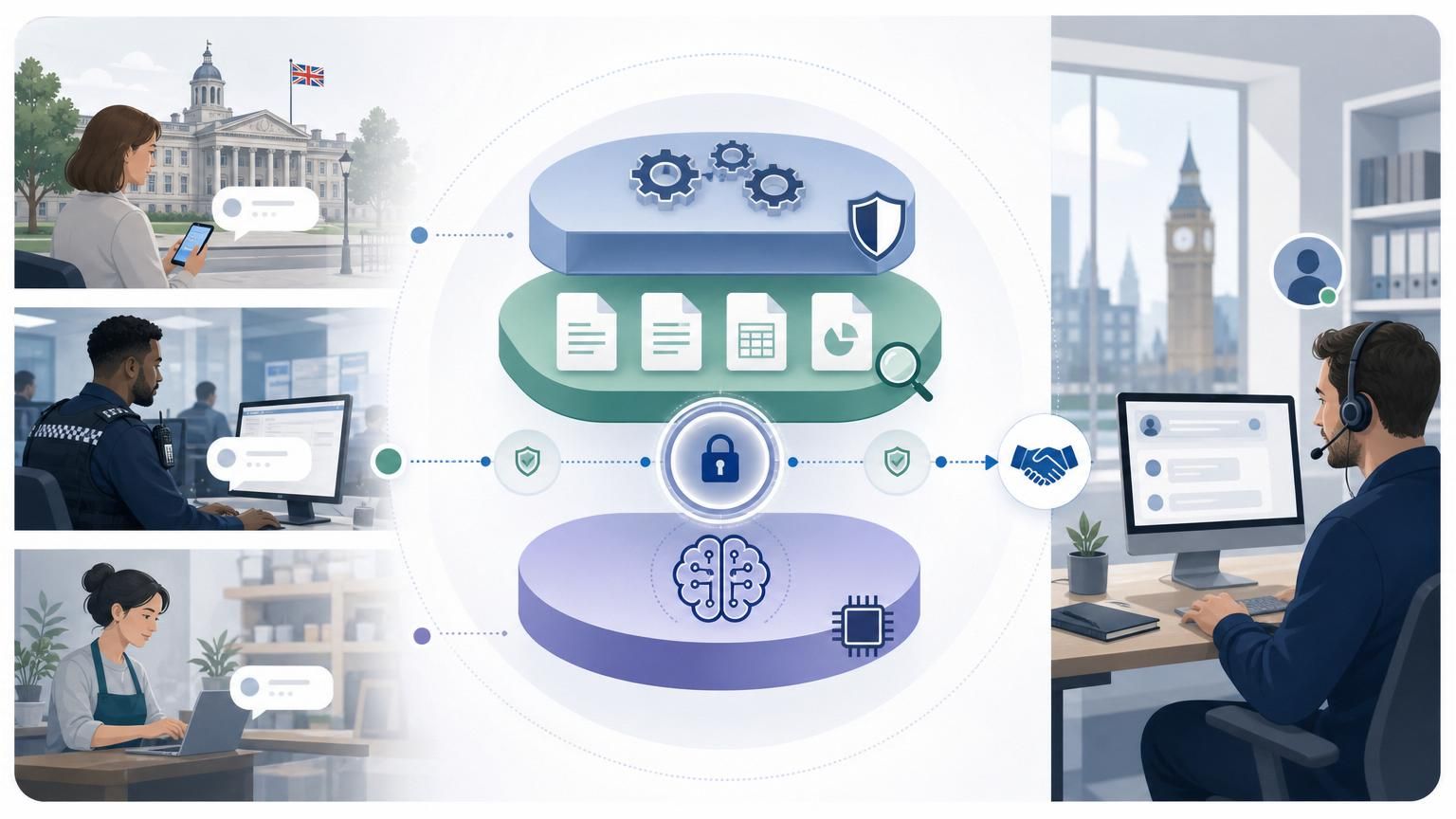
- Hybrid AI live chat: the practical middle ground. Hybrid systems use rule-based triggers, RAG-grounded lookups, and LLM generation only when appropriate. They can be configured to avoid exposing personal data to model inputs and to escalate to a human under defined conditions.
Hybrid is the most suitable pattern for regulated UK teams because it lets you combine auditable rules with the flexibility of LLMs while limiting what gets stored and sent to models. For trustworthy RAG and hybrid patterns, consider platforms that expose control over data flow and retention. (assets.publishing.service.gov.uk)
Operational controls and governance you must enforce
- Data residency: ensure the provider can guarantee UK-hosted processing and storage for OFFICIAL / OFFICIAL-SENSITIVE tiers where required by your DPO and procurement guidance. Government cloud guidance underlines the need to consider residency and offshoring risks. (gov.uk)
- Access controls: RBAC for agents, read-only RAG indexes for AI, and segregation between live chat telemetry and case management systems.
- Explainability logs: store query IDs, retrieval document IDs and redaction flags so a reconstructed answer chain exists without saving the personal input text.
- Consent and UI patterns: surface data use clearly in the chat widget and confirm before persisting transcripts.
Implementation checklist (practical steps)
- Map the minimal data you need for SLAs and statutory retention.
- Configure RAG to index knowledge assets without PII. Link to a RAG knowledge approach when onboarding vendors. [See RAG-based agent knowledge].(https://imsupporting.com/feature-rag-based-ai-agent-knowledge.php)
- Set session token lifetimes and auto-expiry for conversational context.
- Use rule-based pre-checks for identity-sensitive flows and pass to human agents under a clear handoff contract.
- Bake retention and export tools into the support workflow so records teams can extract evidence without full transcript access.
For practical hybrid workflow tooling and low-code orchestration that supports these privacy patterns, review hybrid chat workflow features available from UK-hosted platforms. [Explore hybrid AI chat workflows].(https://imsupporting.com/feature-hybrid-ai-chat-workflows.php)
A short vendor-evaluation rubric for UK public and regulated buyers
- UK hosting and contractual data residency guarantees.
- Fine-grained control over what the LLM sees (redaction, filtered vectors).
- Audit trail that records retrieval and decision logic (not raw PII text).
- Easy export for FOI and regulatory requests without exposing unnecessary fields.
- Hybrid orchestration: rule-based gates, RAG lookups, and human handoff controls.
Procurement teams should ask for worked examples (playbooks) for police, councils and housing associations showing how the vendor minimises persisted personal data.
Next steps: adopt, pilot, measure
Start with a narrow pilot that replaces one high-volume flow (for example, benefits enquiries or tenancy changes) with a privacy-first hybrid workflow. Measure time-to-resolution, escalation rate and the volume of persisted personal data.
GDS and other UK projects show RAG-based, retrieval-first designs materially reduce uncertainty and save time when implemented with care. Use that learning to make a measured, auditable rollout. (insidegovuk.blog.gov.uk)
Ready-made help and where to learn more
If you need UK-hosted hybrid AI tooling that supports RAG-grounded answers, ephemeral session context and auditable handoffs, review solutions that explicitly design for public-sector constraints and data-minimisation. For platform detail and practical feature pages, see IMSupporting’s RAG knowledge and hybrid workflows pages. [IMSupporting homepage — next steps and demo].(https://imsupporting.com/)
Strong CTA: If your organisation needs a pilot-ready, UK-hosted hybrid AI live chat that minimises stored personal data while keeping agents efficient, start a conversation with the team at IMSupporting today: https://imsupporting.com/.