
Why treat live chat as an orchestration layer — not just a front door
Live chat is no longer only a channel for quick questions. For UK councils, housing associations, police teams and regulated services it can become an active orchestration layer that: collects minimal evidence, pre-populates case records, applies local policy rules and routes next steps securely across teams. That reduces costly handoffs, removes duplication, and produces auditable trails for regulators.
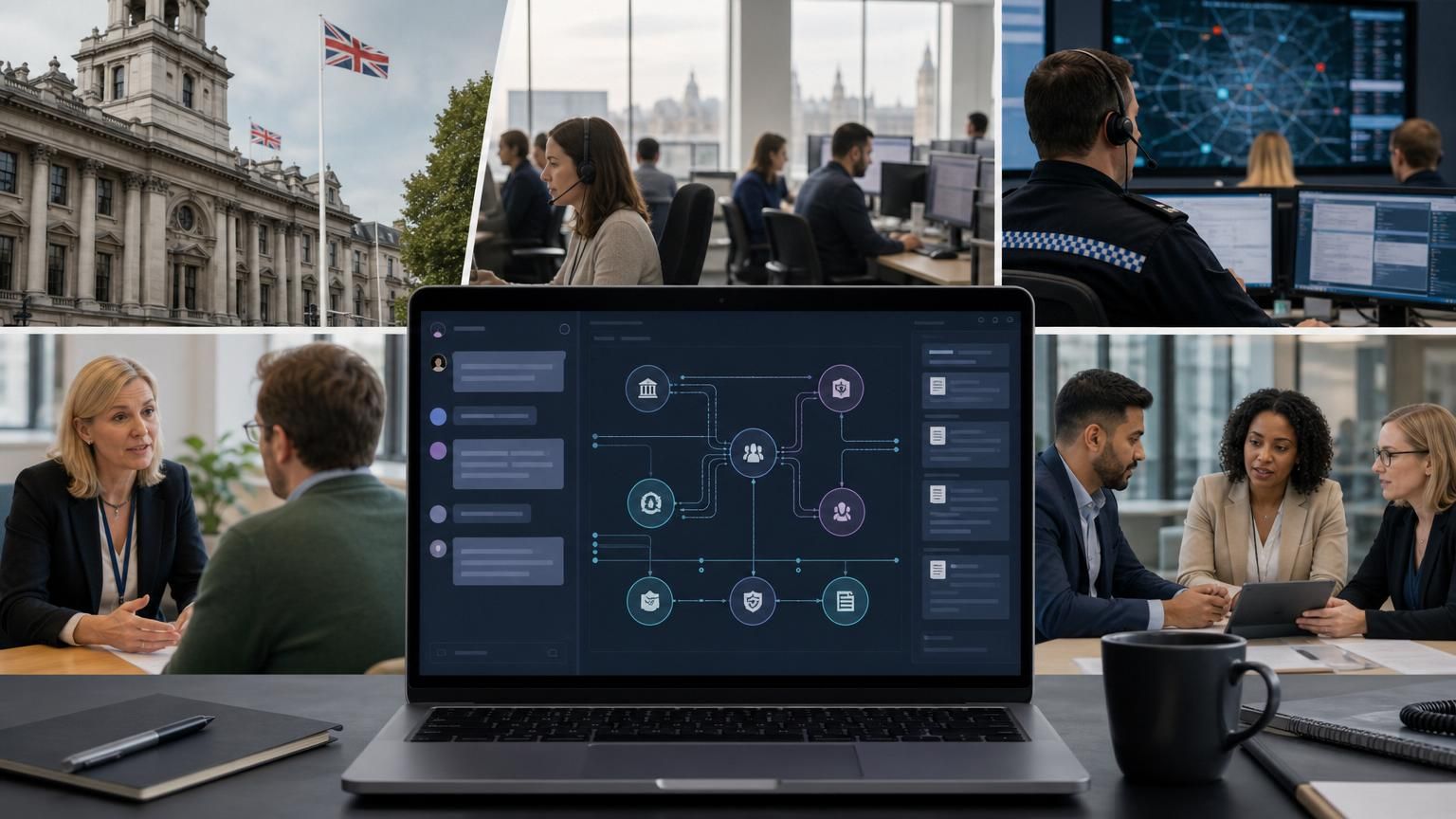
This article explains how to build that layer using hybrid AI (RAG-backed knowledge + human oversight), what to avoid, and how UK-hosted architecture and operational controls make it procurement-safe for public services.
The technical stack you actually need
- Retrieval-Augmented Generation (RAG) — indexes documents and returns precise evidence snippets the AI can use as context. (en.wikipedia.org)
- Hybrid chat workflows — rule engines and task-orchestration that let AI triage and assemble case bundles, then hand off to the right team with metadata. (See hybrid AI chat workflows.)
- UK-hosted data stores with strict access controls and retention policies to meet UK GDPR and public-sector procurement expectations. The ICO has published guidance on AI and data protection that teams must follow. (ico.org.uk)
Key functional capabilities to demand
- RAG-based agent knowledge so the bot answers from indexed local policies and documents, not global LLM memory. See how RAG is purpose-built for this. (en.wikipedia.org)
- Policy-coded routing that maps queries to legal/operational rules.
- Granular consent capture and lawful-basis selection captured inside the chat workflow for audit.
- Case-bundle pre-assembly: attachments, timestamps, provenance, and a short decision log before handoff.
If you want a product blueprint, review IMSupporting’s RAG and hybrid-workflows features for a practical reference. https://imsupporting.com/feature-rag-based-ai-agent-knowledge.php and https://imsupporting.com/feature-hybrid-ai-chat-workflows.php
Rule-based chatbots vs pure LLM bots vs hybrid AI: what each actually delivers
- Rule-based chatbots: deterministic, fast, auditable. Good for form-filling and fixed decision trees but brittle with unstructured questions.
- Pure LLM bots: flexible, conversational, but prone to hallucination and lack provenance. Not acceptable alone for regulated, audit-sensitive interactions.
- Hybrid AI live chat: uses RAG or a retrieval layer to give LLMs factual documents as context, plus workflow rules that escalate to humans when complexity, legal risk or empathy is required. This is the only approach that balances responsiveness and verifiable evidence at scale. (en.wikipedia.org)
How orchestration reduces cost and risk — the operational case
When hybrid AI pre-populates case bundles and applies routing rules, it reduces the cognitive load on agents and speeds up resolution. For multi-agency workflows this means:
- Fewer transfers between teams (lower MTTR and less paper-trail fragmentation).
- Consistent evidence capture across departments that respond to FOI, SAR or audit requests.
- Faster identification of sensitive cases that must be diverted to human-only handling.
GOV.UK guidance for using chatbots and webchat highlights transparency, usability and the need to design for handoffs — a clear signal that orchestration must be planned, not bolted on. (gov.uk)
Design patterns for multi-agency orchestration (practical)
- Minimal data first: start with the least personal data required to triage. Collect additional details progressively after lawful-basis capture.
- RAG-backed fact injection: pull policy paragraphs, statute excerpts and local guidance into the AI response so human agents see the evidence used.
- Metadata-first handoff: attach route code, risk score, consent record, and retrieved document IDs to the ticket.
- Cross-team routing matrix: encode responsibility mappings (e.g., housing, benefits, enforcement) so the chat automatically chooses the right team and SLA.
- Audit snapshots: freeze a transcript + document bundle when sensitive actions occur.
These patterns produce consistent outcomes and make procurement/compliance reviews straightforward.
Security, sovereignty and governance — the UK specifics
UK public-sector buyers must see three things to sign off on hybrid AI:
- UK hosting and clear data residency.
- Demonstrable compliance with ICO guidance on AI and data protection. (ico.org.uk)
- Full exportable audit bundles that a team can use in FOI or DPA responses.
Design the solution so all retrieval indices and logs are held on UK infrastructure, with role-based access and separation between indexing and model inference where possible. That separation simplifies audits and retention decisions.
Real-world workflows: short example
- User chats about a housing disrepair and uploads photos.
- Hybrid AI triages: extracts minimal contact and property reference, runs a RAG query to return the local repair policy snippet, and assigns a risk score.
- If the case is potentially urgent (risk score high), chat auto-routes to the on-call housing officer and packages the evidence bundle with timestamps and consent records.
- If not urgent, the chat schedules a follow-up and creates a low-priority case with a link to the retrieved policy paragraphs attached.
This reduces agent input, keeps handoffs clean and produces an auditable trail for regulatory review.
Procurement and roll-out tips for UK councils and regulated teams
- Require demonstrable RAG provenance: vector IDs, retrieval timestamps and document checksums in the export.
- Insist on hybrid workflows that allow instant human takeover and human-in-loop approval for sensitive decisions.
- Run a one-month pilot on a limited service area to measure handoffs, average handling time and audit response time.
National procurement reviewers and digital teams will expect evidence that solutions operate within UK legal frameworks — design your RFP around those needs and keep hosting explicit.
Where to start next (practical checklist)
- Map 3 high-volume multi-agency scenarios (e.g., homelessness + benefits, antisocial behaviour, licensing complaints).
- Identify the minimal documents that must be authoritative for those flows and build a retrieval index.
- Prototype a hybrid chat workflow that returns evidence snippets, captures consent, and hands off with metadata.
For a turnkey option that already supports RAG-based agent knowledge and hybrid chat workflows in a UK-focused deployment model, review IMSupporting’s feature pages and platform overview. https://imsupporting.com/feature-rag-based-ai-agent-knowledge.php and https://imsupporting.com/feature-hybrid-ai-chat-workflows.php. Also see the platform homepage for UK-hosting details: https://imsupporting.com/
Final takeaway and CTA
If your organisation operates across teams or agencies, the single biggest improvement you can make is to stop treating chat as isolated conversations and design it as an orchestration layer: RAG-backed facts + workflow rules + UK-hosted controls. That approach preserves trust, speeds outcomes and produces audit-ready records for regulated services.
Ready to move from theory to a procurement-ready pilot? Explore a UK-hosted hybrid AI live chat platform built for multi-agency orchestration and compliance at IMSupporting — start your pilot and keep control of data and auditability. https://imsupporting.com/