Why Policy-as-Code matters for UK public and regulated support
Policy-as-Code is the practice of converting legal, regulatory and organisational rules into machine-executable checks that run inside automation and AI workflows. For UK councils, police forces, housing associations and regulated teams, it turns vague compliance requirements into repeatable, auditable decisions inside live chat triage and agent handoffs.
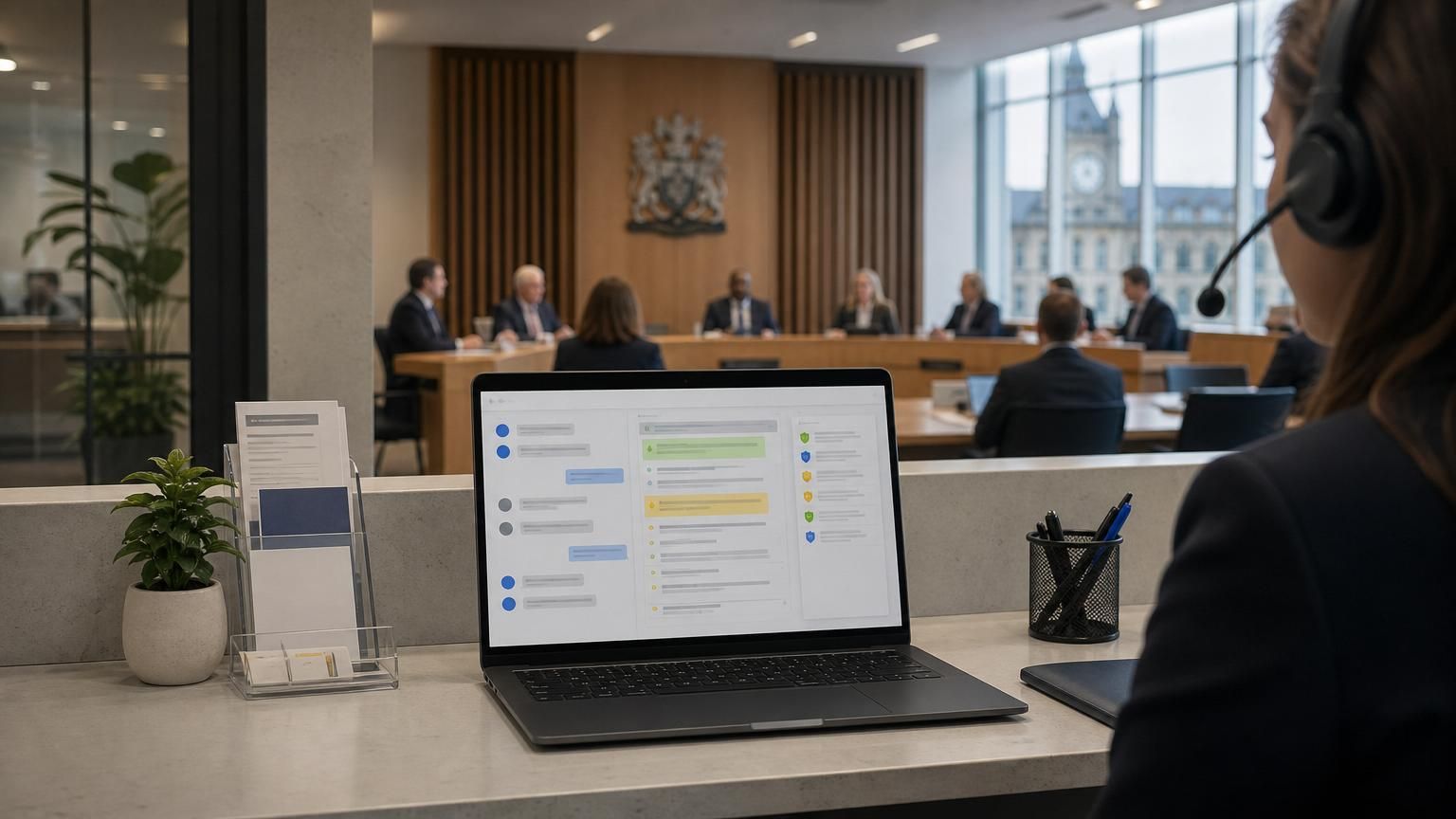
Policy-as-Code is not a novelty: it solves three persistent risks in live chat for regulated organisations — inconsistent answers, hidden data flows, and non‑auditable decisions. The right implementation keeps the conversation fast for users while giving compliance teams concrete traces and configurable controls.
Three short definitions every support leader must use
- Rule-based chatbots: scripted flows and decision trees that follow explicit if/then logic. Low risk, predictable, but brittle for open queries.
- Pure LLM bots: general large language models that generate natural answers from patterns in their training data. Flexible and fluent, but prone to hallucination, and hard to audit.
- Hybrid AI live chat: LLMs + retrieval (RAG) + deterministic policy checks + human agents. Hybrid stacks combine generative responses with knowledge retrieval and policy-as-code enforcement to produce grounded, auditable answers.
RAG (retrieval-augmented generation) explicitly pulls documents and facts into the model context so answers are grounded in source material rather than model memory. This reduces hallucination and creates an evidence trail for decisions. ()
Market context — why act now (UK-specific)
Adoption of AI across UK firms has risen sharply in recent years, meaning support teams must adopt guardrails quickly to stay compliant while improving service. The ONS and government research show a material increase in firms reporting AI use since late 2023. This shift means procurement and audit teams are now asking how AI decisions are controlled and evidenced. (ons.gov.uk)
Financial services and other regulated sectors are further ahead in embedding AI with controls — for example, many financial firms report high levels of AI usage and oversight practices that other sectors can adapt. ()
At the same time, UK cloud and multi-region guidance gives public bodies flexibility but requires thoughtful data jurisdiction and contractual controls — this matters when choosing a live chat vendor or hosting setup. Government guidance does not universally mandate UK-only hosting for OFFICIAL data, but you must follow the multi-region guidance and document risk decisions. (gov.uk)
How Policy-as-Code sits inside a hybrid AI live chat stack
Embed Policy-as-Code at two control points:
- Ingress checks (pre-answer): mandatory filters and routing rules that evaluate whether a chat contains sensitive content, special categories of data, or regulated requests. If flagged, the system triggers escalation, redaction, or stays in human-only mode.
- Response checks (post-draft): deterministic validators that run on model responses and retrieved citations. These checks assert compliance: data residency, citation present, no legal advice language, or required signposting to statutory routes.
Example micro-checks (expressed as plain rules):
- If message contains "access to records" or "FOI", require RAG-sourced citation to a policy doc and route to human agent.
- If user supplies personal data (NI, DOB), redact and switch to secure channel; log the event and require agent confirmation.
- If response asserts statutory timeframes, attach the source document and confidence score.
These micro-checks can be encoded as Policy-as-Code policies that run deterministically and are version-controlled.
Practical architecture: components and responsibilities
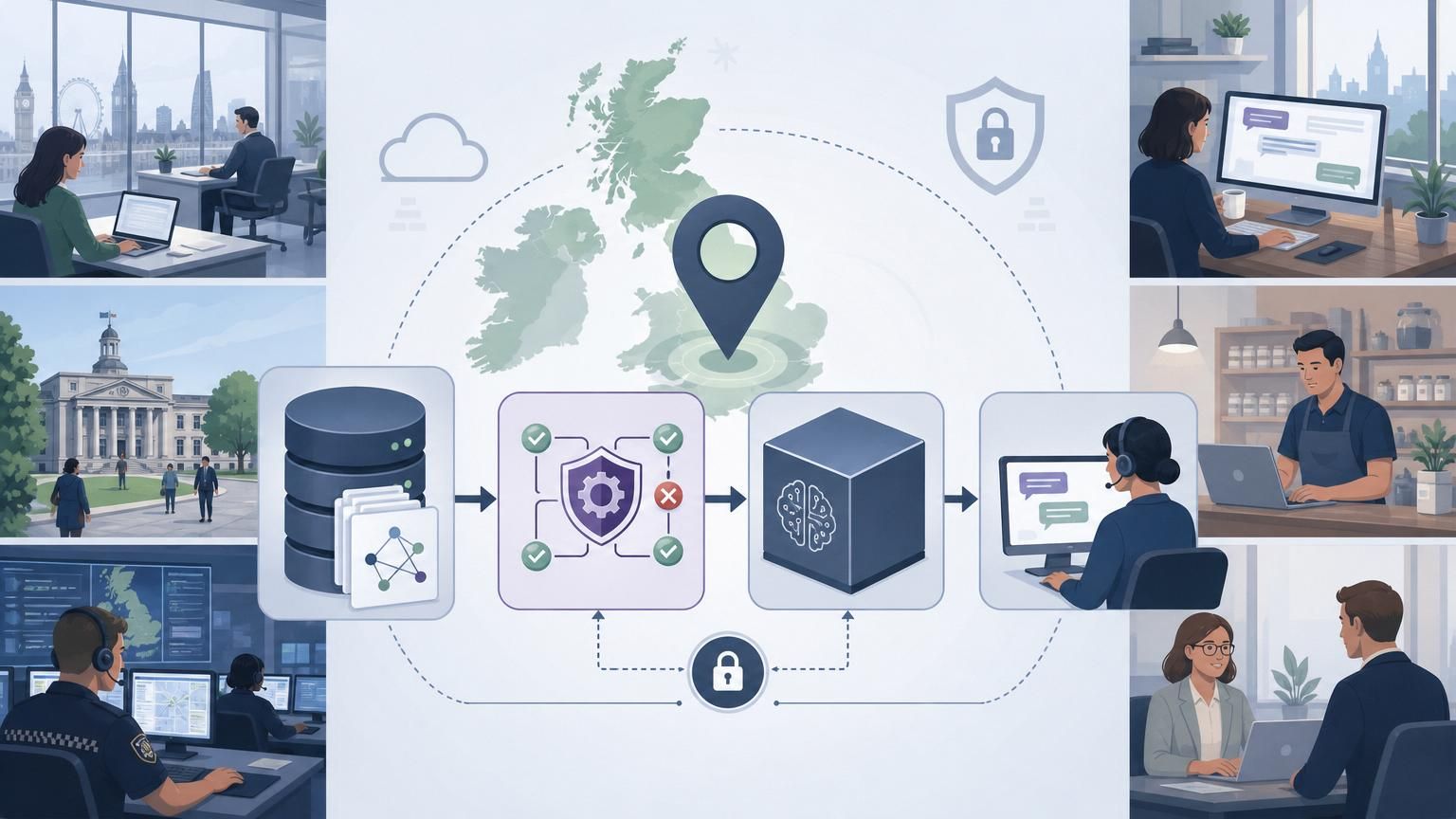
- UK-hosted document index (RAG store): all internal knowledge — policies, SOPs, statutory pages — indexed and stored in a UK region to meet data residency preferences.
- Policy engine: lightweight evaluation layer (policy-as-code) that checks incoming messages and outgoing drafts against encoded rules.
- LLM + RAG runtime: generates candidate answers using retrieved passages as context.
- Human agent layer: receives flagged cases or accepts AI-suggested drafts with inline citations and edit controls.
- Audit store: append-only logs of decision inputs, policy checks, citations, and agent handoffs for FOI, audits, or complaints.
IMSupporting supports RAG-backed agent knowledge and hybrid workflows suitable for these patterns — see their RAG feature and hybrid chat workflows for examples of how to implement retrieval and handoffs in practice. IMSupporting RAG feature | IMSupporting hybrid workflows
Five design rules for regulated UK orgs
- Host sensitive indexes in UK regions and record where each document lives. This simplifies data-mapping and procurement conversations. (gov.uk)
- Treat RAG citations as primary evidence — require the model to attach a citation every time a statutory claim is made. ()
- Encode the minimum set of policy checks as Policy-as-Code and put them under version control (change logs are your first line of defence in an audit).
- Use human-in-loop for edge cases: policy triggers must escalate rather than suppress human involvement.
- Keep an auditable, tamper-evident log of policy decisions, RAG sources, and agent edits to satisfy ICO and internal governance teams. (ico.org.uk)
Operational checklist before procurement
- Map the data types that will touch chat (personal, special category, law enforcement, housing case notes).
- Confirm hosting options and contract clauses for UK data residency and key management with prospective vendors. (gov.uk)
- Request examples of the vendor’s policy engine and version history for rules.
- Validate RAG behaviour: ask for sample responses showing attached sources and how the system reacts when no source is available.
- Run tabletop exercises with FOI and complaint scenarios to verify the audit trail.
KPIs that matter (not vanity metrics)
- Compliance hit rate: percent of conversations that passed policy checks without escalation.
- Escalation accuracy: percent of escalations that truly required human intervention.
- Time-to-evidence: median time to produce a citation and policy decision for audit requests.
- Reduction in complaint reversal: percentage drop in complaints where AI-provided answers were initially used.
A practical statistic to keep in mind: UK AI adoption is increasing year-on-year, so procurement teams are now asking for demonstrable controls and evidence trails rather than feature lists. (ons.gov.uk)
Final prescription — a 90-day rollout plan
Weeks 1–2: Policy inventory — collect top 20 regulations and public guidance documents you must reference.
Weeks 3–6: Index selection and RAG setup — host documents in a UK region and build retrieval pipelines. Test citation sourcing for 50 sample queries.
Weeks 7–10: Policy-as-Code implementation — convert 10 critical micro-checks to executable rules; integrate with your chat routing.
Weeks 11–12: Pilot with one service area (housing or FOI) and gather audit logs; run governance review and refine escalation thresholds.
Where to start now
If your procurement, legal or support leads need a UK-focused, auditable hybrid live chat platform that combines RAG-backed knowledge and policy-as-code controls, review practical product capabilities and deployment options with a provider that supports UK hosting and hybrid workflows. See how IMSupporting implements RAG-backed agent knowledge and hybrid chat workflows for regulated teams: https://imsupporting.com/feature-rag-based-ai-agent-knowledge.php and https://imsupporting.com/feature-hybrid-ai-chat-workflows.php.
Want a short, no‑nonsense demo that maps Policy-as-Code to your top three regulations and shows the audit trail in 30 minutes? Book a conversation and pilot at https://imsupporting.com/ — build trust into the chat layer before users rely on it.