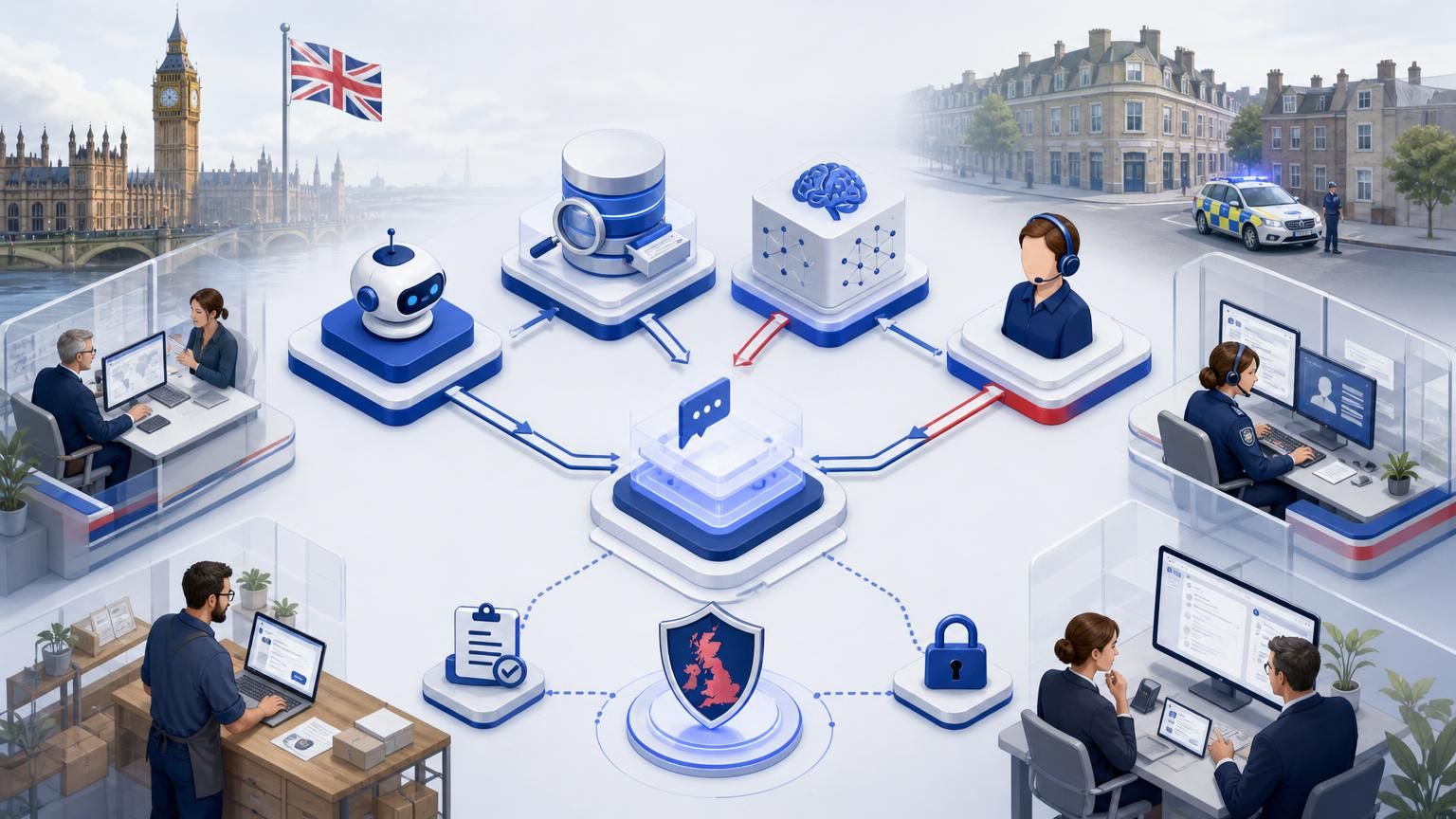
The idea in one line
Treat your chat widget as a programmable, policy-enforced "support mesh" that applies data-residency, SLA and escalation rules in real time — using hybrid AI (RAG-enabled LLMs plus human agents) to keep audit trails, speed up resolution and meet UK public-sector requirements.

Why a policy-driven support mesh matters now
UK public bodies and regulated organisations no longer accept chat as an informal channel. They need:
- Data residency and transfer controls that comply with ICO and UK government guidance. (ico.org.uk)
- Proven auditability and evidence trails for decisions and escalation.
- Fast, consistent responses without exposing sensitive records to black-box LLMs.
AI is already mainstream: adoption of AI across larger UK enterprises rose sharply in 2024–25, so architects now must embed governance into customer-facing AI — not bolt it on later. ()
Distinguish the three stacks: rule-based bots, pure LLM bots, hybrid AI
If you’re responsible for procurement or architecture, these distinctions matter for compliance and UX.
- Rule-based chatbots
- Deterministic flows (if X then Y). Great for simple, high-volume tasks (opening hours, form links).
- Low risk for data leakage but poor at handling novel or ambiguous requests.
- Pure LLM bots
- Large language models generate free-text answers from learned parameters. They can feel conversational but are often opaque, prone to hallucination, and risky for protected data unless tightly controlled.
- Hybrid AI live chat (the support mesh)
- RAG-backed retrieval for factual answers + LLMs for natural language + rules and human handoff. Provides grounded answers, source citations, and a dynamic policy layer that decides what stays in UK-hosted systems vs what can be queried externally. McKinsey and industry analysts position RAG as the pragmatic path to enterprise-grade generative AI because it keeps outputs grounded in your documents. ()
What a policy-driven support mesh actually enforces
Think of the mesh as a short policy engine, enforcement layer and orchestration fabric that sits between user, AI and human agent:
- Data residency gates: block, anonymise or route queries containing PII so they never leave UK-hosted infrastructure. (Required reading for public sector procurement and the ICO’s transfer rules.) (ico.org.uk)
- Sourceable answers: RAG fetches enterprise documents (contracts, case notes, policy PDFs) and returns answers with provenance to reduce hallucination. ()
- SLA-aware routing: escalate automatically to a specialist agent when time-to-resolution or compliance thresholds are near.
- Auditable handoffs: every automated reply, retrieval result and human intervention is recorded in an immutable case timeline for FOI, subject access requests or internal audit.
Practical blueprint: 6 steps to build it (UK-first)
- Map data residency requirements
- Classify chat data (public, internal, sensitive). Consult ICO and GOV.UK cloud guidance to decide what must remain UK-hosted. (gov.uk)
- Choose RAG as the truth layer
- Keep embeddings and vector stores on infrastructure you control; serve LLM prompts with retrieved context rather than dumping documents into an external model. McKinsey and 451 research recommend RAG for enterprise grounding. ()
- Implement a rule engine for policy decisions
- Simple, declarative rules (if dataset = sensitive then block external call; if user = council-staff then route to verified channel).
- Design graceful handoff patterns
- Use triage: AI handles fact-finding; humans handle empathy, legal judgement and edge-cases. Ensure session context is preserved to avoid repeated explanations.
- Record provenance and build exportable audit trails
- Store retrieval citations, redaction logs and handoff timestamps in case records that can be exported for review.
- Test with public-sector scenarios
- Run tabletop tests for police information requests, housing tenancy disputes and GDPR subject access flows.
Quick commercial lens: what you’ll measure
- First Contact Resolution (FCR) for routine queries should rise as RAG handles facts and agents focus on exceptions.
- Cost per resolution falls as agents spend less time looking up documents.
- Reduction in escalations for misinformation because answers include sources.
Stat: UK enterprise AI adoption jumped in 2024–25, increasing the urgency for governed customer channels; build governance first, features second. ()
Risks and how to neutralise them
- Hallucination risk: mitigate with RAG and strong retrieval quality checks. ()
- Data transfer exposure: keep vector stores and logs in a UK region and apply transfer risk assessments per ICO guidance. (ico.org.uk)
- Operational thrash at handoff: design momentum-preserving handoffs—capture intent, recent messages and agent notes automatically.
How IMSupporting maps to the support mesh (practical features)
IMSupporting provides two immediate building blocks for this approach:
- RAG-based AI agent knowledge
- Use a RAG knowledge layer so AI responses are sourced from your documents and systems rather than model parameters. See the feature overview for technical detail. [IMSupporting RAG agent knowledge].(https://imsupporting.com/feature-rag-based-ai-agent-knowledge.php)
- Hybrid AI chat workflows
- Pre-built workflows let you codify routing, data residency checks and SLA escalations into the chat flow. That reduces integration time and improves auditability. [IMSupporting hybrid AI chat workflows].(https://imsupporting.com/feature-hybrid-ai-chat-workflows.php)
Both features can be deployed on UK-hosted infrastructure, easing procurement and ICO concerns while giving regulated teams the auditability they need. Learn more on the product site. [IMSupporting main site].(https://imsupporting.com/)
Fast checklist for procurement and technical leads
- Require UK hosting and exportable logs in the contract.
- Ask for RAG as default: how are retrieval sources stored and referenced?
- Require redaction and transfer-risk assessment documentation.
- Test handoff flows with real case scenarios from police, councils or housing associations.
Final commercial recommendation (what to do this quarter)
- Run a two-week pilot using a small corpus of policy documents and a single regulated use-case (tenant repair queries, FOI triage, or custody records requests).
- Validate retrieval precision and audit export within the pilot.
- If satisfactory, expand to a staged roll-out with SLA-aware routing and a formal DPA addendum.
If you need a UK-hosted platform that already combines RAG knowledge with hybrid AI workflows and pre-built compliance controls, review IMSupporting’s product pages linked above and start a pilot with your compliance and DPO teams today. Visit https://imsupporting.com/ to book a demo and download technical notes.
Closing note
A policy-driven support mesh turns chat from a risky convenience into a controlled, measurable service channel — ideal for UK councils, police, housing associations and regulated SMEs that must balance speed with legal and audit obligations. The technical tooling exists now; the governance decisions are what separate a compliant deployment from a costly mistake.