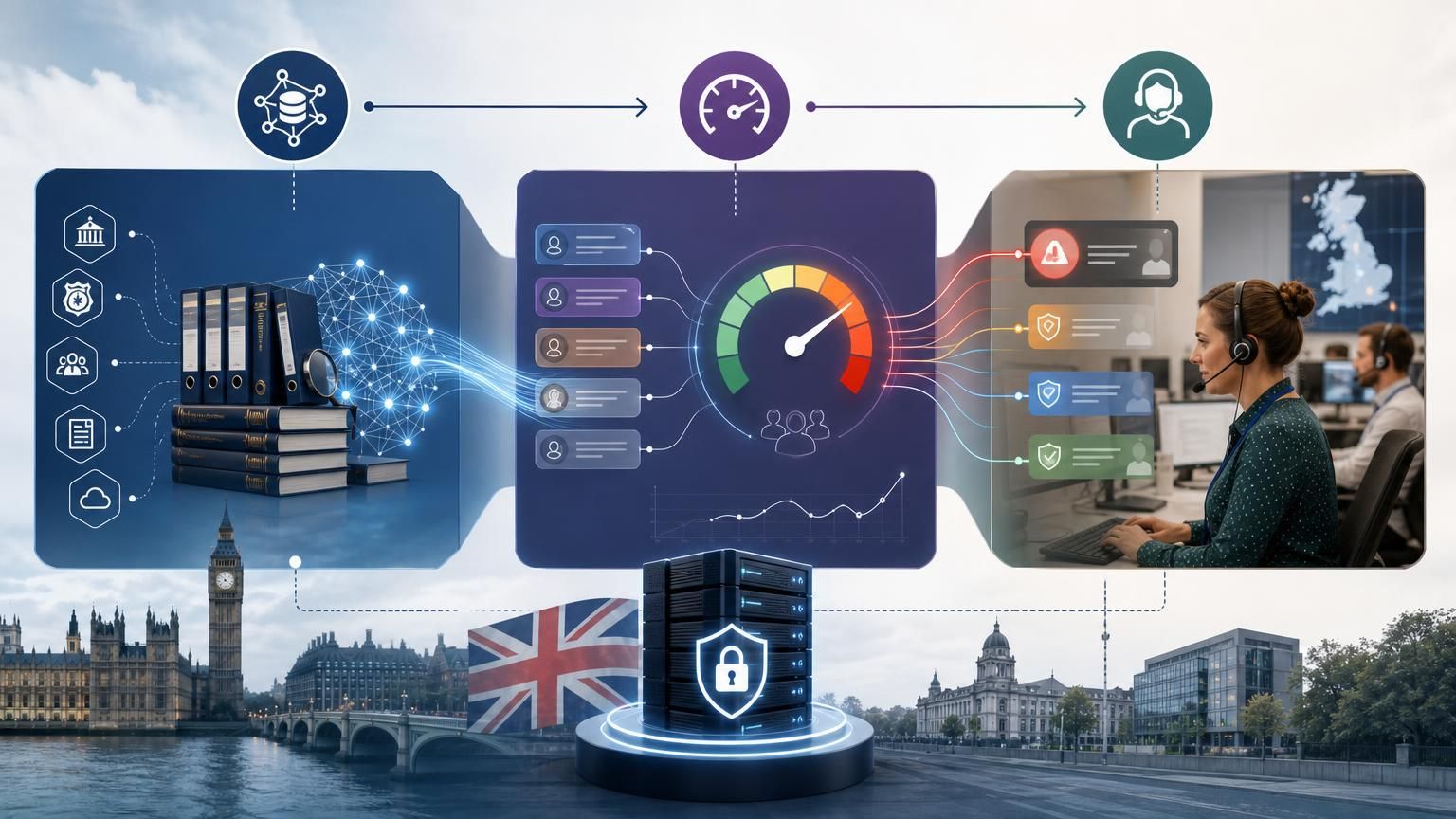
Why predictive escalation matters now
Predictive escalation turns live chat from a reactive channel into a strategic triage layer. Instead of treating every conversation the same, hybrid AI scores risk, intent and compliance needs in real time and reserves human specialists for cases where they deliver the most value — complex benefits claims, safeguarding reports, housing disrepair, and high‑risk policing enquiries.

This shift is practical: UK public‑sector teams face rising demand and strict audit requirements while budget pressure pushes organisations to do more with fewer senior agents. A focused escalation model preserves human time for cases that need judgement, empathy and legal accountability, while AI handles routine queries instantly.
A growing share of UK firms now use AI in parts of their business — adoption rose sharply over recent years — which makes designing predictable, auditable escalation essential for procurement and compliance. (ons.gov.uk)
Rule‑based, pure LLM and hybrid AI — clear differences
Understanding escalation means understanding three tool classes:
- Rule‑based chatbots: deterministic flows built from decision trees and scripted prompts. Reliable for simple transactions but brittle for off‑script questions.
- Pure LLM bots: large language models that generate fluent responses from patterns in training data. They deliver natural answers but can hallucinate, lack local knowledge, and raise data‑sovereignty concerns if hosted outside the UK.
- Hybrid AI live chat: the pragmatic middle path. Hybrid systems combine a UK‑hosted retrieval layer (RAG), a controlled model for instant answers, and deterministic policies that force human handoff when risk, sensitivity or legal threshold is reached.
Hybrid AI is the only approach suited to regulated UK organisations that must show auditable decision trails and keep personal data under UK law. See a practical RAG implementation for agent knowledge here: https://imsupporting.com/feature-rag-based-ai-agent-knowledge.php.
How predictive escalation works in practice
Predictive escalation is a three‑step runtime pipeline that runs inside the chat session:
- Fast triage and fingerprints
- On first user message, the hybrid AI performs a micro‑RAG lookup against curated UK knowledge bases (policy, forms, legislation), and extracts structured signals: named entities, sentiment, keywords (e.g., "safeguarding", "benefit appeal", "hate crime").
- Risk & complexity scoring
- The system computes a risk score using rule tiers (policy triggers), lightweight LLM inference for nuance, and historical outcome models (which chats required human escalation previously).
- Decision & action
- Low risk → AI provides an instant, auditable answer.
- Medium risk → prompt the user for structured info and offer a scheduled human callback.
- High risk or legal threshold → immediate handoff to an on‑duty human specialist with a packed, redacted evidence package.
This flow preserves auditability because every RAG retrieval, rule check and LLM output is logged and versioned. Hybrid chat workflows like these are available as built features in mature UK‑hosted solutions. See https://imsupporting.com/feature-hybrid-ai-chat-workflows.php for workflow examples.
Why micro‑RAG matters for predictive scoring
Micro‑RAG ensures the hybrid model fetches the exact clause, form or council policy needed to decide whether a case must escalate. It prevents free‑text hallucination and supplies the legal anchor for an audit trail. For UK public bodies, that anchoring is critical to pass FOI requests, internal audits and court scrutiny.
Design patterns for safe escalation in the UK public sector
Use these practical patterns when you build predictive escalation:
- Policy triggers first: codify mandatory escalation triggers (safeguarding, criminal allegation, homelessness, serious complaints) into rule sets the AI cannot override.
- Data minimisation at handoff: include the minimum required facts, redact unnecessary identifiers and keep full transcripts in UK‑hosted, access‑controlled storage.
- Agent readiness levels: tag agents by qualification and legal authority; only authorised roles can accept high‑risk handoffs.
- Explainability tokens: when the AI suggests escalation, include the short rationale and the clause or policy that produced the decision (from RAG) for auditors.
- Handoff playbooks: automated checklists the human agent receives, to speed response and maintain consistency.
These patterns keep risk low and procurement confident — buyers can see the decision logic before purchase and ask for UK‑only hosting, audit logs and SLA clauses.
Measuring success: KPIs that matter
Move beyond vanity metrics. Track these KPIs to prove business and compliance value:
- High‑risk deflection rate: proportion of high‑volume, low‑risk chats fully handled by AI.
- Average time‑to‑escalation for high‑risk cases: should be measured in minutes for policing and safeguarding workflows.
- First‑contact resolution for medium‑risk queries after an AI–human workflow is used.
- Audit completeness: percent of escalations with a RAG source + rationale attached.
- Cost per handled case vs. baseline channel (phone/email).
Public bodies buying live chat want measurable reductions in specialist time without raising legal risk — these KPIs make that case to finance teams.
Security, governance and procurement notes
The ICO’s guidance on AI and data protection highlights lawfulness, transparency and data‑minimisation as core requirements for AI systems operating on personal data. UK organisations must be able to demonstrate lawful bases, DPIA outcomes and technical measures such as encryption and access controls. (ico.org.uk)
Procurement teams should insist on:
- UK‑only hosting and data residency guarantees.
- Exportable audit bundles (RAG traces, decision logs) for legal discovery.
- Clear SLAs for handoff latency and surge handling.
Government and industry research shows AI adoption in UK firms is increasing, but implementation quality — governance and skills — varies across organisations. Expect procurement to prioritise vendors who can prove both capability and compliance. (gov.uk)
Quick rollout checklist for councils, police and housing associations
- Audit: map top 20 call reasons and tag which must always escalate.
- Build: author RAG knowledge bundles from local policies and forms.
- Configure: set policy triggers and agent qualification tags.
- Pilot: run a 6‑week pilot on non‑sensitive services, then a controlled roll‑out to higher‑risk teams.
- Review: use audit logs to refine thresholds and retrain the retrieval index.
Final note and next step
Predictive escalation is the practical way to make hybrid AI live chat a core support asset for UK public sector and regulated organisations. It lowers operating cost, protects citizens and keeps evidence auditable when it matters.
If you need a UK‑hosted platform with RAG‑anchored agents and built hybrid workflows designed for public‑sector compliance, review IMSupporting’s hybrid chat features and RAG agent capabilities: https://imsupporting.com/ and https://imsupporting.com/feature-rag-based-ai-agent-knowledge.php. Ready to pilot? Speak to a specialist and get a controlled, auditable plan tailored to councils, police and housing teams: https://imsupporting.com/.