Why predict escalation, and why now?

Conversations that end up escalating are the hidden cost in every support centre: long handle times, duplicated evidence, frustrated citizens and fragile audit trails for regulated teams. Predictive escalation turns escalation from a last-minute scramble into a smooth, measurable handover — and that matters for UK businesses, councils, police teams and housing associations that must prove compliance and data sovereignty.
What is predictive escalation in hybrid AI live chat?
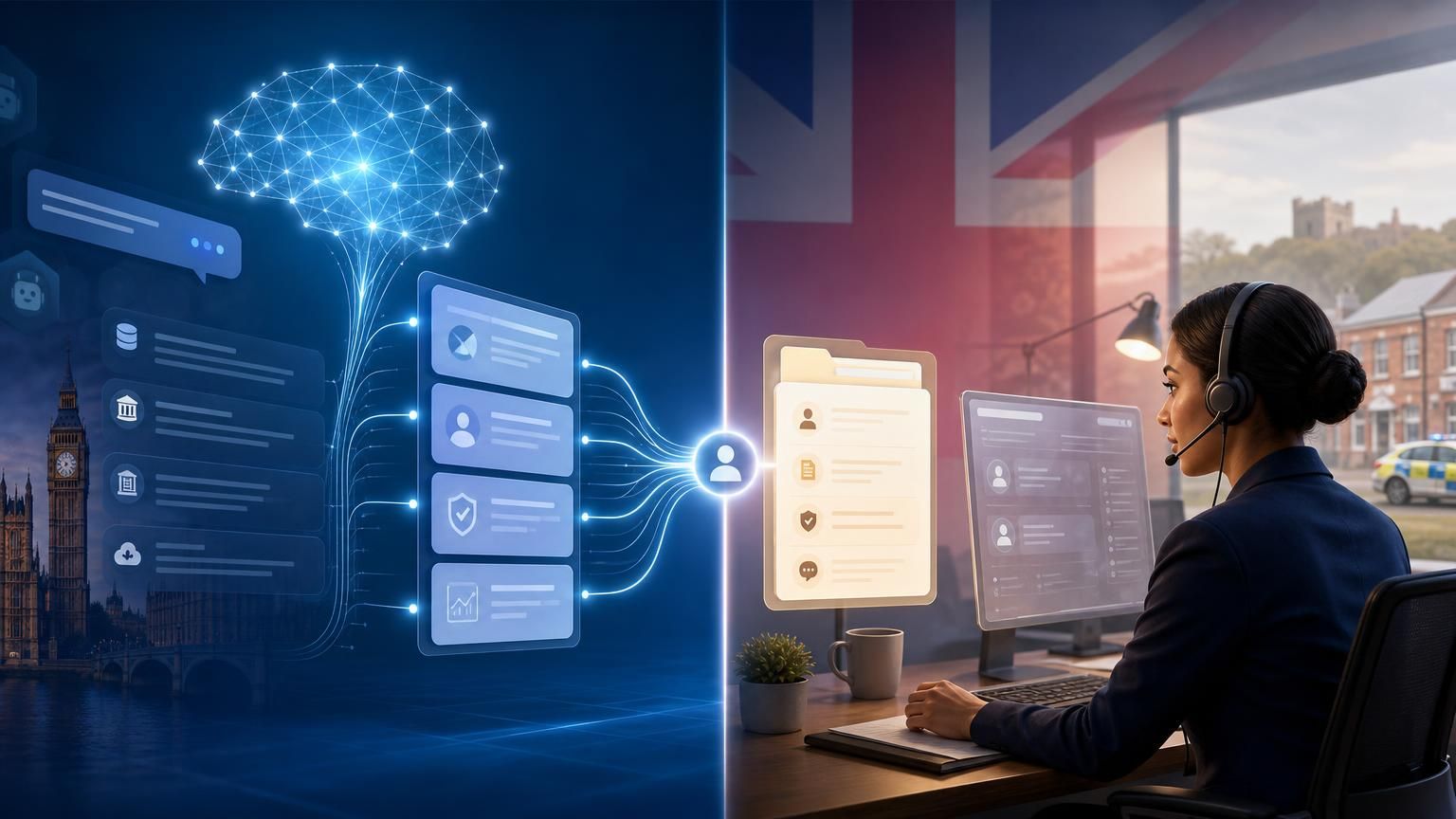
Predictive escalation is a hybrid workflow where AI scores an active chat for likelihood of human escalation, then automatically prepares a "pre-warmed" agent context pack: verified facts, RAG-sourced evidence snippets, user identity signals and suggested routing metadata. When the human agent takes over, they receive a compact, auditable case file so work doesn’t restart at square one.
This isn’t guesswork. Predictive signals are a mix of conversation patterns (sentiment drift, repetition), intent confidence thresholds, and back-office indicators (case age, policy flags). The result: faster diagnosis, fewer re-prompts, and stronger first-contact resolution.
Why this is a strategic play for UK organisations
- Public-sector teams must retain auditable trails and host sensitive content in the UK — predictive escalation minimises data exposure and collects only what’s needed before handover.
- Regulated sectors need defensible decision trails when a case escalates; pre-warmed packets create that trail automatically.
- Commercial support teams reduce average handle time (AHT) and agent rework while improving customer satisfaction.
Government and regulator attention to AI is accelerating; the UK has published a pro-innovation AI regulation approach and active guidance on AI and data protection that support careful, auditable hybrid deployments. (gov.uk)
How it works — the technical anatomy
Signals layer
- Real-time intent confidence from the chat model.
- Conversational heuristics (repetition, negative sentiment, request for human assistance).
- Backend flags: existing open cases, active warrants, benefits or tenancy flags.
Knowledge layer (RAG)
Retrieval-augmented generation (RAG) provides the grounding for pre-warmed context: short, authoritative snippets pulled from indexed policy docs, case law, internal knowledge bases and forms. Index only vetted, UK-hosted sources to avoid leakages and keep jurisdictional control. RAG best practices emphasise small, authoritative chunks and strict ingestion filters to reduce hallucination and PII leakage. ()
Orchestration layer (hybrid handover)
- If confidence < threshold, trigger a pre-warm: bundle user message history, matched RAG snippets, suggested actions and a compliance checklist.
- Route to the right skill group and include suggested SLAs and priority labels.
- When agent accepts, present the pre-warmed pack in the agent UI so there’s no need to re-ask.
This orchestration is exactly what modern hybrid AI workflows provide — see practical workflow features here. https://imsupporting.com/feature-hybrid-ai-chat-workflows.php
Rule-based bots vs pure LLM bots vs hybrid AI
- Rule-based chatbots: deterministic, low-risk for compliance but brittle for nuanced queries. Good for simple forms and T&Cs checks, poor at triage.
- Pure LLM bots: flexible and fluent, but without grounding they hallucinate and can expose sensitive data to external model providers if not carefully architected.
- Hybrid AI live chat: the pragmatic middle path. AI performs triage and pre-warms context using RAG indexes hosted under your control; humans retain final decision authority for complex or high-risk cases. This is the architecture UK public-sector teams should adopt because it balances agility with auditability.
For a RAG-centred knowledge approach that keeps the AI grounded in your documents, review feature-level details here. https://imsupporting.com/feature-rag-based-ai-agent-knowledge.php
Evidence it moves the needle
Peer-reviewed field studies of generative assistance in support centres show measurable productivity gains; multiple analyses report higher throughput and reduced AHT when agents receive AI assistance that complements, rather than replaces, human judgement. One large study observed productivity gains consistent with a ~14% uplift in resolved issues per hour after AI assistance. Another sector review recorded double-digit reductions in handle time when AI was used for triage and evidence retrieval. ()
Use conservative modelling when you build business cases: assume a modest 10–20% efficiency uplift from predictive escalation plus a reduction in rework and escalations that compounds over time as knowledge indexes improve.
Procurement- and compliance-friendly checklist
When you spec predictive escalation for UK procurement or internal purchase:
- UK hosting: insist the RAG index, logs and full audit trail are hosted in the UK and retained per your retention policy.
- Evidence minimisation: capture only required fields before handover and redact PII unless expressly permitted.
- Explainability: require admins to export the RAG sources used for any answer for audit review.
- SLA hooks: automatic priority tagging and SLA clock transfer on handover.
- Human-in-loop defaults: escalate to human on any request for legal, medical, policing or housing enforcement advice.
This procurement language makes the solution tender-ready while keeping it future-proof against evolving UK regulation. (ico.org.uk)
Implementation roadmap — 90 days to a working pilot
- 0–30 days: map sensitive routes and build a minimal UK-hosted RAG index of policy files.
- 30–60 days: deploy a hybrid triage bot, set predictive thresholds and start collecting pre-warm packets for agent feedback.
- 60–90 days: measure false positives/negatives, tune thresholds, expand indexed sources and add SLA handover automation.
Quick wins: reduce re-prompts by 30–50% on complex queries, slash post-handover wrap-up time, and produce instant audit trails for escalated cases.
Security, data sovereignty and governance
Keep everything that could identify a citizen in UK infrastructure and use dynamic data-minimisation: only index public policy and anonymised templates where possible. Apply ingestion filters and limit RAG retrievals to vetted documents to reduce hallucination and protect privacy. Architecture patterns that secure the RAG ingestion pipeline and enforce approval workflows are now well-established and essential for regulated organisations. ()
Next step — turn the theory into a secure pilot
If your team needs a UK-hosted hybrid AI live chat partner that builds predictive escalation and pre-warmed handovers into a compliant workflow, review practical feature details and request a pilot with full UK hosting and RAG-grounded knowledge: https://imsupporting.com/.
Book a demo or speak to a solutions architect to map a 90-day pilot and procurement-friendly specification. https://imsupporting.com/