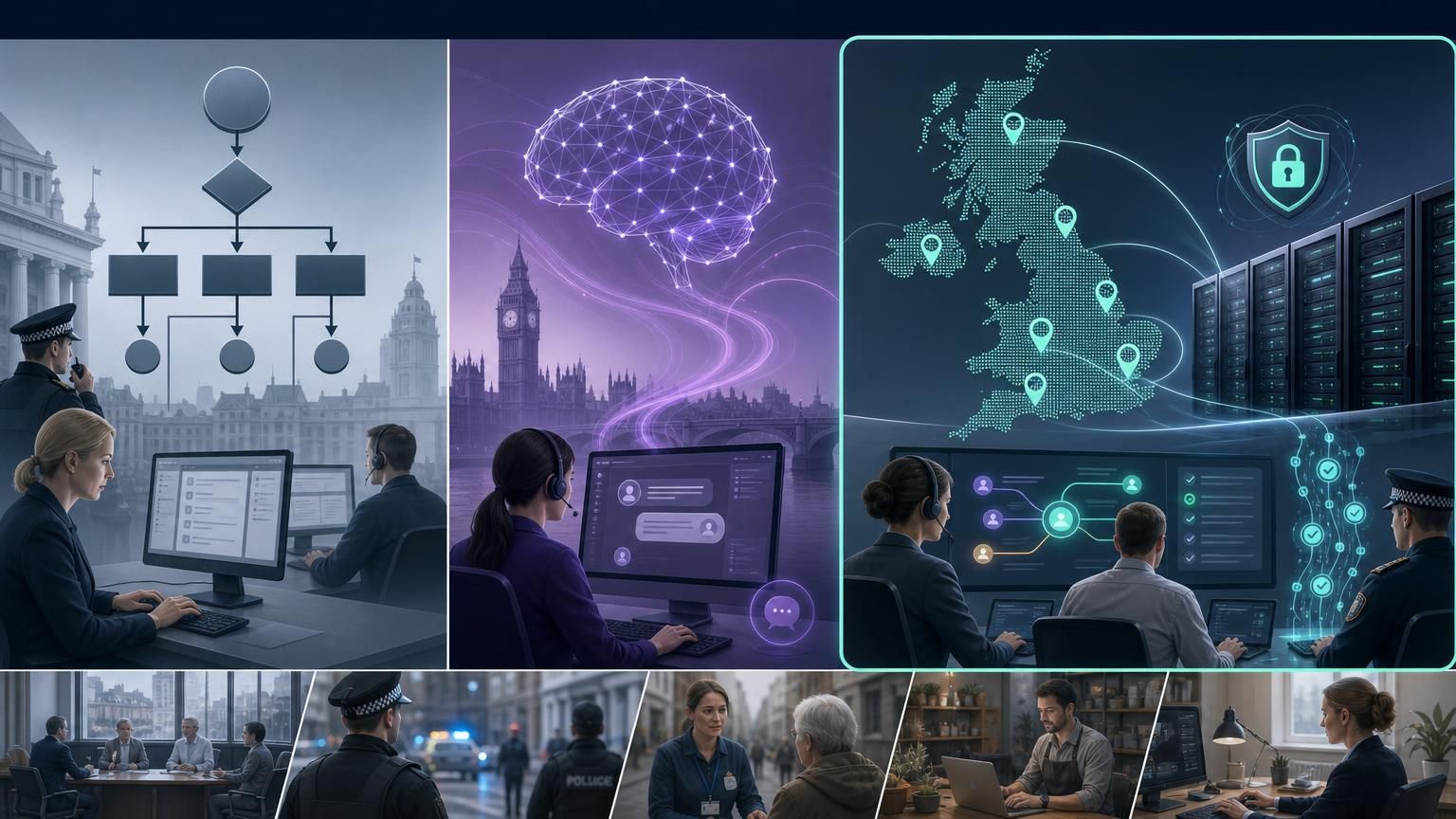
Predictive routing is the next strategic shift in live support
Predictive routing pairs customer intent analysis with hybrid AI triage so the first human agent sees the right case, with the right context, at the right time. For UK councils, police CAD teams, housing associations and regulated organisations this is not a novelty — it’s a practical lever to reduce handovers, accelerate SLAs and preserve auditability.
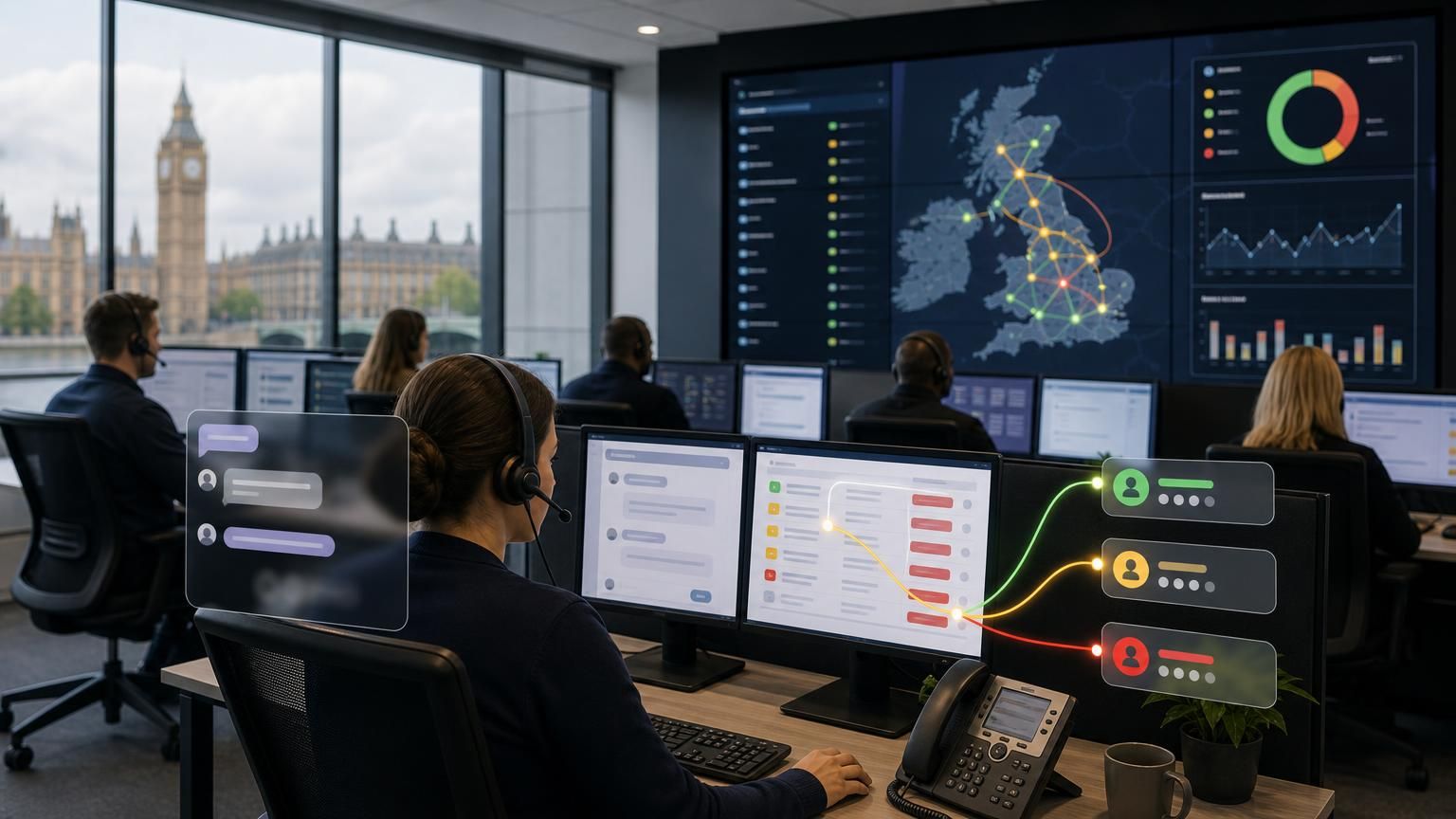
This post shows how predictive routing differs from simple bots, which technical patterns to adopt, and a practical rollout checklist you can use to measure ROI.
What predictive routing actually does — and the outcomes you can expect
Predictive routing uses live-chat data and short, explainable AI inferences to:
- estimate case urgency and complexity in seconds,
- attach the right knowledge snippets and risk flags to the conversation,
- route to the best specialist queue (or escalate to human follow-up) automatically.
Why it matters commercially:
- Faster first-response and fewer transfers increase resolution rates and lower assistant hours.
- Audit-ready triage decisions reduce compliance risk for regulated teams and give procurement confidence.
- Better routing raises citizen satisfaction and reduces repeat contacts — a crucial KPI for public services.
Quick stat: AI use in UK businesses remains cautious — around one in six organisations report using at least one AI technology today. (gov.uk)
Rule-based chatbots, pure LLM bots and hybrid AI — a clear technical distinction
If you run a support programme you must choose the right architecture. These three patterns behave very differently under pressure.
Rule-based chatbots
- Deterministic flows built from answers trees and hard rules.
- Predictable, auditable, low-risk — but brittle and poor at handling unexpected phrasing.
- Good for fixed forms, eligibility checks and simple FAQ automation.
Pure LLM bots
- Use large language models to generate free-text answers and soft routing decisions.
- Fast to prototype and conversational, but can hallucinate, produce inconsistent provenance and be hard to govern for regulated processes.
Hybrid AI live chat
- Combines LLM-based understanding with controlled knowledge layers (RAG), deterministic routing rules and human-in-the-loop handover.
- Provides the conversational benefits of LLMs while anchoring responses to auditable sources and policy logic.
- The sweet spot for UK public sector use: flexible, explainable, and privacy-conscious when hosted on UK infrastructure.
For RAG-powered, auditable knowledge and agent context, see IMSupporting’s RAG-based knowledge approach. RAG-based AI agent knowledge
How predictive routing works in a hybrid architecture (technical pattern)
Designing predictive routing requires three layers working together:
- Intent & risk classifier (fast inference)
- Lightweight LLM or supervised model that tags urgency, confidentiality flags, and likely subject.
- Must log provenance for every tag (who/what inferred it, timestamp).
- Policy & routing engine (deterministic rules)
- Rules map tags to queues, SLAs, and mandatory human checks.
- Risk thresholds switch behaviors (for high-risk cases: immediate human takeover; for low-risk: AI-assist with human oversight).
- Knowledge & context store (RAG + agent notes)
- Retrieve the small set of trusted documents, SOP lines and case history snippets the agent needs.
- Present the exact passage and a confidence score to the agent — not a free-text dump.
Combine these and you get fast, explainable routing without sacrificing human judgement or audit trails. For an example hybrid AI workflow pattern, see IMSupporting’s hybrid AI chat workflows. Hybrid AI chat workflows
Design considerations for UK-hosted, regulated environments
Public sector and regulated teams must bake compliance into the design:
- UK hosting and data residency: keep inference logs, conversation transcripts and provenance in the UK to simplify compliance and procurement.
- DPIA and governance: run a Data Protection Impact Assessment for predictive models and follow ICO guidance on AI and data protection. (ico.org.uk)
- Explainability and audit trails: capture the model’s score, retrieved knowledge IDs and the routing decision in machine-readable logs.
- Escalation policy: require human validation for flagged categories (safeguarding, crime, financial risk).
Practical public-sector use cases
- Police non-emergency portals: rapidly identify incidents that need immediate escalation to a district duty officer.
- Councils housing teams: triage repair vs safeguarding flags so the right team and urgency slot is assigned.
- Regulated financial advice helplines: detect regulated-advice intent and force human handoff with compliance notes attached.
Metrics and rollout checklist
Measure both operational and compliance outcomes.
Operational KPIs
- Triage time to correct queue: baseline vs week 4, week 12.
- Transfer rate: % of chats requiring >1 human handover.
- First-contact resolution and ASA for high-priority queues.
Compliance KPIs
- Percentage of routed cases with full provenance logs.
- Number of DPIA findings resolved before go-live.
- Audit query time: how fast you can reassemble the decision trail for any case.
Rollout checklist
- Start with a pilot queue (housing repairs, non-emergency police) with measurable SLAs.
- Limit AI autonomy to classification + recommended routes; keep final routing decision auditable and reversible.
- Train agents on the UI: show retrieved evidence, confidence scores and how to correct the model.
- Turn human corrections into controlled knowledge updates — closed-loop learning under governance.
Context note: adoption is uneven — some surveys show broader use of NLP and text-generation among adopters, but many UK firms remain cautious about full automation. Practical pilots and governance reduce political friction. (gov.uk)
Quick vendor selection checklist for UK public bodies and regulated teams
Look for:
- UK hosting and contractual commitments for data residency.
- RAG-backed knowledge controls and evidence-level retrieval.
- Configurable routing rules and per-conversation risk profiles.
- Machine-readable provenance and exportable audit trails.
- Clear DPIA support, templates and ICO-aligned guidance.
Why choose a purpose-built, UK-hosted hybrid AI workflow partner
Predictive routing is only valuable if it reduces human effort, preserves trust, and stands up to audit. UK-hosted hybrid AI vendors that combine RAG knowledge, configurable chat workflows and auditable handover are the pragmatic route to scale.
IMSupporting’s hybrid AI features combine RAG-backed knowledge and governed chat workflows to deliver predictable routing and auditable handovers — designed for UK councils, police teams and regulated organisations. Explore how their approach maps to the patterns above: https://imsupporting.com/ and review the RAG and workflow features in detail at the links above.
If your priority is cutting triage time, reducing escalations and keeping everything auditable and UK-resident, start with a scoped pilot that tests urgency detection, routing accuracy and provenance capture. Ready to design a pilot built for UK compliance? Visit https://imsupporting.com/ to learn how IMSupporting configures hybrid AI live chat for public sector and regulated teams.