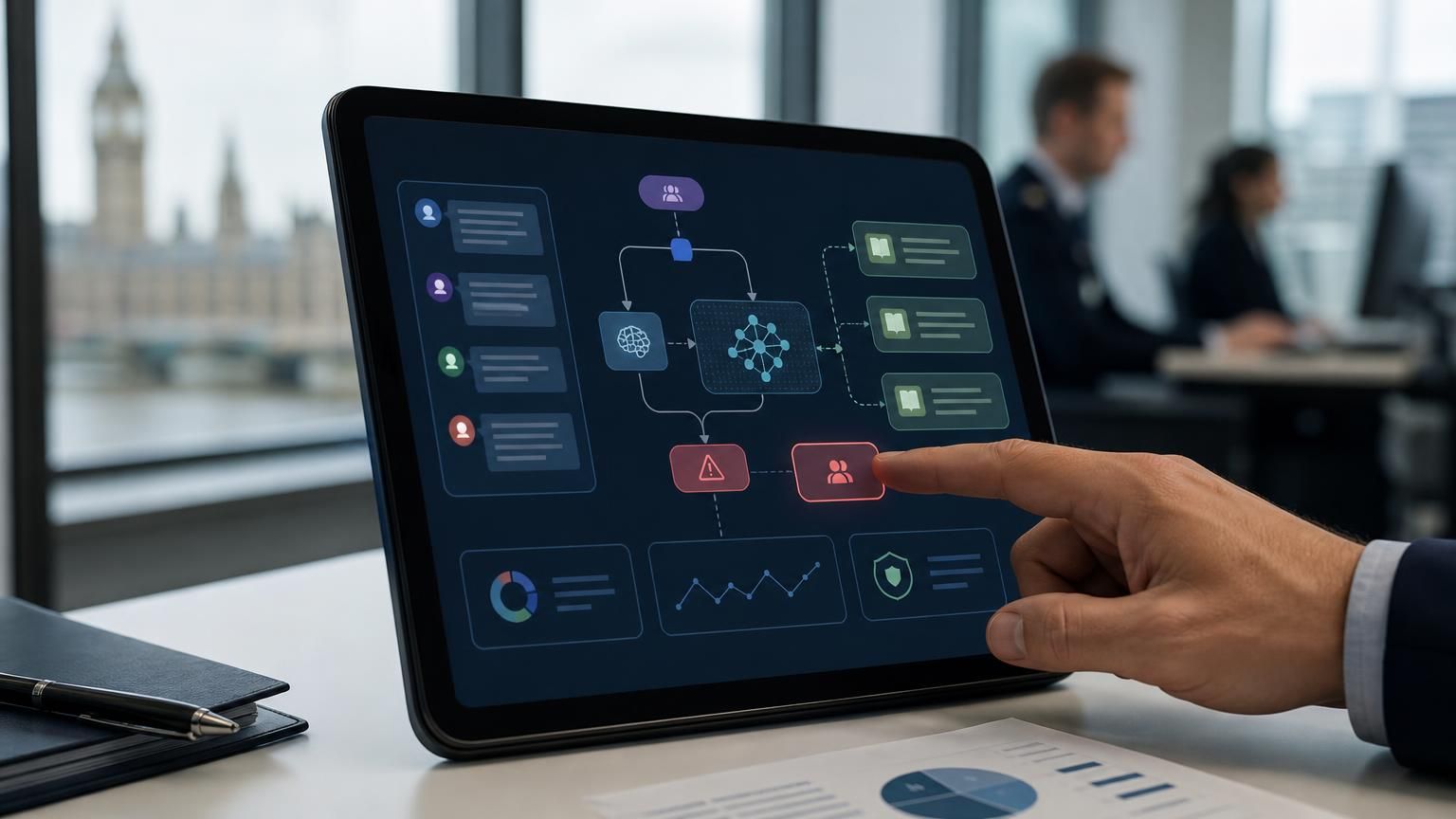
Why predictive triage matters now
Support teams in councils, police forces, housing associations and regulated organisations are drowning in demand spikes that can quickly produce SLA breaches and hidden risk. Predictive triage — a hybrid AI approach that scores incoming enquiries for urgency and complexity in real time — changes that equation. It turns live chat from a reactive contact channel into a strategic intake and routing engine that protects vulnerable people, preserves officer and agent time, and reduces missed deadlines.

Real-world UK examples show the scale of the opportunity: automated bots and digital intake systems have freed hundreds of thousands of hours across policing and local services, and single-channel bots have resolved substantial proportions of demand in pilots. (gov.uk)
What predictive triage actually does (practical, not theoretical)
- Instantly scores each contact for urgency (e.g., threat-to-life, housing risk, legal deadline) and predicted resolution path.
- Routes the highest-severity contacts to the right human agent or an escalation queue with a prefilled case summary.
- Hands lower-risk enquiries to self-serve flows or knowledge-base responses that are audited and UK-hosted.
- Produces a concise audit trail for every hand-off to support compliance and FOI/subject-access requests.
A successful predictive triage pipeline must be UK-hosted, auditable, and integrate RAG-style knowledge controls so the system only uses authoritative policy sources when it scores or answers a contact. See IMSupporting's RAG-based AI agent knowledge for an approach that keeps training data and outputs grounded in authoritative sources. https://imsupporting.com/feature-rag-based-ai-agent-knowledge.php
Three core components — how to design for UK public sector constraints
1) Data sovereignty and hosting
Keep all contact transcripts, scoring metadata and the authoritative knowledge base within UK infrastructure. That reduces procurement friction, simplifies DPIAs, and satisfies many regulators and internal counsel. Local-first hosting also makes audits and e-discovery faster and preserves chain-of-custody for sensitive cases.
2) Controlled knowledge (RAG) layer
Never let a pure LLM hallucinate policy. Use a RAG (retrieval-augmented generation) layer that restricts answers and triage factors to indexed policy documents, legislation, and approved guidance. That way scoring decisions and answer snippets are traceable back to exact policy sources. IMSupporting documents this approach for public services and regulated teams. https://imsupporting.com/feature-rag-based-ai-agent-knowledge.php
3) Hybrid hand-off workflows
Design workflows so AI does first-pass triage and task prep, then escalates to human agents for cases above a configurable severity threshold. For predictable peaks, configure dynamic agent pooling and pre-authorised escalation pathways so agents receive a one-screen briefing and suggested next steps. IMSupporting's hybrid AI chat workflows show how to embed these hand-offs into existing contact-centre tooling. https://imsupporting.com/feature-hybrid-ai-chat-workflows.php
Rule-based bots vs pure LLM bots vs hybrid AI — the operational difference
- Rule-based chatbots: Operate with decision trees and fixed scripts. Predictable and auditable, but brittle when language varies. Best for standard FAQs and form-filling.
- Pure LLM bots: Great for flexible language understanding and drafting, but they can hallucinate, lack grounding in authoritative policy, and are harder to make auditable for regulated use.
- Hybrid AI live chat: The pragmatic middle path. Use LLM understanding for natural language parsing, but ground outputs and triage logic in a RAG layer and safeguard escalation to humans for complex or high-risk cases. This is the only model that scales conversational flexibility while meeting auditability and data-sovereignty needs for UK public services.
Metrics that matter (and how to measure them)
Measure triage success with a handful of operational KPIs:
- SLA breach rate for priority queues (target: single-digit %).
- Mean time to assign (MTTA) for high-severity cases.
- Correct first-route percentage: the share of contacts routed to the right team first time.
- Agent time saved per month and reduction in average handle time.
Pilot data and sector research indicate measurable gains: dynamic predictive routing and AI-assisted triage can reduce mean response time by 10–20%, while AI-assisted case management programs commonly report 25–40% reductions in average handling time and clear productivity gains in contact centres. ()
Practical rollout plan (6 steps to pilot predictive triage)
- Governance first: run a DPIA and create an algorithmic transparency record for triage scoring.
- Pick a contained use-case (e.g., homeless housing referrals, non-emergency police reports) and define severity bands.
- Assemble the RAG knowledge set: statutory guidance, local policy, escalation criteria.
- Deploy a hybrid AI workflow that does live triage and pre-populates case notes for humans. Start with UK-hosted infrastructure only.
- Run a dual-run pilot: AI suggestions visible to agents but not actioned automatically for 4–8 weeks.
- Measure and iterate: focus on false negatives (missed urgent cases) first; tune thresholds and escalation rules.
Local UK authorities and police units are already using chat and bot intake successfully: single online channels have resolved significant proportions of demand in pilots and returned measurable capacity gains. (gov.uk)
Common failure modes — and how to avoid them
- Over-trusting the LLM: always require human sign-off for high-severity or ambiguous cases.
- Weak knowledge hygiene: keep RAG indexes current and versioned to avoid routing on outdated policy.
- Opaque scoring: publish an internal score-card and explanation rules per case type to preserve transparency.
- Ignoring accessibility: maintain phone and in-person routes and ensure chat works with assistive tech.
Use cases that deliver quick ROI in the UK
- Police non-emergency reports triaged to preserve 999 capacity and accelerate crimes requiring immediate safeguarding. (gov.uk)
- Housing associations prioritising homelessness or repair cases with potential risk to tenants.
- Councils reducing missed critical contacts during benefit or adult social care assessments.
Vendor & procurement checklist for predictive triage
- UK-hosted data centres and contractual data residency guarantees.
- RAG-based knowledge controls and provenance logging for every generated answer. (See IMSupporting's RAG approach.) https://imsupporting.com/feature-rag-based-ai-agent-knowledge.php
- Configurable hybrid workflows with agent hand-off metadata and SLA-triggered escalation. https://imsupporting.com/feature-hybrid-ai-chat-workflows.php
- Audit and export tools to satisfy FOI, DPIA, and internal audit requests.
Quick pilot success story (what good looks like)
A council pilot that used hybrid AI triage for housing repairs routed urgent welfare cases directly to a duty officer and cut priority queue SLA breaches by a measurable margin within 12 weeks. Agents received prefilled case summaries; referral errors fell and backlog time dropped. For many public services, a small pilot that proves false negatives are eliminated is the turning point for scale.
Next steps — how to get started today
If you manage a council contact centre, social services team, or a regulated support function and you need a UK-hosted, auditable predictive triage capability, start with a controlled pilot that uses RAG-grounded knowledge and hybrid workflows. IMSupporting provides both the RAG knowledge tooling and the hybrid AI chat workflows needed to run such pilots—book a demo or request procurement details to see how a pilot would work in your service. https://imsupporting.com/
Explore IMSupporting's RAG knowledge approach and hybrid workflow capabilities to design a pilot that stops SLA breaches before they start. https://imsupporting.com/feature-rag-based-ai-agent-knowledge.php https://imsupporting.com/feature-hybrid-ai-chat-workflows.php
Ready to protect vulnerable contacts and cut SLA risk? Book a demo with IMSupporting and outline a 90-day pilot for predictive triage in your service. https://imsupporting.com/