Make live chat work for everyone — not just the digital majority
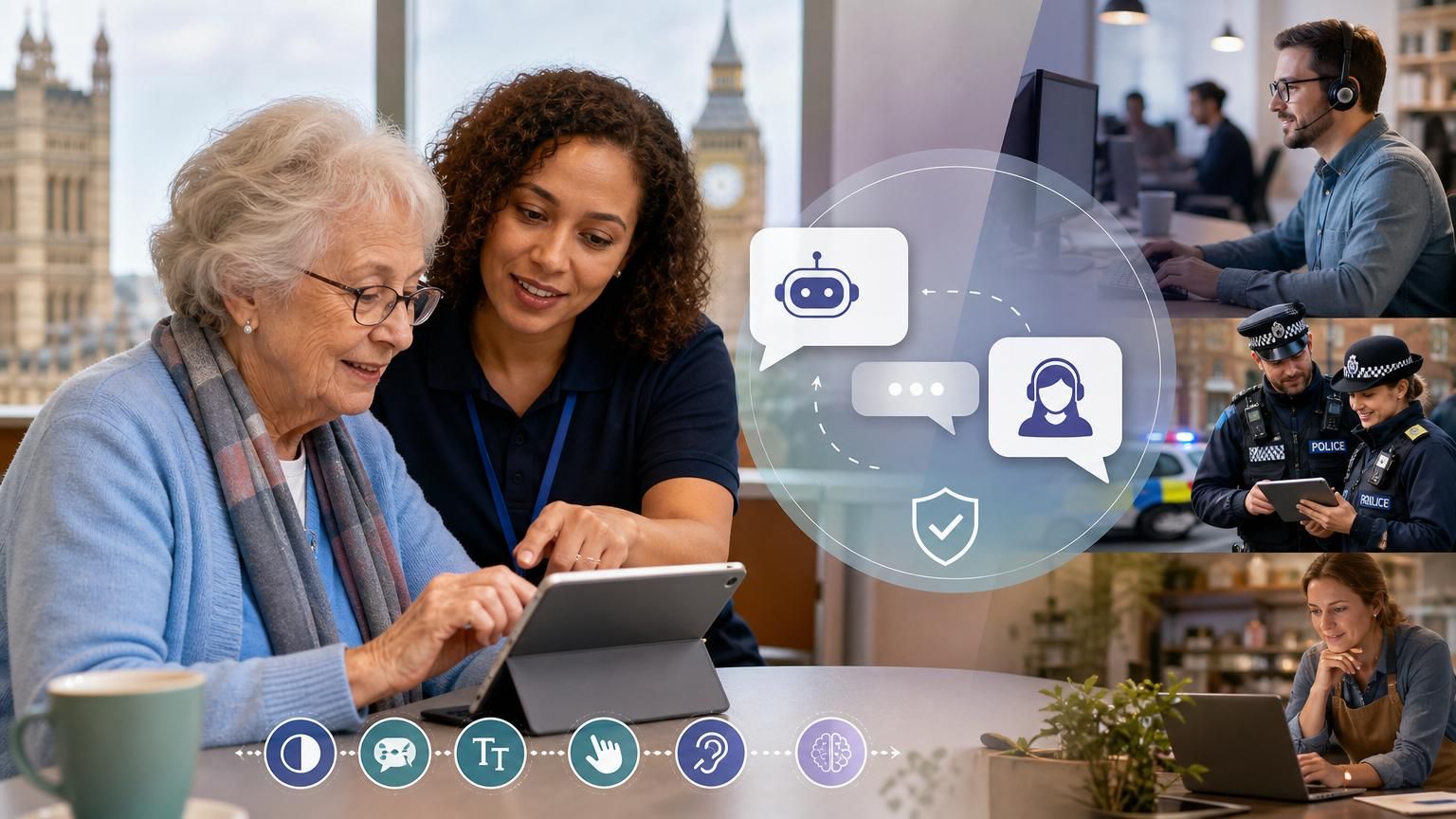
When UK councils, housing associations, police contact centres or regulated teams choose a new live chat platform they face three non-negotiables: it must be UK-hosted for data sovereignty and procurement confidence; it must serve digitally excluded residents (assisted digital); and it must combine instant AI triage with human empathy where necessary.
This post explains a practical pattern you can use now: a privacy-first, accessibility-led hybrid AI live chat that uses Retrieval-Augmented Generation (RAG) for accurate answers, rule-based logic for deterministic flows, and human agents for empathy and complex judgement.
Why UK hosting and privacy-first design matter
- Procurement and data residency: UK public-sector buyers must show where data lives and how it is processed. UK-hosted platforms simplify governance and audit trails.
- Regulatory risk: the ICO has explicit guidance on applying UK GDPR to AI systems; public organisations must demonstrate DPIAs, transparency and minimisation for AI-driven support. (ico.org.uk)
- Citizen trust: many residents will only interact if they know their data is handled locally and with oversight.
Put simply: a hybrid AI strategy that ignores hosting or data protection will stall at procurement or attract avoidable risk during audit.
A three-layer architecture that matches risk to channel
Design the chat stack as three distinct layers — each with its own rules and controls.
1) Rule-based front door (deterministic, auditable)
- Purpose: rapid routing and eligibility checks (e.g., urgent welfare, public safety flagging).
- Characteristics: deterministic decision trees, explicit scripts, clear audit logs.
- When to use: identity thresholds, service eligibility, safeguarding triage.
Why this matters: rule-based flows produce predictable, testable outcomes that are easy to include in procurement specs and record in casefiles.
2) RAG-powered knowledge agent (context-aware, UK-data-first)
- Purpose: surface up-to-date, sourced answers from your internal knowledge base and policy documents.
- How it works: the system retrieves relevant documents, then generates an answer whose sources are recorded (RAG). This reduces hallucination and creates an evidence trail.
- Control knobs: restrict retrieval to UK-hosted repositories, enforce redaction rules, log sources for every response.
This is the practical replacement for brittle FAQ bots: accuracy comes from controlled retrieval, not blind generative output. See an example implementation pattern for RAG-based AI agents. https://imsupporting.com/feature-rag-based-ai-agent-knowledge.php
3) Human-in-the-loop (empathy, complex judgement, accountability)
- Purpose: handle edge cases, make discretionary decisions, and support vulnerable users.
- Integration: smooth warm-handoff with full context and suggested agent replies; transcripts archived for FOI and case evidence.
Hybrid AI is not automation for its own sake — it’s a practical allocation of labour where machines handle the predictable, and humans handle the rest.
Differentiating chat types — clarity for procurement
- Rule-based chatbots: scripted, deterministic flows that follow pre-approved logic. Low risk, high predictability, limited scope.
- Pure LLM bots: generative-first models that create free-text answers, often without traceable source links — higher risk of hallucination and data leakage unless constrained.
- Hybrid AI live chat: combines rule-based triage, RAG retrieval for sourced answers, and immediate human handover when required. This is the recommended pattern for UK public and regulated services.
Procurement teams should specify which model the vendor will use, how it restricts training data, and where retrieval indices are hosted.
Accessibility and assisted-digital: the business case
Millions of UK residents remain on the wrong side of the digital divide; assisted-digital remains a statutory and moral requirement for many local services. Good Things Foundation and sector initiatives track persistent digital exclusion and call for inclusive design and assisted-digital support. ()
Practical rules to reduce exclusion:
- Always offer a simple route to speak to a human agent (phone or in-person) from the chat window.
- Provide large-font, high-contrast chat themes and a clear ‘ask for help’ toggle for assisted-digital staff.
- Allow case creation on behalf of the resident, with explicit consent capture and minimal data collection.
A privacy-first hybrid chat makes assisted-digital easier: agents can join the chat, complete forms manually, and store records in UK-hosted systems.
Public-sector examples and expectations
Local digital programmes already encourage councils to build multi-channel services that reduce face-to-face and phone demand while keeping assisted routes open. Effective implementations combine chat, case tracking and data transparency so residents don’t have to repeat their story. (localdigital.gov.uk)
Operational outcomes you can expect with a rights-based hybrid chat:
- Faster triage and reduced call volume for routine queries.
- Better first-contact resolution for services with well-maintained knowledge bases.
- Audit-ready transcripts because RAG and rule logs provide provenance for answers.
Governance: what procurement and SOC teams should demand
Include the following in any tender or evaluation:
- Proof of UK hosting and contractual data residency guarantees.
- RAG provenance: every AI answer must link to a retrievable source stored in your UK index.
- DPIA and model governance artefacts, plus a runbook for human handover and emergency escalation.
- Accessibility and assisted-digital support standards, including staff training metrics.
- Exportable, FOI-ready transcripts and secure evidence bundles for regulated casework.
The ICO’s guidance on AI and data protection is the authoritative starting point for policies and DPIAs. (ico.org.uk)
Quick technical checklist for architects
- Use RAG indices built from UK-hosted documents only.
- Keep a closed vocabulary of policy-critical responses in the rule engine.
- Log provenance, redactions and agent edits for every case.
- Test for accessibility with representative cohorts and assisted-digital volunteers.
If you want a configurable hybrid workflow that already implements these patterns, review hybrid AI chat workflow approaches and in-chat triage examples. https://imsupporting.com/feature-hybrid-ai-chat-workflows.php
KPI suggestions (what to measure)
- Assisted-digital handovers per 1,000 contacts.
- First-contact resolution for routine queries (target +10–20% improvement within 6 months).
- Percentage of AI responses with linked sources (target 100% for RAG answers).
- Time to human handover for vulnerable or high-risk cases (target under 2 minutes).
Final recommendation and next step
Hybrid AI live chat done properly balances speed, inclusion and auditability. For UK public services and regulated teams, the right pattern is rule-based triage + RAG-sourced answers + human-in-the-loop — all on UK-hosted infrastructure with DPIAs, accessibility checks and clear governance. Good procurement language and an implementation partner who understands assisted-digital will shorten timelines and reduce risk.
If you want a platform built specifically for these constraints — UK hosting, RAG provenance and hybrid workflows ready for councils, police and housing associations — review the platform features and contact the team to discuss pilots: https://imsupporting.com/ and the hybrid AI workflow example at https://imsupporting.com/feature-hybrid-ai-chat-workflows.php
Take the next step: schedule a demo or procurement-readiness conversation to see how a privacy-first hybrid AI chat can reduce avoidable contact, protect residents’ data and improve outcomes for vulnerable users. Visit https://imsupporting.com/ to start the conversation.