Why procurement teams must treat live chat like a regulated service
Live chat is no longer a simple widget. For councils, police, housing associations and regulated teams, it's a front-line service channel that must pass procurement, security and data-protection gates. The good news: a properly configured hybrid AI live chat (RAG-backed knowledge + human handoff + UK hosting) can speed procurement approvals and reduce operational risk — if you design it to meet the exact checks buyers will ask for.

Recent UK government guidance and regulator activity has moved AI from a tech curiosity to a procurement risk item buyers must evaluate. The ICO has publicly warned organisations to assess data-protection risks posed by chatbots, and expects reasonable mitigations for generative AI deployments. (ico.org.uk)
Short market context — why this matters now
- Public familiarity with chatbots is rising, but use in work contexts is still limited: around 28% of adults reported using chatbots at least monthly for work-related purposes (an increase from previous waves), which means public-facing services must balance usability with assurance. (gov.uk)
- The UK Government's AI Playbook and Cyber Security Code set practical expectations for how AI systems should be risk-assessed, documented and procured. Procurement teams and solution architects should map live chat features to those expectations during tender evaluation. (gov.uk)
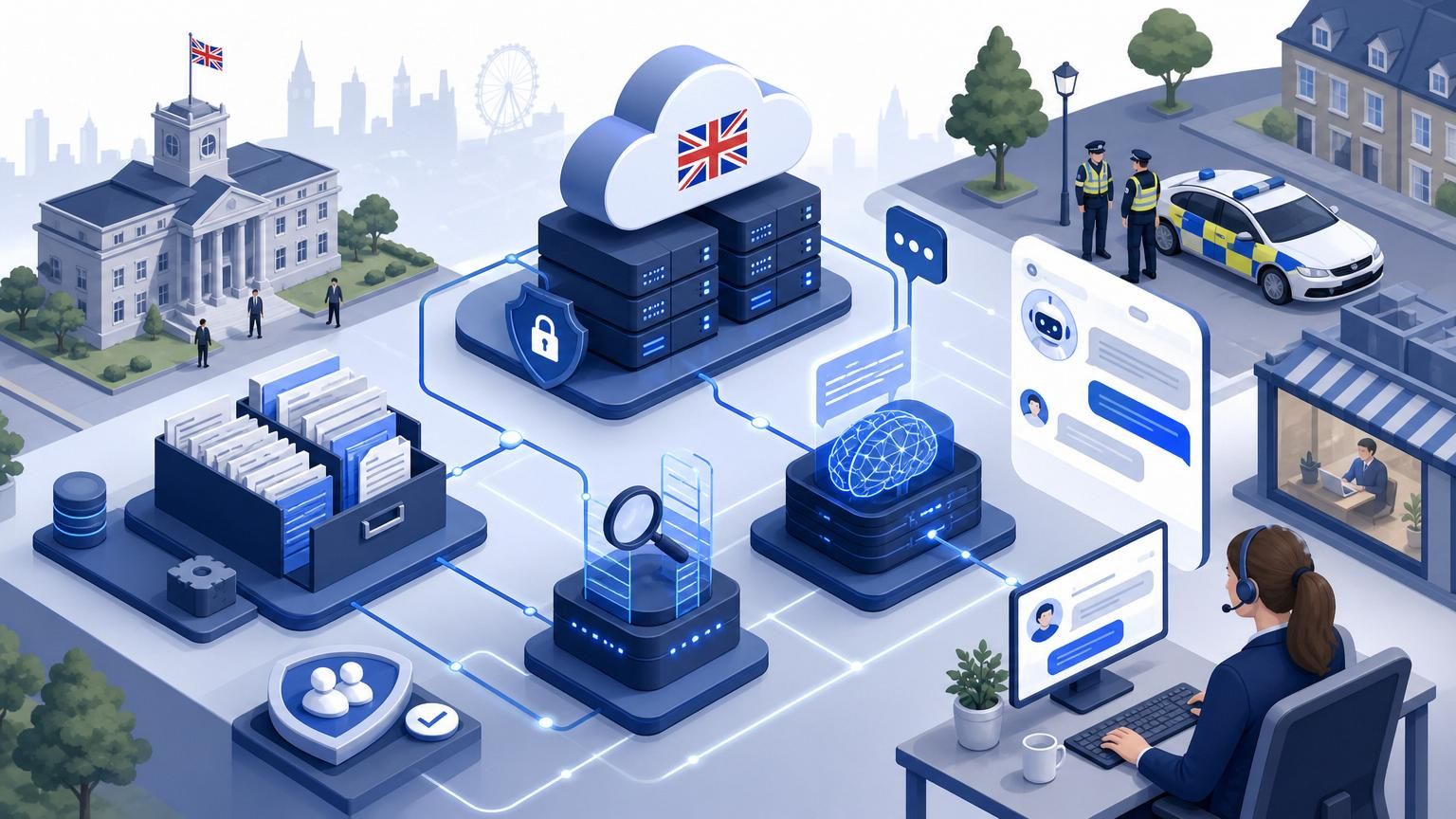
The procurement-ready architecture: three layers that reviewers want to see
- Data residency & hosting (UK-first)
- Knowledge grounding + explainability (RAG)
- Operator control & human-in-the-loop workflows
Each layer answers a specific procurement question: where does the data live, how do you stop hallucination and how do humans retain control?
1. UK-hosted service and data sovereignty
Procurement panels increasingly treat UK data residency as a minimum for public-sector contracts. Look for explicit UK hosting, clear contractual commitments on data location, and evidence of export controls in the supplier's terms. Sovereign hosting reduces legal complexity during IG and FOI reviews and speeds internal sign-off. ()
2. RAG-based knowledge grounding (reduce hallucination)
Rule-based chatbots fetch from pre-set scripts; pure LLM bots generate fluent text but can hallucinate and leak prompts. RAG (Retrieval-Augmented Generation) combines a search layer over your documents with an LLM to generate answers grounded in your own policy, guidance and forms. That means predictable, verifiable responses that procurement and legal teams can inspect. IMSupporting’s RAG feature is a practical example of turning documents into instant, auditable answers. (imsupporting.com)
3. Human-in-the-loop workflows and seamless handoff
Hybrid AI should automate routine triage but pass complex, sensitive or high-risk conversations to human agents with full context. Visual, ruleable workflows let you enforce checks (age, vulnerability flags, escalation triggers) so the system never takes an action that requires human judgement. IMSupporting’s hybrid AI workflow builder shows how you can visualise and test these handoffs before procurement reviewers ask for evidence. (imsupporting.com)
Rule-based, pure LLM and hybrid AI — quick technical differentiator
- Rule-based chatbots: deterministic scripts and decision trees. Cheap and predictable but brittle on language variety.
- Pure LLM bots: generate free-text using large models. Great fluency but higher risk of hallucination, unpredictable outputs and data-leak concerns.
- Hybrid AI live chat: RAG-grounded answers + LLM fluency + human handoff. Offers accuracy, traceability and operational controls — the sweet spot for regulated UK use cases.
Procurement teams should require suppliers to state which model class they use, how RAG sources are managed, and how human handoffs are logged.
A procurement checklist that wins approvals
Use this checklist in your tender or supplier assessment to fast-track sign-off:
- UK data residency: hosting locations and contracts. (Ask for exact data-centre locations.)
- Data processing agreement & DPIA: template DPIA and evidence of ICO-compliant assessments. (ico.org.uk)
- RAG evidence: sample queries with returned source snippets and vector search traces. Ask for reproducible examples. (imsupporting.com)
- Human handoff controls: workflow screenshots, escalation rules and time-to-agent SLAs. (imsupporting.com)
- Auditability & FOI readiness: exportable transcripts with redaction tools and immutable timestamps.
- Security posture: pen-test results, MFA, SOC/ISO summaries and Cyber Essentials where relevant. (assets.publishing.service.gov.uk)
- Liability & SLAs: uptime, response-time guarantees and incident escalation commitments.
- Training & continuous improvement: how the vendor uses human-in-the-loop learning while preventing model drift.
Operational roadmap: 90-day MVP that impresses procurement
Week 0–2: Run a DPIA and map data flows; record hosting and supplier contracts. Use the AI Playbook checklist to map risk mitigations. (gov.uk)
Week 2–6: Build a minimal RAG knowledge set (policy PDFs, FAQs, forms) and test 100 representative queries. Capture source pointers in every answer.
Week 6–10: Set up hybrid workflows with escalation rules, vulnerability flags and a single audit log. Run tabletop tests with front-line agents.
Week 10–12: Produce procurement artefacts — DPIA, test transcripts, SLA draft and security evidence pack — and present to procurement and data-protection teams.
This fast, evidence-based approach turns live chat from a vague promise into a documented, auditable service.
Use cases that procurement buyers care about
- Councils: reduce call centre volumes while keeping council-tax, benefits and planning advice auditable and FOI-ready.
- Police non-emergency: triage intelligence and route cases to neighbourhood teams, ensuring sensitive details are handled by officers, not an LLM.
- Housing associations: support tenants with repair reporting and rent queries while protecting household data and vulnerability flags.
Each use case requires the same four procurement assurances: UK hosting, RAG grounding, human handoff and audit trails.
Closing argument — buying criteria that convert
Procurement panels respond to evidence: show them a UK-hosted environment, demonstrable RAG outputs, human-in-loop workflows and a security pack mapped to the AI Playbook and Cyber Security Code. Doing so moves the conversation from theoretical risk to operational readiness — and shortens procurement timelines.
IMSupporting already bundles RAG-based knowledge and a visual hybrid-workflow builder designed for UK organisations; use their feature pages to map product capabilities to your procurement checklist. (imsupporting.com)
Next step (quick win)
If you need a procurement-ready proof-of-concept, get a short demo and a tailored evidence pack from IMSupporting to test against your DPIA and procurement criteria: https://imsupporting.com/.
Start with a small, UK-hosted pilot that proves RAG accuracy, human handoff and exportable audit logs — and you’ll convert procurement sceptics into operational sponsors.