What progressive disclosure buys you — and why UK teams must care
Progressive disclosure is simple: ask for the minimum personal data you need, only when you need it, and escalate requests for identity step‑by‑step as the case requires. For UK councils, police contact teams, housing associations and regulated services this isn't a UX nicety — it's a risk control lever that cuts PII exposure, reduces evidence‑handling burden, and speeds lawful resolution.

Live chat is no longer just reactive typing. When combined with a UK‑hosted hybrid AI layer you can: reduce unnecessary data capture up front, surface verifiable guidance quickly, and route only high‑risk cases to human specialists. That shift both improves conversion and lowers compliance overhead. 79% of businesses report live chat positively affects revenue, sales and loyalty — but public sector teams also gain lower case re‑work and fewer data‑handling incidents when they minimise first‑contact PII. ()
The current regulatory context you must design for
- The UK has moved quickly to place a statutory duty on the ICO to prepare a code of practice for AI and automated decision‑making; that instrument came into effect in May 2026 and changes procurement and operating expectations for any AI touching personal data. Design choices that reduce automated decision risk and limit upfront PII will help you stay aligned. ()
- The ICO’s guidance on AI and data protection emphasises transparency, lawful basis and robust human oversight where systems influence people. Hybrid architectures that keep humans in the loop for material outcomes are explicitly safer. (ico.org.uk)
These are not theoretical: build flows that minimise data at first contact and you lower the bar for DPIAs, fast‑track user rights responses, and make procurement teams happier.
Rule‑based bots, pure LLM bots, and hybrid AI — the practical differences
- Rule‑based chatbots: predictable, deterministic scripts. Good for form filling, opening hours, and signposting. They don’t hallucinate, but they lack context, retrieval from internal knowledge, and dynamic triage.
- Pure LLM bots: large language models that generate fluent answers. They can summarise and draft responses but may hallucinate facts and can’t reliably obey strict data‑handling rules without external controls.
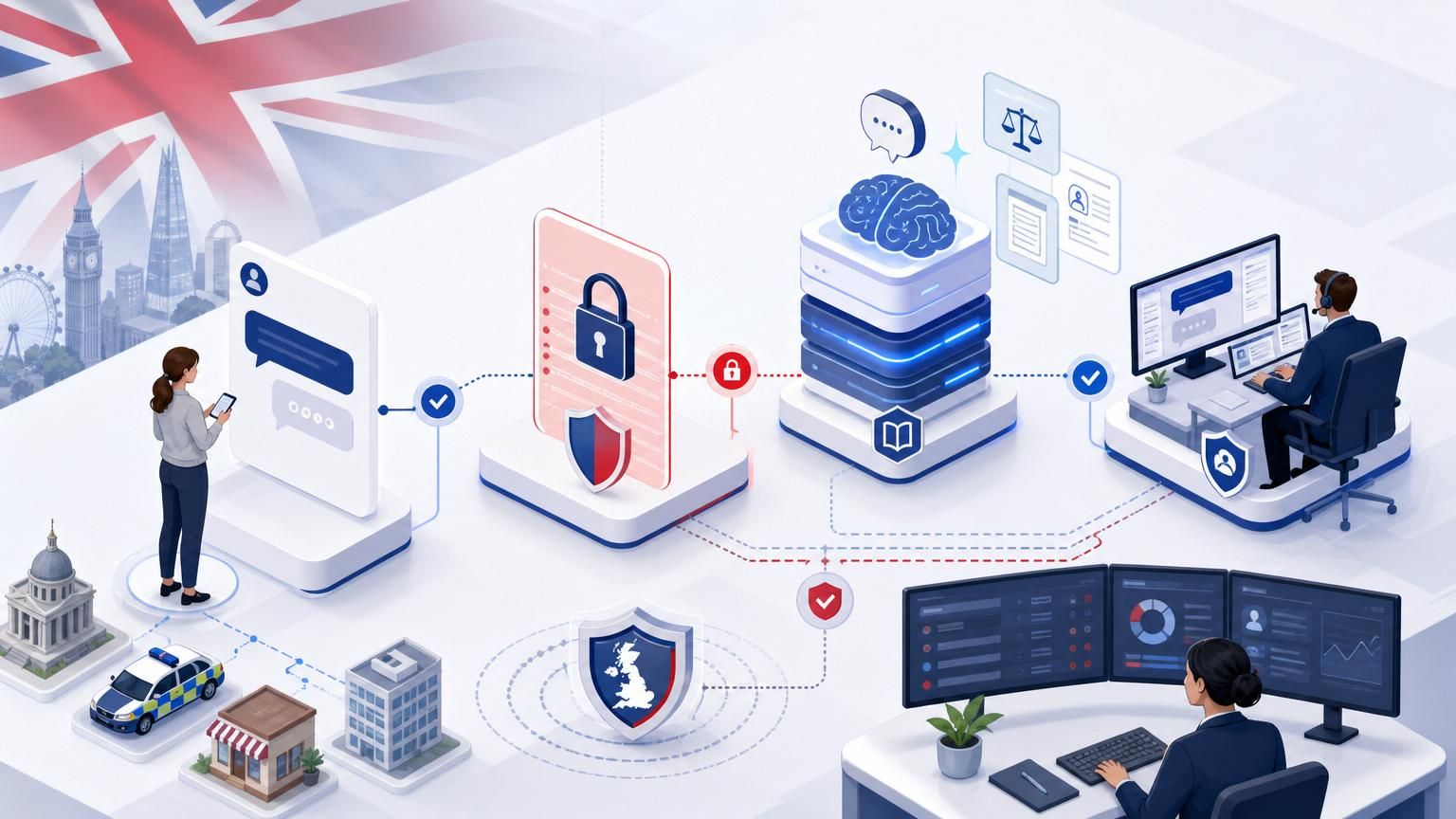
- Hybrid AI live chat: combines LLM fluency with retrieval (RAG), policy filters, and an engineered human handoff. It runs safe, verifiable answers from vetted knowledge bases and automatically escalates to a human when identity, empathy or legal judgement is needed.
If your support service carries legal or safeguarding risk, only hybrid AI provides the balance of speed, explainability and human accountability you need.
Progressive disclosure patterns that work in live chat
Use these patterns to keep first contact low‑risk while still resolving frequent queries fast:
- Minimal entry: ask only for the category of query (benefit claim, report a crime, housing repair) and a non‑PII context field on first contact.
- Just‑in‑time identity: request name, DOB, or tenancy number only when an action requires it (payment, enforcement, opening a secure case).
- Tokenised continuity: issue a session token or case reference immediately so subsequent queries link to the case without storing PII in chat transcripts.
- Escalation gating: built‑in checks require human consent before any sensitive data is stored in long‑term records.
- Auto‑redaction + audit trail: redact PII from AI prompts, keep a sign‑off log when a human agent confirms identity and action.
These patterns map directly to common public sector flows — for example, triaging a noise complaint vs. escalating a safeguarding referral.
How to implement progressive disclosure with hybrid AI (practical steps)
- Map your contact taxonomy: identify which interactions can be resolved without identity and which always need it.
- Build a minimal first screen in chat that offers intent buttons (not free text) for priority cases.
- Use retrieval‑augmented generation (RAG) to answer policy or entitlement questions from a curated knowledge base — this keeps the AI grounded in approved documents and reduces hallucination. See IMSupporting’s approach to RAG-based agent knowledge for an example of policy‑fed retrieval. (ico.org.uk)
- Layer policy filters and consent checkpoints: before any sensitive field is asked, show why it’s needed and who will access it.
- Automate a confidence check: if the hybrid AI’s confidence is low, route to a named human queue with a pre‑assembled case bundle.
- Log every handoff and show an auditable trail — not optional for regulated teams.
IMSupporting exposes hybrid AI chat workflows that make step 3–6 operational rather than theoretical. Their workflow tooling lets you codify gate rules for identity requests and human handoffs. (See hybrid AI chat workflows.)
Links: https://imsupporting.com/feature-rag-based-ai-agent-knowledge.php and https://imsupporting.com/feature-hybrid-ai-chat-workflows.php
KPI playbook — what to measure (and why)
Measure both commercial and control metrics:
- Conversion & case‑closure speed: track % of chats resolved without PII and time‑to‑resolution.
- PII surface area: proportion of sessions that collect identity fields at first contact.
- Escalation accuracy: % of AI->human handoffs where human accepted AI pre‑triage.
- Compliance lead indicators: number of DPIAs needing escalation, number of SARs citing chat transcripts.
A target to aim for: shift 30–50% of routine enquiries off identity capture while keeping overall resolution rates steady — freeing agents for high‑trust work.
Real operational risks (and how to mitigate them)
- Hallucination risk from LLMs: mitigate with RAG, source‑tagging, and strict answer templates. Use a UK‑hosted knowledge index to ensure data residency and provenance.
- False human oversight: the ICO warns that nominal human review without authority or training is not sufficient oversight. Train agents and define clear stop‑rules for automated suggestions. (ico.org.uk)
- Procurement and legal queries: procurement teams now need to show how your AI reduces unnecessary PII exposure and preserves user rights — document the progressive disclosure flows in tender packs.
Why UK‑hosting and audit trails matter here
For councils, police and other public bodies, UK data residency reduces cross‑border complexity and strengthens control over logs and audit trails. With the ICO placing an AI code of practice on a statutory footing in 2026, public sector buyers and regulated organisations should prefer UK‑hosted hybrid solutions that can produce auditable evidence on request. ()
Quick implementation checklist (10–12 week sprint)
- Week 1–2: Define contact taxonomy and high/low PII flows.
- Week 3–4: Build minimal chat entry UI and intent buttons.
- Week 5–6: Integrate RAG index and vet knowledge sources. See IMSupporting RAG feature for how knowledge can be curated. (link above)
- Week 7–8: Implement policy gates, tokenisation and redaction rules.
- Week 9–10: Pilot with a single service (housing repairs or benefits queries).
- Week 11–12: Train agents, measure KPIs, tighten handoff rules.
Bottom line and next step
Progressive disclosure is a practical, high‑impact way to make hybrid AI live chat safe and useful for UK public services and regulated businesses. It reduces PII exposure, helps you meet evolving ICO expectations, and keeps human judgement where it matters most — all while preserving the conversion and speed benefits of modern live chat. 79% of businesses already report measurable benefits from live chat; with a progressive disclosure‑first hybrid strategy, UK teams can keep the upside while shrinking risk. ()
If you want to see how a UK‑hosted hybrid AI approach with RAG, workflow gates and auditable human handoffs looks in practice, review IMSupporting’s feature pages and contact their team for a tailored pilot: https://imsupporting.com/ and https://imsupporting.com/feature-hybrid-ai-chat-workflows.php
Ready to reduce PII at first contact and keep complex cases human?: start a pilot with a UK‑hosted hybrid AI live chat that codifies progressive disclosure today — visit IMSupporting to book a demo. https://imsupporting.com/