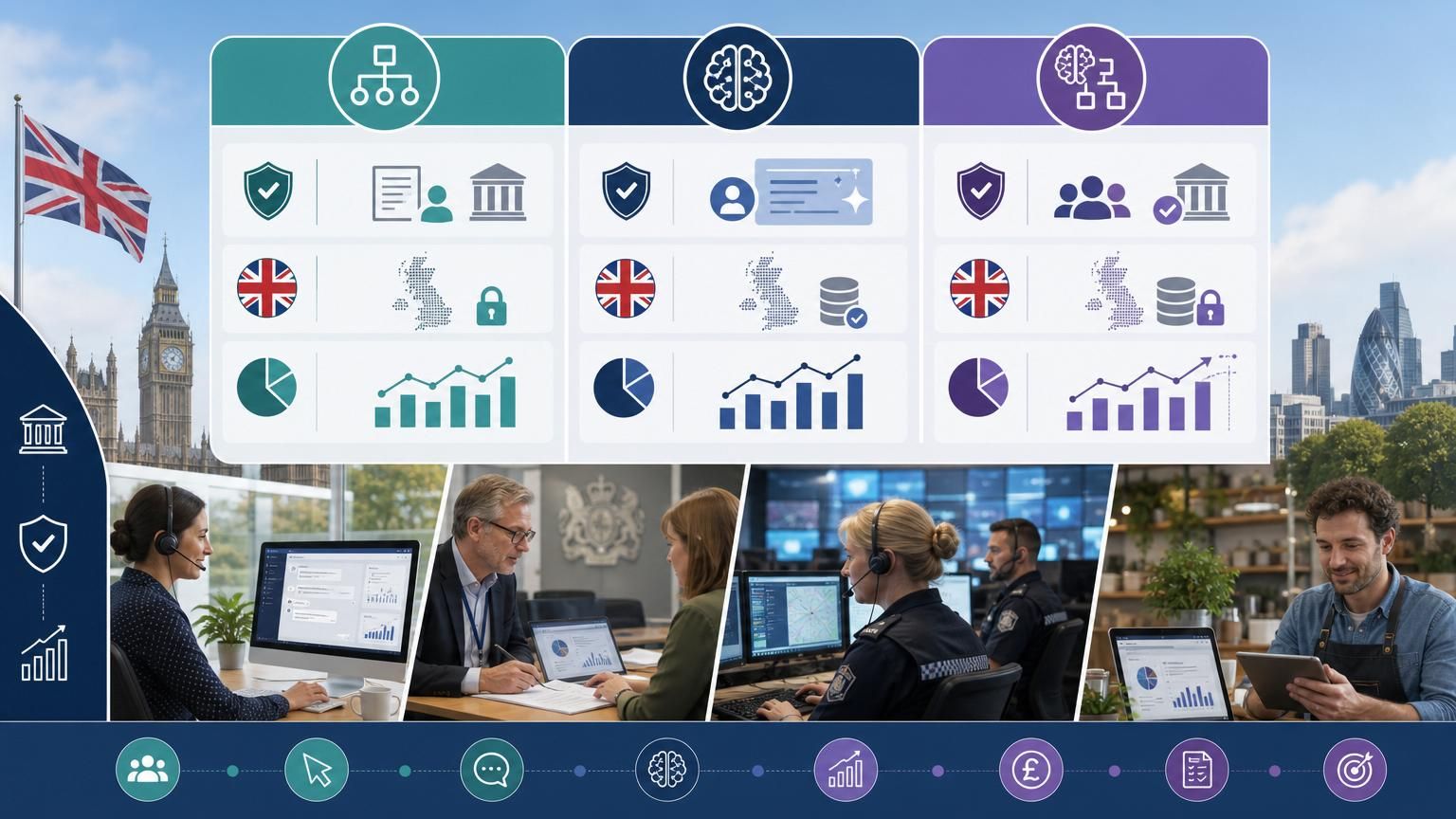
Why a measurement playbook matters for UK organisations
If your council, housing association or regulated business treats live chat as a 'widget' rather than a measurable service, you’re missing both cost savings and compliance controls. Hybrid AI live chat is not just about instant replies — it changes where and how value is created: fewer escalations, faster first-contact resolution (FCR), and higher conversion on transactional pages.

Chat-assisted shoppers and service users convert at materially higher rates: research shows customers who use live chat before purchase are far more likely to complete a transaction — with industry figures commonly cited around a 40% uplift for engaged visitors and a typical overall conversion boost near 20% when chat is deployed on high-intent pages. ()
For UK public sector teams the stakes are different: the benefits are efficiency, accessibility and defensible decisions. The Local Government Association found readiness to explore or use AI across local government is high, but barriers like governance, funding and clear use cases remain. Measurement helps bridge that gap by turning experimentation into accountable outcomes. (local.gov.uk)
The four metrics every UK procurement or support lead must track
Measure what your CFO and your Data Protection Officer both understand. Build a dashboard around these four primary metrics:
- Conversion lift on high-intent pages (e.g., apply, renew, book): incremental revenue or completed transactions attributable to chat interactions.
- First-contact resolution (FCR): share of queries fully resolved in the initial chat session — this is a direct proxy for reduced case-handling costs.
- Cost-to-serve: cost per resolved contact before vs after hybrid AI triage (include agent time, AI compute, and overheads).
- Data-sovereign audit trail: percent of messages and model calls processed and stored on UK-hosted infrastructure, plus timestamped consent markers.
Each metric must be mapped to a financial line (saved agent minutes, prevented escalations, revenue captured) and a compliance outcome (evidence for ICO/Procurement). Use the metrics to produce monthly and quarterly reports that feed into procurement and audit cycles.
Attribution: how to tie chat activity to real outcomes
Stop using last-click or vanity metrics alone. Use a mix of deterministic and probabilistic attribution tailored for chat:
- Deterministic signals: tracked conversions where the same authenticated user engaged with chat during the session (straightforward for logged-in services).
- Session-level attribution: for anonymous visitors, record session IDs, page paths and chat transcript metadata to link chat-assisted journeys to conversions within a window (e.g., 24–72 hours).
- Econometric lift tests: run A/B or holdout experiments for panels of pages or users to isolate chat impact on conversion and FCR.
Strongly prefer experiments and session-level linking for public-sector processes (applications, appeals, benefit renewals) where wrong decisions are costly.
Rule-based vs pure LLM vs hybrid AI — what to measure differently
- Rule-based chatbots: predictable, script-driven. Measure accuracy of flows (drop-off points in trees), intent coverage and hand-off frequency. Low variability — easier to trace back to a decision.
- Pure LLM bots: broad language coverage but unpredictable. Measure hallucination rate, safety incidents, and downstream escalation volume. LLMs can help scale answers but require strong content moderation and post-hoc review.
- Hybrid AI live chat (recommended for UK regulated teams): AI handles triage, form-fills, and instant answers for low-risk queries and then hands off to a human agent for complex, sensitive, or regulated decisions. Measure triage precision (correct hand-off rate), FCR uplift from AI-augmented agents, and the reduction in average handling time when agents receive AI-generated context.
Hybrid models give the best mix of speed and safety for councils, police contact centres and regulated businesses because they allow human oversight on critical decisions while automating routine work.
Data sovereignty and reporting: the non-negotiable layer
Many UK organisations still don’t fully know where their data is stored — that’s a procurement risk. UK departments and businesses increasingly demand UK-hosted processing and clear international transfer contracts. ()
Actionable rules for procurement and DPOs:
- Require UK-hosted transcript storage and model inference logging where possible (or a clear, auditable justification for any overseas processing).
- Include detailed logging for every hand-off and every model call: who saw what, why the hand-off happened, and a human sign-off field for regulated decisions.
- Produce an automated monthly compliance digest for auditors that shows storage location, retention status and redaction audits.
These controls protect citizens and reduce the legal and reputational risk of relying on opaque AI services. Widespread industry concern about sovereign AI makes these clauses standard in new contracts. ()
Practical reporting stack and templates
A pragmatic stack for UK teams combines session analytics, chat transcripts, and a reporting layer that ties to finance and case management systems. Use purpose-built analytics rather than generic dashboards:
- Capture: session IDs, user identifiers where available, timestamped transcripts, agent notes, hand-off markers.
- Enrich: map transcripts to intents, classify sentiment, tag risk level and estimate time saved by AI suggestions.
- Report: weekly FCR, agent time saved, conversion lift per channel, and a quarterly compliance dossier.
If you need a ready-to-run reporting platform that supports exportable audit trails and UK hosting options, review the IMSupporting reporting and analytics platform for chat and contact-centre metrics. See the feature page for specifics on data exports and reporting templates. https://imsupporting.com/feature-reporting-analytics-platform.php
Quick ROI calculator (three lines)
- Take baseline: average handling time (AHT) monthly contacts agent cost = baseline cost.
- Estimate improvement: % AHT reduction from AI triage + FCR uplift converted to fewer follow-ups = new cost.
- ROI = (baseline cost - new cost) / implementation cost over 12–24 months.
Example: a 15% AHT reduction plus 10% FCR improvement usually pays for a chat platform in 6–12 months in most mid-size public services.
Governance checklist for procurement and IT
- Insist on UK-hosted storage and processing options and contractual clauses for international transfers. (gov.uk)
- Require transparent logging for each AI decision and human override.
- Mandate a phased rollout with measurable KPIs (FCR, cost-to-serve, conversion lift) and a six-month review.
- Include training and an escalation playbook for hallucinations or safety incidents.
Next step: convert measurement into procurement-ready reporting
Start with a 60-day measurement sprint: instrument two pilot pages or two service pathways, deploy hybrid AI triage in a controlled panel, and run a holdout test. Use the outputs to build the procurement SOW and an audit-ready KPI pack.
If you want a reporting platform that supports UK hosting, audit trails and pre-built chat metrics for public sector use cases, explore IMSupporting’s platform and pricing to evaluate fit: https://imsupporting.com/ and see pricing and onboarding options. https://imsupporting.com/index.php#pricing
Strong measurement separates hope from impact. Build your attribution, insist on UK data sovereignty, and choose hybrid AI for the control public and regulated organisations need.