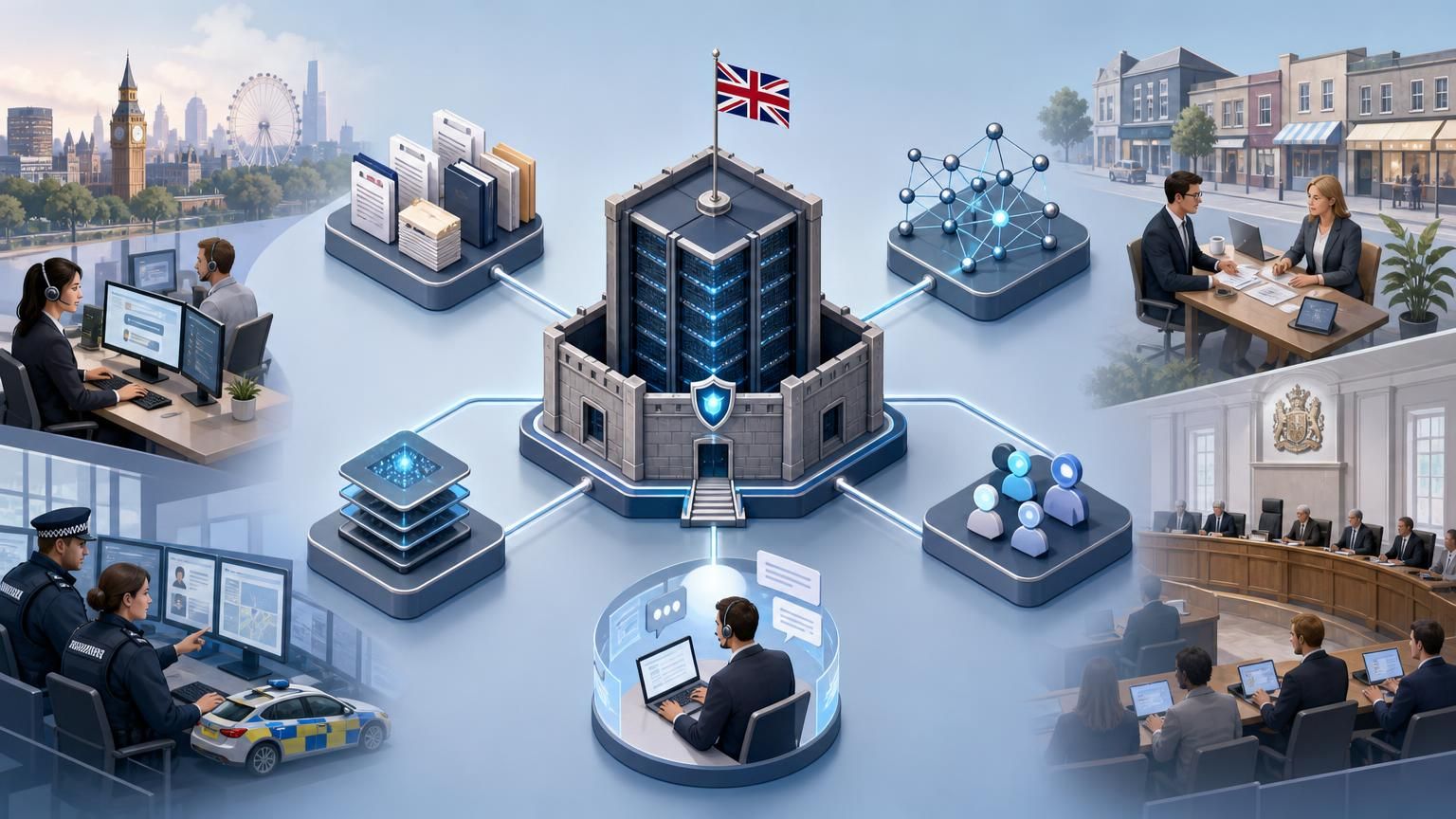
The specific problem: trusted, auditable answers at scale
Regulated UK organisations—councils, police, housing associations and health-facing teams—need live support that does three things simultaneously: delivers fast, accurate answers; preserves auditable trails; and keeps data inside UK jurisdiction. Off-the-shelf LLM chat or rule-only bots fail one or more of those tests. The fix is a RAG-first, hybrid AI live chat that treats human agents and retrieval as equal citizens of the workflow.

Why a RAG-first approach matters now
RAG (retrieval-augmented generation) makes an LLM answer from a live, versioned set of documents rather than from a floating neural memory. Enterprises adopting GenAI are rolling out RAG as the dominant pattern — more than half of mature GenAI deployments now include RAG components. ()
RAG isn't just trendy; it measurably reduces hallucinations in enterprise knowledge scenarios — practical implementations report hallucination rates falling to near-acceptable margins when retrieval is well-engineered. This is why RAG is the natural backbone for regulated support where accuracy and provenance matter. ()
Rule-based chatbots vs pure LLM bots vs hybrid AI live chat
- Rule-based chatbots: deterministic, easy to audit, but brittle. They handle structured forms and fixed decision trees well and are excellent for compliance-first flows—but they break when users deviate from scripts.
- Pure LLM bots: flexible and conversational, but their outputs come from model parameters and training data; they can hallucinate, and provenance is weak unless you add complex logging.
- Hybrid AI live chat (RAG-first): uses retrieval to ground responses, applies LLM reasoning where appropriate, and routes complex or sensitive interactions to humans with full context and decision logs. This is the only model that balances speed, accuracy and auditability for UK regulated teams.
Commercial impact you can measure
- Faster first responses: modern live chat pushes first replies in seconds; when combined with grounded AI triage, high-intent queries are resolved instantly and routed correctly to agents when needed.
- Better outcomes: live chat remains one of the highest-converting channels for digital service enquiries, with measured uplifts in conversions and satisfaction when response quality is high. One practical benchmark: businesses using proactive live chat often cite conversion improvements in the high single digits to ~20% on transactional journeys. ()
Use this simple metric set to measure success: first response time, resolution-without-human percentage, escalation accuracy, audit-log completeness, and time-to-close for regulated cases.
Design principles for UK-hosted, auditable hybrid live chat
1) UK data residency by default
For councils, police and other public bodies, select platforms that host data and run RAG indices in the UK to avoid cross-border transfer risk and simplify ICO compliance reviews. Government cloud guidance specifically flags residency and offshoring as risk areas to manage. (gov.uk)
2) Ground every AI answer with a verifiable source
Display or record the retrieved document IDs and snippets used to generate each reply. That provenance layer is what turns conversational AI into evidence-grade support.
3) Human-in-loop escalation rules
Automate low-risk FAQs and form fills, but require an immediate agent handover for any legal, sensitive or multi-agency case. The handover must carry full context, retrieval snippets and a timestamped audit trail.
4) Configurable policy gates
Allow teams to define policy gates that block AI from answering on specific topics (safeguarding, legal advice, crime reporting) or to force a lawyer/inspector review before closure.
5) Lightweight, versioned knowledge pipelines
A single canonical knowledge store with versioned documents and change audit makes RAG effective: updates to policies or fees should be visible to the retrieval layer within minutes, not weeks.
Practical architecture blueprint (executive-level)
- Ingest: secure, UK-hosted document store with granular access controls.
- Index: vector + lexical indexes that are refreshed on policy pushes.
- Retrieval router: rules to pick the right index per query type (policy vs transactional).
- LLM layer: used as a reasoning and writing engine, not as the primary knowledge source.
- Workflow engine: enforces escalation rules, SLA timers, and multi-agency notifications.
- Audit & storage: immutable logs of retrieved sources, prompts, AI outputs and human edits.
This RAG-first architecture is the minimal safe baseline for any public sector or regulated deployment.
Use cases that pay back quickly for UK teams
- Councils: automated benefits triage that pulls the right policy paragraphs and hands over complex claims to trained caseworkers with pre-populated forms.
- Police non-emergency desks: immediate, grounded guidance for reporting options, with automatic escalation to detectives when a threshold is met.
- Housing associations: tenancy queries resolved instantly with clear provenance and links to the last policy update.
These reduce manual workload, improve response SLAs and create auditable decision trails.
Operational checklist before pilot
- Confirm UK hosting and data residency controls. (ncsc.gov.uk)
- Define the first 20 knowledge sources (policies, forms, FAQs) and version them.
- Map escalation thresholds and appoint human reviewers.
- Run a staged RAG evaluation: test hallucination rates, retrieval precision and escalation false positives.
Where technologies like IMSupporting fit
Choose a provider that offers a RAG-based agent knowledge layer and hybrid AI chat workflows out of the box so you don’t have to assemble brittle point solutions. IMSupporting’s RAG-based knowledge feature shows how retrieval can be exposed to agents and AI triage, and its hybrid AI chat workflows let you define human handover rules and SLA-aware escalations. See their RAG agent knowledge and hybrid workflows pages for product details: https://imsupporting.com/feature-rag-based-ai-agent-knowledge.php and https://imsupporting.com/feature-hybrid-ai-chat-workflows.php
Quick governance template (for procurement teams)
- Require UK hosting and data residency.
- Demand immutable audit logs for every AI interaction.
- Request RAG test results showing hallucination reduction and retrieval precision.
- Insist on configurable human handover and policy gates.
These four clauses should sit in technical annexes for any public-sector procurement.
Conclusion — one clear next step
If you run support for a UK regulated team, start with a small, high-value pilot: 20 documents, one service path (e.g., housing priority), RAG-indexed and paired with a human-in-loop escalation. Measure hallucination reduction, first-response time and SLA compliance in weeks, not months.
Ready to pilot a UK-hosted RAG + hybrid AI live chat that keeps data sovereign and audit-ready? Explore IMSupporting and their hybrid AI workflow and RAG knowledge features to get started: https://imsupporting.com/.