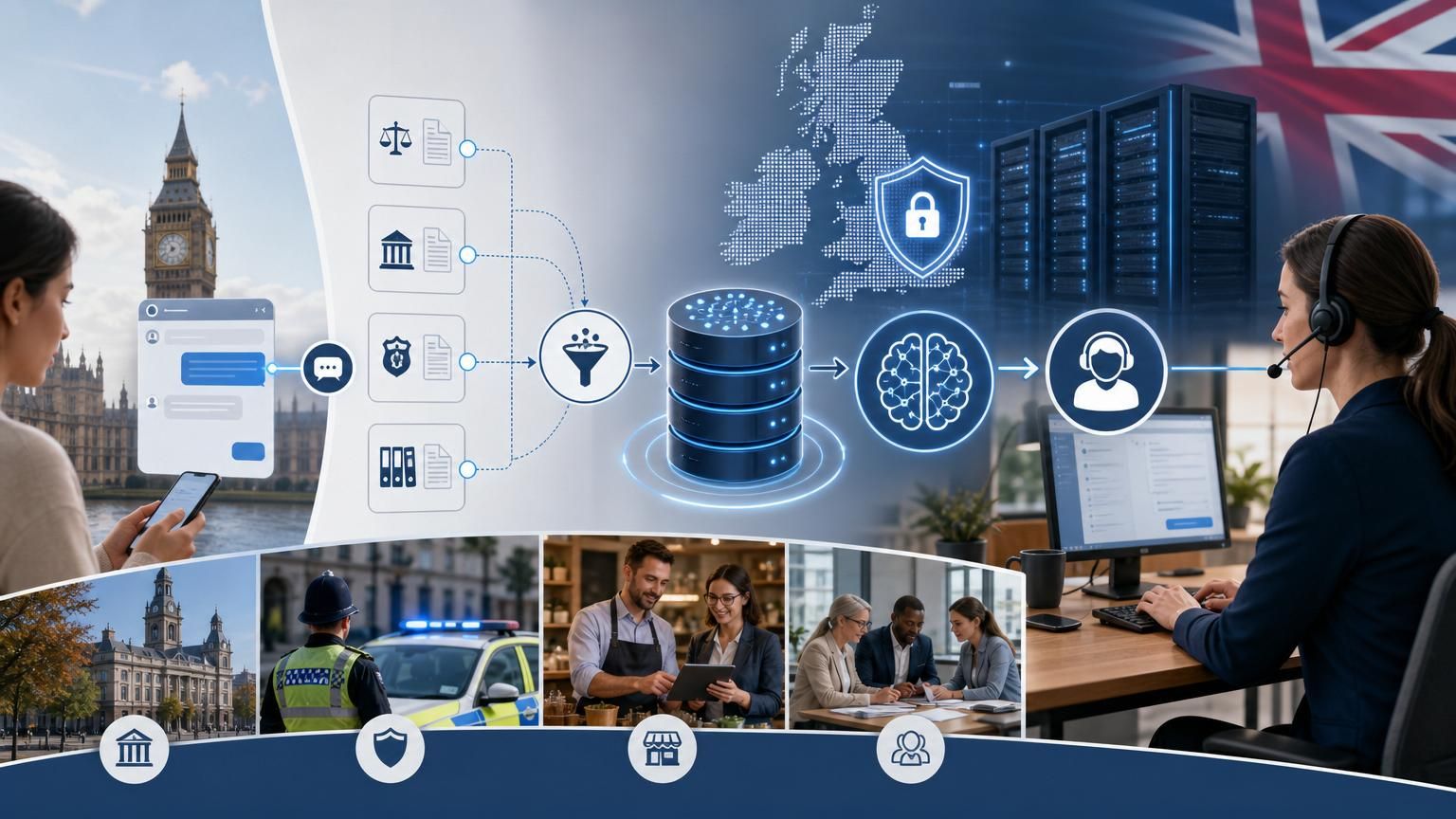
Why UK regulated teams need a "regulatory-aware" live chat
Regulated organisations—local councils, police forces, housing associations and financial services operating in the UK—face three simultaneous pressures: reduce response times, prove compliance, and keep citizen data inside UK jurisdiction. A generic chatbot that improvises answers won’t pass an FOI request, an audit trail review, or a regulator’s evidence request.

Nearly half of UK customer service teams already use AI in some form, and public sector pilots are increasing—so the question is no longer "if" but "how" you prove the answers were correct, auditable and appropriately handled. ()
This post explains a commercially practical approach: treat hybrid AI live chat as a regulatory control as well as a CX channel. That means RAG-backed answers, deterministic provenance, and mandatory human handoffs where policy requires it.
What "regulatory-aware" actually means in practice
Regulatory-aware live chat is not a single feature. It's a design pattern that combines these elements:
- UK-hosted data and compute to satisfy data residency and public-sector procurement expectations.
- RAG (Retrieval-Augmented Generation) or indexed knowledge that links every AI answer back to source documents and timestamps.
- Deterministic handoff rules so cases requiring human empathy, legal caution, or discretionary judgment are escalated automatically.
- Full audit logs with redaction controls for FOI/DSAR requests.
- Role-based access, encryption-at-rest, and policy-managed retention schedules.
RAG has become the enterprise backbone for reliable LLM responses because it anchors generated text to known documents—critical for auditability and repeatability. Enterprise adoption of RAG architectures and production LLM pipelines surged in recent years as teams prioritised accurate, sourceable responses. ()
Rule-based chatbots, pure LLM bots, and hybrid AI: clear differences
- Rule-based chatbots: deterministic, low-risk, and limited. They follow scripted trees and are easy to audit, but they fail on unstructured queries and scale poorly for knowledge-heavy tasks.
- Pure LLM bots: flexible and fluent. They can answer many questions out of the box but are unpredictable, may hallucinate, and provide no inherent provenance—an obvious problem for regulated responses.
- Hybrid AI live chat: the middle path. Hybrid systems use RAG to retrieve authoritative snippets and then a tuned LLM to produce conversational answers, with fast detection and deterministic escalation to a human agent when required. That combination gives you speed and flexibility with a record of sources and controllable risk.
For UK public services that must demonstrate how an answer was formed, hybrid AI is the only pragmatic architecture that balances service levels with compliance obligations. Research and enterprise reports show RAG-centered hybrids became the default approach for production LLM use cases in recent years. ()
Architecture and controls to demand from a vendor
If you're procuring live chat software for regulated work, insist on the following minimums:
- UK-hosted environments with documented data residency and subprocessors.
- RAG-enabled knowledge: each AI response must link back to the document(s) used.
- Immutable event logs and tamper-evident export for audits.
- Policy-driven handoff workflows: e.g. if an answer contains legal terms, patient data, or a complaint, route to a named human team within a set SLA.
- Explainability features: confidence scores, matched sources, and ability to force-source quoting.
- Configurable retention and redaction to satisfy DSAR/FOI timelines.
Vendors that treat AI purely as a UX novelty will struggle in tenders; procurement panels want verifiable controls, not marketing claims. The UK government’s AI adoption and guidance documents emphasise the need for oversight and documented controls—so alignment with national guidance matters in public-sector procurement. (gov.uk)
Practical rollout checklist (for support leaders and architects)
- Map regulatory touchpoints: identify every question type that carries legal, safeguarding, financial, or sensitive implications.
- Create a RAG corpus: contracts, policies, SOPs, council webpages, and local statutes used to answer queries.
- Define escalation policies: what triggers a human handoff and who owns the SLA.
- Deploy a staging environment: test FOI/DSAR extractions and provenance before going live.
- Train agents on the hybrid workflow: agents must know how to validate, annotate, and close AI-assisted cases.
- Monitor failure modes: track hallucinations, fallback rates, and human takeovers—then tune retrievers and prompts.
A well-run hybrid pilot will typically reduce triage time while keeping complex decisions human-controlled—delivering both efficiency and defensibility.
Measurement: what proves this approach works
Measure both performance and governance.
Key metrics:
- First-contact resolution for low-risk enquiries (expect uplift from RAG-enabled responses).
- Rate of human handoffs and why they occurred (triage accuracy).
- Provenance completeness: percentage of AI answers with at least one cited source.
- Audit extraction time: how quickly you can produce exportable logs for an FOI or compliance review.
Industry evidence shows organisations that ship agentic or RAG-backed AI systems can handle materially more tickets with fewer escalations—enterprise studies report double-digit improvements in throughput as teams shift to hybrid models. ()
Where IMSupporting fits (practical vendor fit for UK buyers)
If your procurement brief requires UK hosting, RAG provenance and configurable hybrid workflows, look for vendors that explicitly publish those capabilities. IMSupporting documents both RAG-based knowledge features and hybrid workflow controls—two foundations of a regulatory-aware live chat approach. See IMSupporting’s RAG feature detail and hybrid chat workflow pages for concrete functionality and controls: RAG-based AI agent knowledge and Hybrid AI chat workflows.
Quick risk checklist for public sector teams
- Data residency: verify UK-hosted tenancy and subprocessor list.
- Audit exports: can you produce tamper-evident logs within the statutory deadline?
- Human oversight: are handoff rules enforced automatically or left to agents’ discretion?
- Procurement compliance: does the vendor provide security, accessibility and accessibility evidence for tenders?
Final recommendation and next steps
Make hybrid AI live chat a compliance project as much as a CX one. Start with a focused corpus (payments, council tax, housing benefits), enable RAG provenance, and lock in deterministic handoffs for anything that could trigger legal or safeguarding risk. Treat auditability, retention and UK hosting as procurement gates—not optional extras.
If you want a practical vendor that documents RAG provenance and hybrid workflows and can demonstrate UK-friendly hosting and governance, review IMSupporting’s capabilities and ask for a compliance and provenance demo on your live data. Learn more and request a demo at the IMSupporting homepage: https://imsupporting.com/.