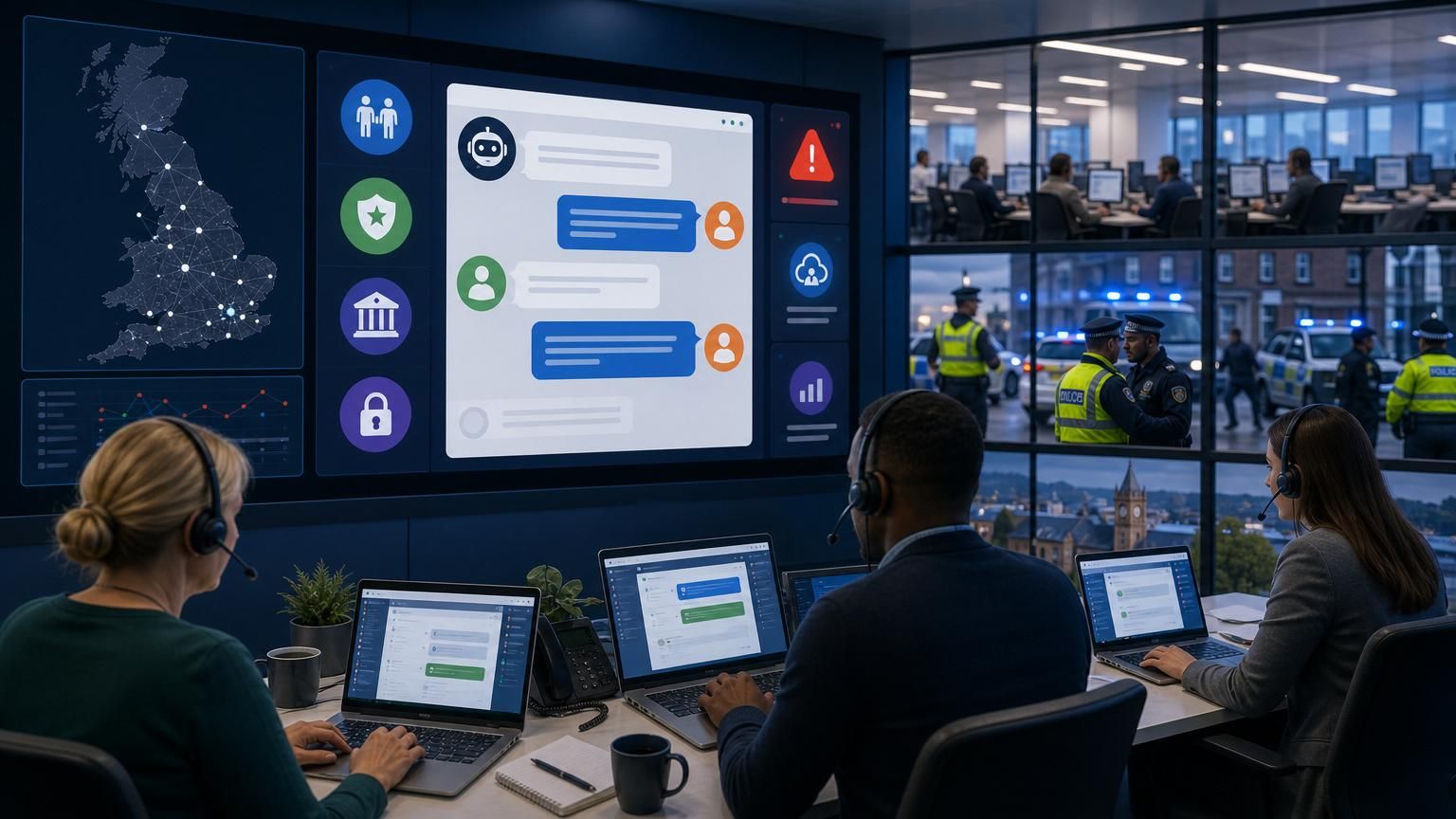
Why resilience should be the frontline metric for UK support
Surges are the rule, not the exception. Weather events, benefit roll-outs, local elections and sudden staffing shortfalls create predictable spikes that break legacy phone queues and overwhelm email. For UK councils, police contact centres and regulated teams, those spikes aren't just frustrating — they are a risk to service continuity, public safety and legal compliance.
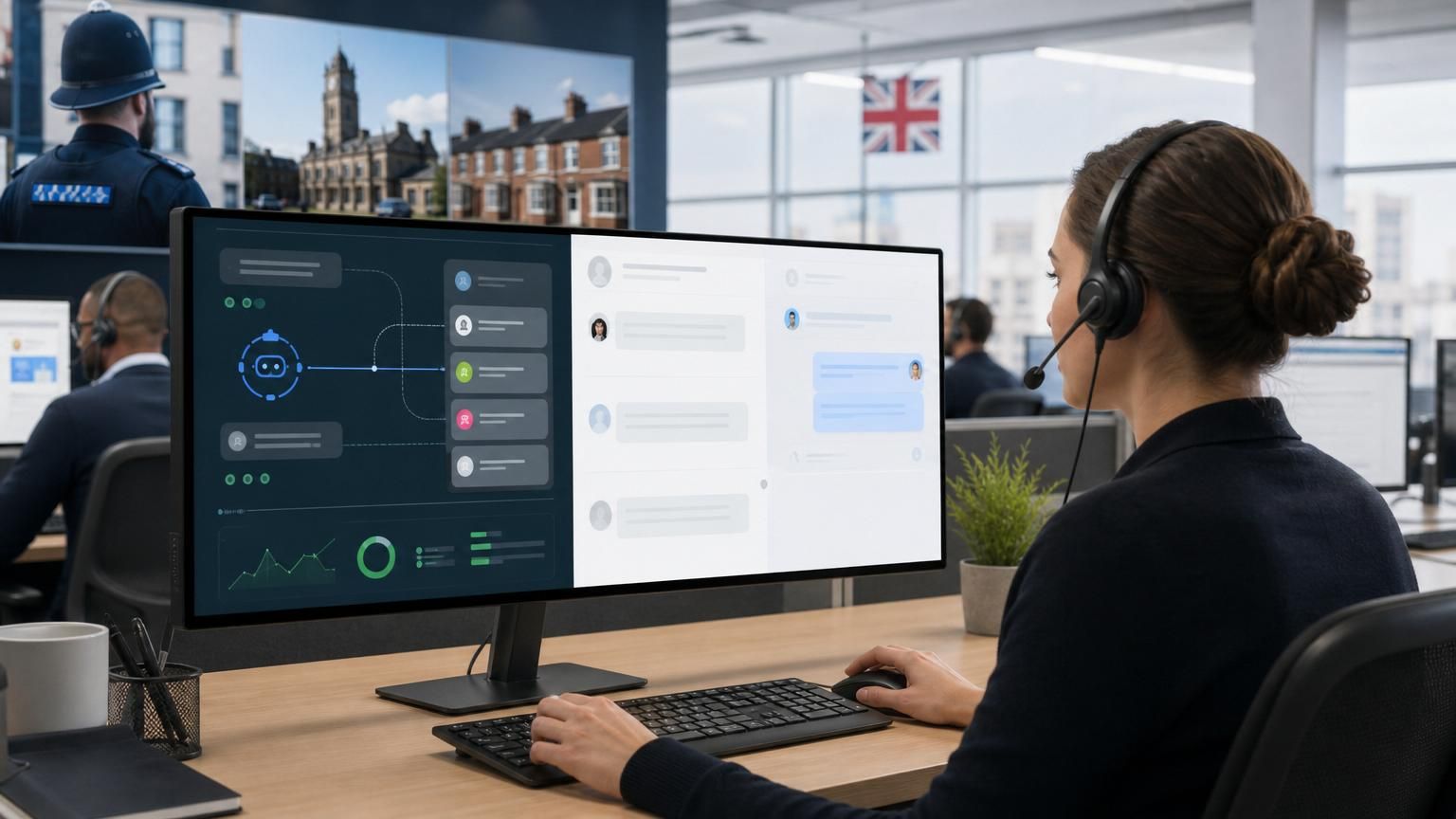
Hybrid AI live chat is the pragmatic way to build a resilient front line: a UK-hosted, policy‑aware triage layer that absorbs volume, preserves evidence, and hands-off only the cases that truly need human judgement.
What resilience looks like in practice
Resilience here means three operational outcomes:
- Fast, reliable first contact during spike periods.
- Safe, auditable handoff for high‑risk cases.
- Data sovereignty and minimum-data capture to meet UK requirements.
A single well‑designed hybrid chat stack can reduce peak response time, increase contact rates, and prevent low‑value caseloads from routing to overstretched specialists.
The commercial case: measurable impact
Where implemented correctly, live chat improves conversion and contact outcomes: businesses commonly report conversion uplifts around 20% after adding live chat on key pages, and chat satisfaction figures often sit very high—useful benchmarks when arguing business case or budget for councils and housing associations. ()
Statistics-style sentence: expect single‑digit to low‑double-digit percentage improvements in first‑contact resolution and significant drops in abandonment during surge windows when chat is paired with smart routing.
Rule-based bots, pure LLMs, and hybrid AI — what each does (and why hybrid wins for resilience)
- Rule-based chatbots
- Definition: deterministic scripts, menu trees and pre-set flows.
- Strengths: predictable, auditable, low risk for regulated queries.
- Limits: brittle under novel questions; high maintenance during policy or process change.
- Pure LLM bots
- Definition: generative models that answer with broad language ability.
- Strengths: fluid language, good for exploratory help or knowledge discovery.
- Limits: higher hallucination risk, unpredictable for legal/safeguarding content, and hard to certify for audit trails.
- Hybrid AI live chat
- Definition: a composition approach: RAG or knowledge‑agent retrieval for precise answers, deterministic workflows for sensitive steps, and instant human handoff when policy or empathy is required.
- Strengths: fast triage, low hallucination when paired with RAG sources, auditable handoffs and policy enforcement.
For resilience during surges you need the predictability of rule-based flows for critical processes, the language flexibility of LLMs for broad enquiries, and a governance layer that unifies them — that’s hybrid AI.
Technical blueprint: how to build a resilience-first hybrid chat
- UK-hosted RAG knowledge layer
- Keep knowledge stores and vector indexes in UK-hosted infrastructure to satisfy data‑sovereignty concerns for councils, police and regulated services. Use RAG (retrieval-augmented generation) so the AI answers from vetted sources rather than free‑generation. This dramatically reduces hallucination risk during surge volumes. Link your RAG agent to authoritative local policy pages and case logs. See IMSupporting’s RAG-based agent features for an example of this architecture. ()
- Policy-first triage workflows
- Implement deterministic workflows for gating sensitive interactions (safeguarding, crime reports, benefit appeals). Use hybrid workflows that triage automatically but require explicit human confirmation for case creation or PII capture. IMSupporting documents hybrid AI chat workflows that combine automation with guaranteed human escalation paths.
- Minimal, consented data capture
- Capture only the fields needed for triage on first contact. Use progressive consent: request more details only when a safe handoff is in progress. This reduces legal risk and keeps public trust.
- SLA-aware routing and elastic human pools
- Configure the hybrid platform to route based on SLA and agent skill during spikes. Maintain mutual aid pools across neighbouring councils or housing providers (contractually) to absorb overflow without moving data off‑shore.
- Audit trails and exportable artefacts
- For every handoff create an immutable, exportable evidence bundle that includes time‑stamped transcript, RAG citations, and the reason for escalation. That single artefact shrinks case assembly time and supports FOI or investigatory needs.
Procurement and compliance: what buyers are asking for now
Procurement teams increasingly ask for certifiable AI governance and evidence. Expect ISO/IEC 42001 (the AI management system standard) or equivalent governance evidence to appear in tenders as buyers demand proof of lifecycle controls and risk registers. Make sure supplier responses map features to those governance checkpoints. ()
Regulatory context is changing fast: the ICO’s guidance on AI and data protection, and recent UK data‑use legislation, reshape how public bodies must design consent, explainability and data‑sharing in chat services. Buyers should insist on vendor controls that directly map to ICO toolkits and the UK legislative baseline. (ico.org.uk)
Real-world playbook for a 90‑day resilience pilot
Week 1–2: Audit and scope
- Map top 10 surge scenarios (storms, service launches, benefit deadlines).
- Identify data classifications and mandatory gating logic.
Week 3–6: Build and connect
- Stand up UK-hosted RAG index and import policy content.
- Configure deterministic flows for four highest‑risk processes.
Week 7–10: Run a controlled surge test
- Simulate peak demand with staged traffic and mutual aid routing.
- Validate handoff artefacts and SLAs.
Week 11–12: Iterate and scale
- Tune prompts, tighten gates, add agent training for overflow pools.
When to pick hybrid AI over alternatives
Choose hybrid when you need:
- Guaranteed evidence trails for regulated interactions.
- UK data residency and predictable behaviour under stress.
- Rapidly scalable triage during known surge windows.
Rule‑based alone is too brittle; pure LLM alone is too risky. Hybrid pairs each approach where it belongs.
Quick vendor checklist for procurement leads
- UK hosting and data residency guarantees.
- RAG or knowledge‑agent support with source citations.
- Deterministic gating for safeguarding, and immutable handoff bundles.
- ISO/IEC 42001 or mapped AI governance artifacts available.
- Elastic routing and contractual mutual‑aid options for local government clusters.
For a practical implementation that maps RAG-based accuracy to hybrid workflows built for UK public services, review IMSupporting’s RAG agent and hybrid workflow features: https://imsupporting.com/feature-rag-based-ai-agent-knowledge.php and https://imsupporting.com/feature-hybrid-ai-chat-workflows.php.
Next steps and a pragmatic CTA
If you need a fast, procurement-ready pilot that proves resilience during real surge windows, pick a UK-hosted hybrid stack and run a 90‑day stress test with exportable artefacts and SLA reporting. Start with a controlled pilot for one service line (housing repairs or benefit enquiries) and expand after measurable improvements in response time and case throughput.
See how a UK-hosted hybrid AI live chat can be structured for surge resilience and compliance at IMSupporting — schedule a demo or pilot to map this blueprint onto your services: https://imsupporting.com/.