Why risk-adaptive live chat matters for UK organisations
One size does not fit all. UK councils, police teams, housing associations and regulated services need a live chat approach that adapts the AI's autonomy to the actual risk and sensitivity of each conversation — not a fixed bot that either over-escates every enquiry or dangerously automates decisions it shouldn't.

Regulatory bodies expect auditable, explainable processing of personal data and AI-driven decisions. The ICO has published specific guidance on how organisations must handle AI and personal information under UK GDPR. (ico.org.uk)
At the same time, public-sector programmes and central reviews show AI adoption is increasing, but with strong emphasis on control, transparency and skills gaps. The National Audit Office and Local Government Association reports underline that government departments and councils are planning AI but require governed approaches. ()
The three chat architectures — and why the difference matters
- Rule‑based chatbots: follow scripted flows and decision trees. Predictable, easy to certify, but brittle — they fail when enquiries deviate from templates and force manual handovers that slow service.
- Pure LLM bots: generative models that produce human-like replies. Great for natural language, but without grounding they hallucinate, and they offer limited provenance for audits.
- Hybrid AI live chat: the operational middle ground. A Retrieval‑Augmented Generation (RAG) foundation pulls authoritative documents into the model context, while policy layers and human handover gates control autonomy. This is the architecture UK public services need when sovereignty, auditability and speed all matter. ()
What 'risk‑adaptive' actually means in practice
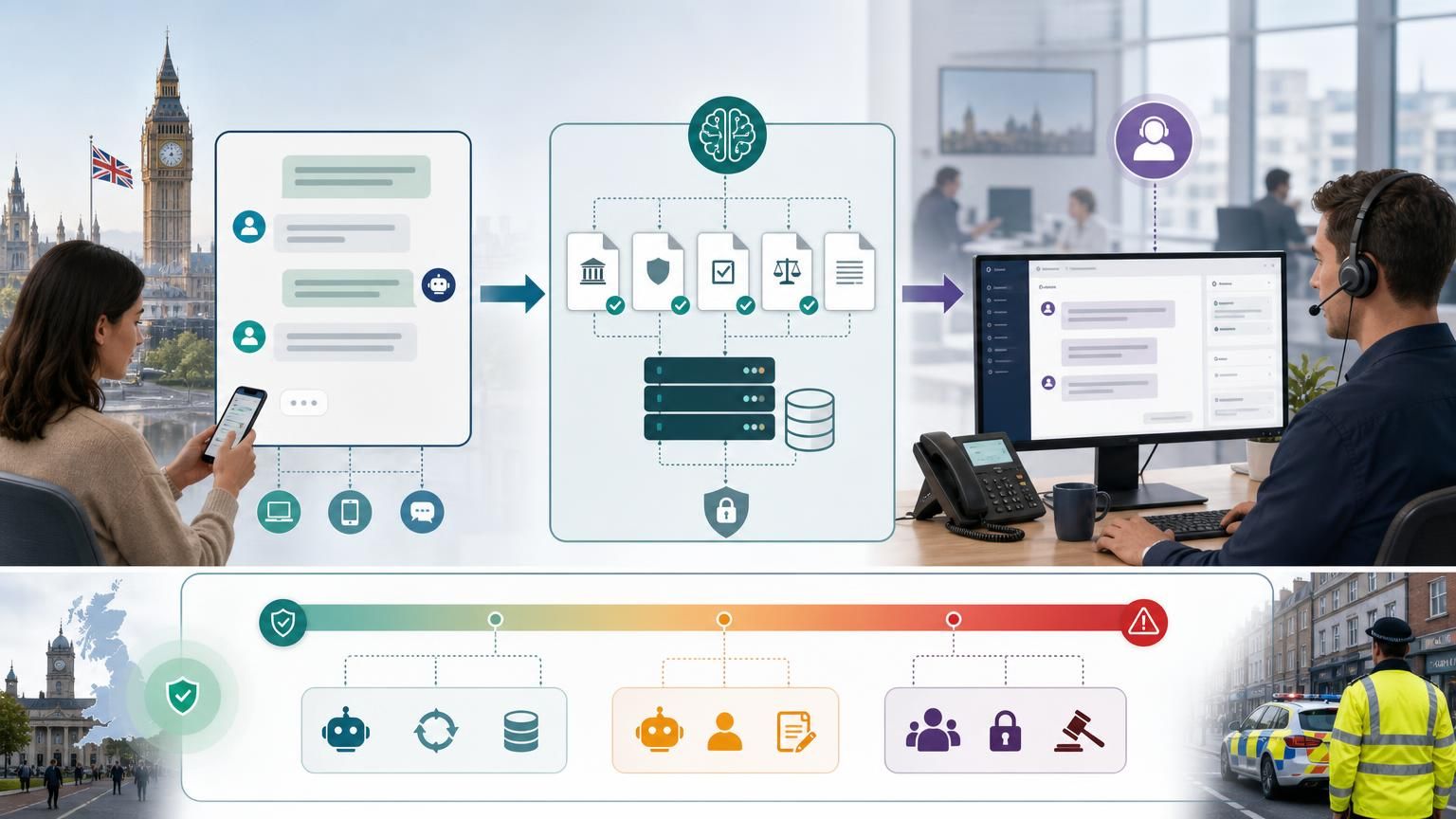
Risk‑adaptive hybrid AI live chat dynamically adjusts three things, per conversation: autonomy, logging detail, and escalation thresholds.
- Autonomy: low‑risk queries (opening hours, application forms, status checks) can be auto‑answered by RAG‑backed AI with templates. Higher‑risk queries (safeguarding, enforcement, sensitive personal data) require agent approval or immediate handover.
- Logging detail: full provenance and evidence capture for regulated interactions; minimal metadata for simple FAQs to reduce storage footprint and privacy exposure.
- Escalation thresholds: the system raises a human alert when policy rules or confidence scores fall below safe limits, or when detected keywords match risk categories.
This approach reduces unnecessary human workload while guaranteeing human oversight where it counts.
A simple risk taxonomy you can implement this week
- Level 1 — Informational: public, non-personal. Auto-respond with cached RAG answers, short provenance.
- Level 2 — Transactional: identity or account updates, requests requiring authentication. AI drafts answers; agent review before send.
- Level 3 — Regulated or Safeguarding: crime reports, social care, eviction notices. Immediate human takeover, mandatory evidence capture and UK‑hosted storage.
Map your services and tag every chat entry point. Use metadata (user type, page visited, keywords) to map the taxonomy to live routing logic.
How RAG and hybrid workflows reduce hallucination and increase auditability
RAG connects the AI to an authorised knowledge base at query time, so answers are grounded in current, organisation‑owned documents rather than model memory. That reduces factual errors and helps you provide citations inside agent notes and audit trails. ()
Hybrid workflows add policy gates: confidence scoring, keyword triggers, and role-based handover routes that are auditable and configurable. This is the architecture recommended for regulated environments where decisions must be defensible in reviews or FOI requests.
For product-level options that implement RAG-backed knowledge with handover workflows, see IMSupporting's feature pages on RAG-based AI agents and Hybrid AI chat workflows. https://imsupporting.com/feature-rag-based-ai-agent-knowledge.php and https://imsupporting.com/feature-hybrid-ai-chat-workflows.php
Example use cases for UK councils, police and housing associations
- Councils: auto-respond to bin collection, council tax bands (Level 1); draft housing benefit case replies for agent review (Level 2); triage safeguarding referrals to duty teams (Level 3).
- Police: public advice and non-emergency reporting through AI triage; immediate handover and evidence capture for crime reports; routed escalation to on‑call officers with full provenance.
- Housing associations: automate routine tenancy checks; agent-approved templates for arrears communications; human-only handling for vulnerable tenant reports.
These patterns protect citizens and reduce avoidable human workload.
Implementation checklist — seven pragmatic steps
- Map critical conversation types to the three risk levels.
- Choose a UK‑hosted platform that supports RAG indexing and configurable handover rules. (UK hosting keeps data sovereignty and procurement simpler.)
- Build knowledge connectors for authoritative sources (policy docs, case notes, legislation) and version them.
- Define policy gates: confidence thresholds, keyword lists, user identity checks.
- Configure logging and retention per risk: searchable evidence for Level 3; compressed metadata for Level 1.
- Run a closed‑loop pilot: measure escalation rate, time‑to-resolution, and compliance incidents. Use human corrections to refine retrievers and templates.
- Train agents on 'explain and escalate' handovers so citizens receive context-rich replies and a clear human point of contact.
A well-run pilot will show measurable reductions in repeat escalations and faster first‑contact resolution.
Metrics that matter for leadership
- Escalation rate by risk level (target: reduce Level 1 escalations by 40% in 90 days).
- Time to handover (average seconds) and time to resolution (hours/days).
- Audit completeness: percent of regulated conversations with full provenance and evidence.
- Citizen satisfaction (CSAT) changes for automated vs human‑handled interactions.
Vendor and public surveys suggest customers value choice: many prefer a mix of bot and human depending on complexity. One consumer study found a clear split between users who prefer automated answers for basic queries and human support for complex issues. ()
Procurement and procurement-friendly governance notes for UK buyers
- Demand UK hosting and named data flow maps in contracts.
- Require capability to export full provenance for audits and FOI responses.
- Insist on configurable policy layers and a documented handover trail for each conversation.
- Ask for a pilot with public-sector references and a plan for secure onboarding of knowledge assets.
The NAO and other reviews highlight the importance of governance and skilled delivery teams for public-sector AI programmes. ()
Start small, govern fast, scale safely
Risk‑adaptive hybrid AI live chat is not about replacing people — it's about reallocating human time to the highest‑value, highest‑risk work while delivering faster, auditable service for citizens and regulated customers. If you need a concrete implementation partner with UK‑hosted RAG options and configurable hybrid workflows, review practical feature details at IMSupporting's RAG and workflow pages and then request a demo to see risk gates in action. https://imsupporting.com/feature-rag-based-ai-agent-knowledge.php and https://imsupporting.com/feature-hybrid-ai-chat-workflows.php
Ready to pilot a risk‑adaptive live chat that keeps data in the UK, preserves audit trails, and reduces unnecessary escalations? Book a demo and start a secure pilot with IMSupporting today: https://imsupporting.com/
Quick recap
- Use RAG to ground answers; use policy gates to control autonomy.
- Implement a simple 3‑level risk taxonomy and map channels to levels.
- Prioritise UK hosting, exportable provenance, and configurable handover flows for public‑sector procurement.
Make the next iteration of live chat a risk‑aware support assistant — faster for citizens, safer for your organisation.