Start with risk not intent. Design live chat so the platform evaluates legal, privacy and service risk in the first 1–2 messages and routes the session to the right channel: human-first for high-risk, automated for low-risk, or hybrid for cases where RAG checks and a short human check are required.

Why risk-aware routing matters now
Many UK public and regulated teams are trialling conversational AI — but the wrong decision at triage can create data leaks, compliance breaches, or long, costly handovers. Gartner predicts rapid conversational AI adoption across service channels, and CX leaders are already piloting generative AI at scale. ()
For UK councils, police contact centres and regulated organisations, the difference between a fast automated answer and a wrongly handled sensitive case is reputational, legal and operational. UK public guidance allows public sector use of cloud services, but insists on clear risk assessments and safeguards where data sensitivity or sovereignty matters. (gov.uk)
This is where risk-aware hybrid AI live chat earns its keep: it lets you deliver automation benefits while enforcing policy, preserving evidence trails and keeping sensitive processing UK-hosted and auditable. ICO guidance on data-sharing and cloud use remains central to any design decision. (ico.org.uk)
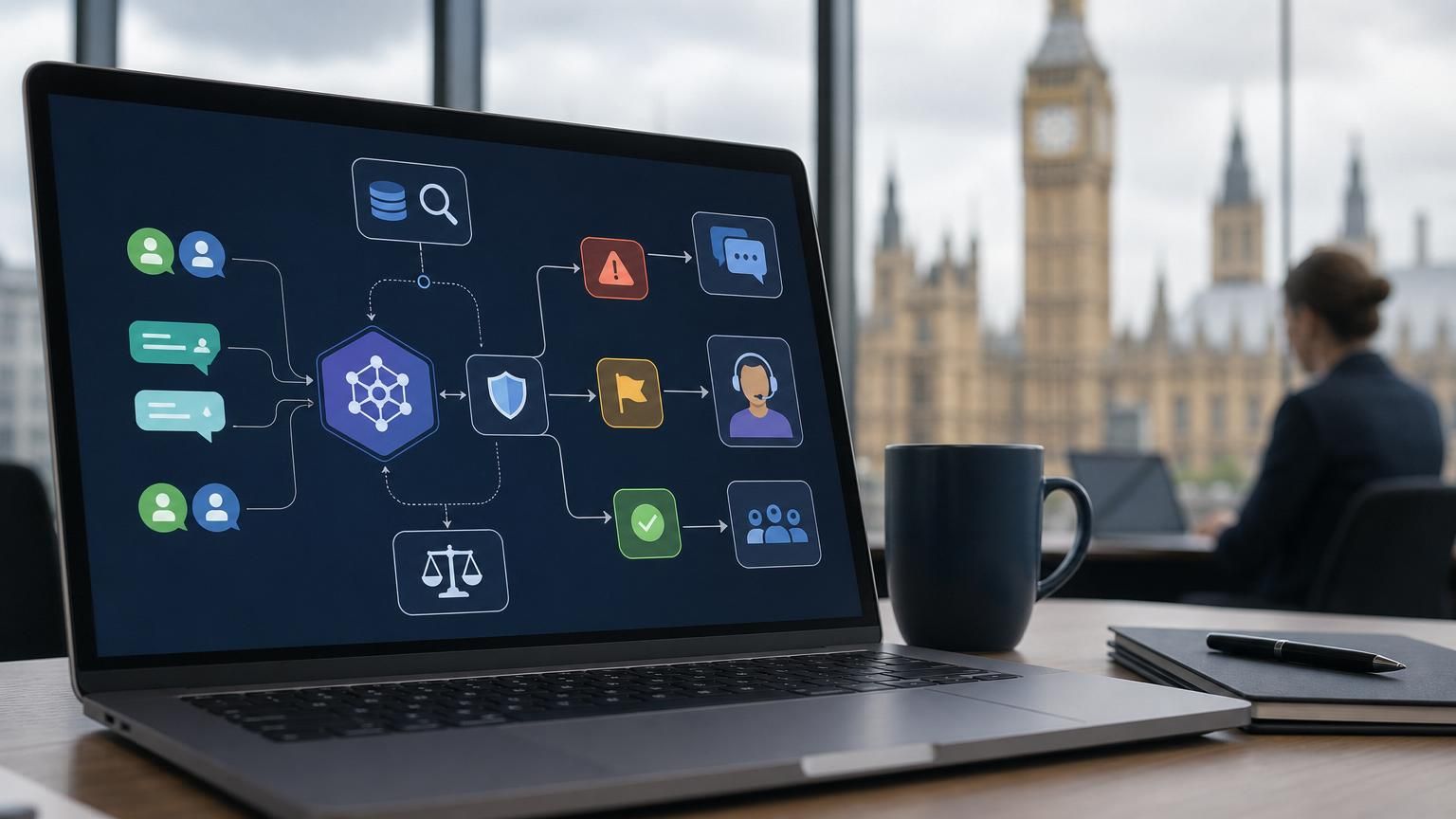
What "risk-aware" routing actually does
- Instantly classifies sessions by risk profile (low / moderate / high) using a short triage flow.
- Applies policy gates: e.g., PII flagging, transaction value, legal sensitivity, or regulated-subject flags (safeguarding, criminal matters, benefits).
- Chooses the execution mode: rule-based automation, RAG-verified AI response, or human agent queue.
- Logs the decision, the applied policy, and the data-handling instructions to create an audit-ready trail.
This approach reduces unnecessary human handoffs for routine queries, and prevents over-automation where risk is high.
Three bot types and where each should be used
Rule-based chatbots
- Deterministic flows (if X then Y). Best for scripted transactions (opening hours, simple FAQs, form-fillers).
- Low technical risk, easy to audit, but brittle with ambiguous queries.
Pure LLM bots (generative-only)
- Produce fluent, flexible replies but may hallucinate, leak data, or make unsupported promises if left unchecked.
- Unsuitable for high-stakes or regulated interactions without strong guardrails.
Hybrid AI live chat
- Combines LLM generative ability with retrieval-augmented generation (RAG), rule gates and human handoff logic.
- RAG reduces hallucination by grounding responses on organisation-controlled documents and policies. Research into RAG architectures highlights its value for improving answer accuracy in knowledge-heavy systems. ()
- Hybrid systems are the practical middle ground for UK regulated services: flexible, auditable, and safe when built with UK-hosted data stores and clear handoff policies.
Practical design patterns for UK-hosted risk-aware hybrid chat
- Fast triage: 2–3 micro-questions to score risk and consent (automated). Keep these UK-hosted and minimal.
- RAG verification layer: For moderate-risk queries, run RAG against UK-hosted policies, guidance, and case notes before replying. Use a confidence threshold to decide whether to reply or escalate. See IMSupporting’s RAG feature for ideas on integrating knowledge-based checks. https://imsupporting.com/feature-rag-based-ai-agent-knowledge.php
- Policy gates: Embed rule checks that block automated action for flagged categories (payments, safeguarding, legal claims).
- Human-in-the-loop handoff: For high-risk sessions, hand to human agents with a pre-assembled case bundle (recent messages, RAG-sourced references, suggested next steps) to cut handling time.
- Audit trail & evidence export: Log every triage decision, the documents retrieved by RAG, and the human confirmations.
IMSupporting’s hybrid AI chat workflows show how to automate triage while keeping human oversight intact. https://imsupporting.com/feature-hybrid-ai-chat-workflows.php
Example use cases (UK-first)
- Councils: Benefit eligibility queries flagged for PII routes to human review. Low-risk housing queries answered instantly with RAG-sourced policy snippets.
- Police contact lines: Non-emergency information answered by hybrid AI; any safeguarding language triggers human escalation and a mandatory evidence capture.
- Housing associations: Rent payment confirmations treated as moderate-high risk — automated checks provide status, but payment changes require a human approval step and an audit trail.
These patterns keep automation where safe and keep humans where trust is essential.
Performance and governance metrics to track
- False negative risk rate (sensitive cases routed to automation). Target: <1% in early production.
- Average time to human handover after escalation. Improving this by pre-assembling case bundles can cut handover time by 20–40% in many deployments.
- RAG retrieval precision (how often retrieved documents support a correct answer).
- Audit completeness: percent of sessions with full decision logs.
A governance cadence (weekly model performance checks, monthly policy review, quarterly tabletop with legal and data-protection officers) is essential.
Technical checklist for architects
- Ensure all personal data used for RAG indexing is stored and processed in UK regions where required; map processing flows for controllers and processors. (gov.uk)
- Use vector stores with access controls and retention rules separate from public cloud LLM endpoints.
- Implement confidence thresholds and fallback rules: if RAG confidence < X, escalate to human.
- Capture consent at triage for any use of citizen data in automated decisions.
- Maintain exportable case bundles for FOI, audit, and compliance requests.
Competitive context — what separates good from risky implementations
- Good: UK-hosted knowledge bases, clear policy gates, RAG verification and transparent audit trails.
- Risky: Black-box LLM replies without grounding, unknown data flows out of UK control, and no accountable handoff process.
Market momentum means tools are moving fast — but public and regulated buyers should prioritise data sovereignty and explainability as non-negotiable procurement criteria. Deloitte and industry reports underline the five vectors advancing conversational AI, including governance and data strategy — not just model capability. ()
Roadmap: 90-day pilot to production
- Day 0–30: Map high-risk processes, gather policy documents and decide triage rules.
- Day 30–60: Build triage microflow, wire RAG to UK-hosted content, set confidence thresholds and logging.
- Day 60–90: Live pilot with a subset of channels (web chat, portal), run weekly audits, and tune gates. Ramp to full service post-approval.
Final word and next step
Risk-aware hybrid AI live chat is not about choosing automation or humans — it’s about choosing the right mix for each contact based on legal, privacy and service risk. For UK councils, police and regulated organisations that need UK-hosted, auditable solutions, start with triage, RAG verification and a mandatory human-overrule path.
If you want a practical, UK-hosted platform that supports RAG-based knowledge, hybrid AI workflows and audit-ready handoffs, review IMSupporting’s features and request a demo: https://imsupporting.com/.
Start your pilot with a clear risk matrix and ensure every automated reply is traceable back to a UK-hosted source — that’s how you deliver faster service without increasing regulatory exposure.