The problem: chat is useful — until it isn’t
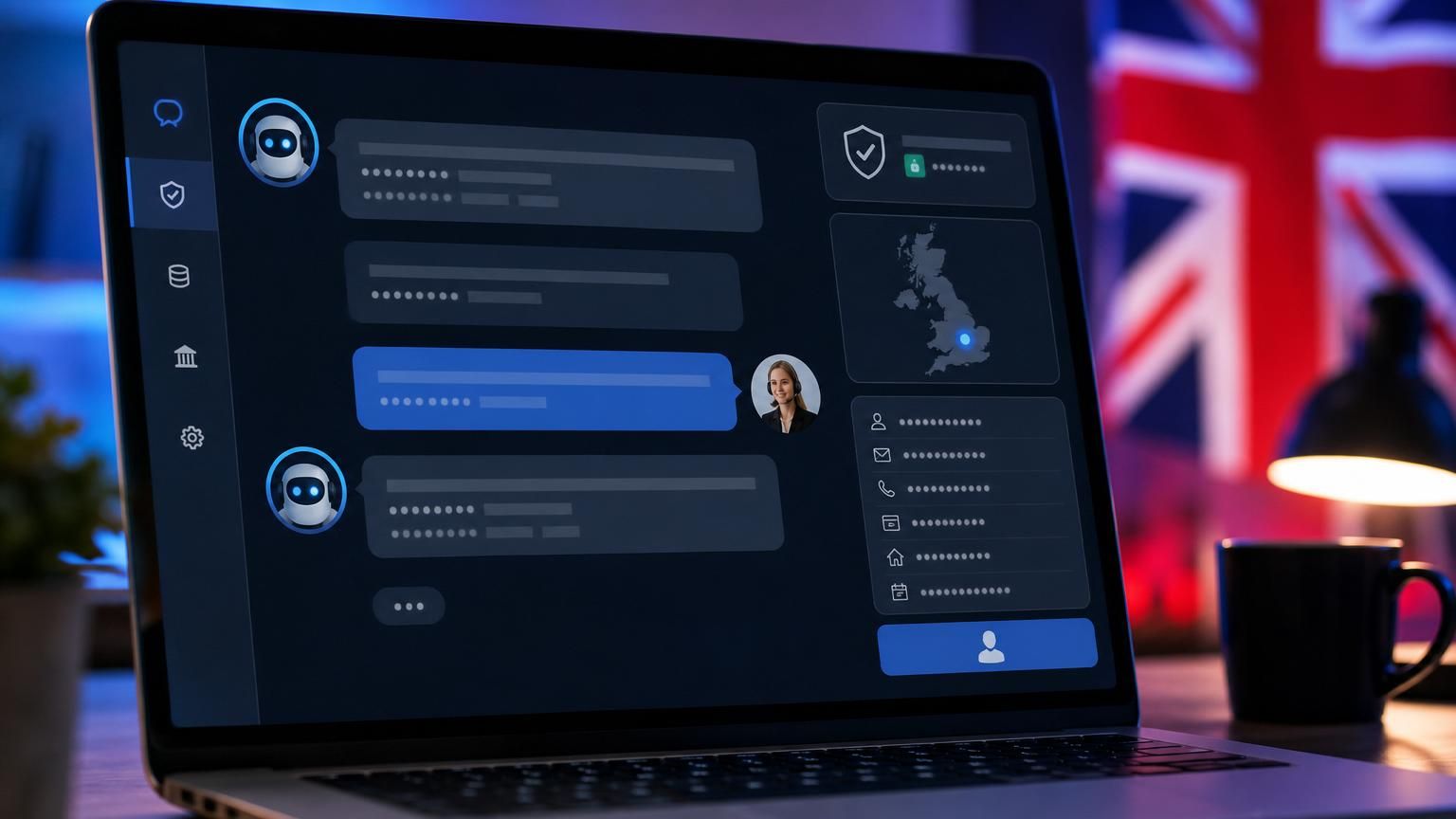
Live chat is now a frontline channel for urgent enquiries from citizens, tenants, victims and procurement teams. That means the stakes are higher: sensitive personal data, case references and safeguarding information routinely flow across chat. Many UK organisations still lack a runtime layer that can enforce jurisdictional rules and redact or route sensitive content before it leaves their control.

Why 'risk-aware middleware' matters for UK regulated teams
- Prevent data leaving UK-only zones when a chat contains personal identifiers.
- Stop full-text export of case notes to third‑party LLMs unless a governance check passes.
- Ensure a human specialist reviews borderline cases (safeguarding, criminal, health) before final advice is given.
This is not theoretical: a growing share of UK organisations treat data residency and auditable controls as operational requirements, not future nice-to-haves. ()
What risk-aware hybrid AI actually is
Risk-aware hybrid AI live chat = three coordinated layers:
- A lightweight policy engine that classifies and tags chat content in real time (sensitivity, jurisdiction, PII).
- A hybrid AI layer that combines RAG-grounded retrieval with small LLM summarisation for triage and suggested replies.
- Human-in-the-loop controls and auditable handoffs where policy or confidence thresholds require escalation.
These layers must run on UK-hosted infrastructure for regulated teams (police, councils, housing associations) to meet data‑sovereignty expectations and procurement rules. Government and enterprise customers increasingly prioritise domestic hosting when choosing conversational platforms. (gov.uk)
Rule-based chatbots vs pure LLM bots vs hybrid AI live chat
Rule-based chatbots
- Triggered by keywords and decision trees.
- Predictable, auditable, but brittle at scale. Good for forms, payments and deterministic flows.
Pure LLM bots
- Rely on large models to generate freeform responses.
- Fast and flexible but risky for regulated data: hallucinations, unpredictable access patterns and unclear data residency unless tightly controlled.
Hybrid AI live chat (what you should aim for)
- Uses RAG (retrieval-augmented generation) to ground answers in your documents and policies and a lightweight LLM for framing.
- Applies a policy layer that redacts or classifies PII before it’s used in model prompts.
- Escalates automatically to humans when confidence, sensitivity, or regulatory flags appear.
Hybrid approaches are now the pragmatic default for UK organisations that must balance speed with control. The academic and production literature shows hybrid frameworks that mix RAG with rule sets outperform pure LLM-only approaches for regulated content handling. ()
A statistic you can use in procurement and board papers
Mature hybrid deployments commonly handle between 70–80% of routine queries via AI triage while keeping the remaining 20–30% for human specialists — a split that preserves specialist time and accountability for complex cases. Use that ratio to model FTE reductions and SLA improvements. ()
Practical controls every UK-first hybrid live chat must enforce
- Data residency gates — block any outbound request to non-UK model hosts if the conversation is flagged as containing restricted data.
- PII redaction pipeline — detect and mask national identifiers, bank details and health information before they enter an LLM prompt.
- Jurisdictional routing — route chats from local residents, police cases or housing tenants to agents with local clearance and relevant scripts.
- RAG grounding with vetted knowledge bases — answers must cite the source document and link back to an auditable snippet, not free-text hallucinations. See RAG-based agent knowledge for practical implementation. IMSupporting RAG feature
- Confidence thresholds & handoff contracts — define the exact conditions that trigger a human takeover and what context is passed to the agent.
- Full audit trail — immutable logs of prompts, retrieved documents and human edits saved on UK-hosted storage for compliance and FOI responses.
Implementation blueprint for councils, police and housing associations
Step 1 — Classify risk profiles
Map every chat use case to a risk level: transactional, personal data, safeguarding, enforcement. This drives routing and redaction.
Step 2 — Deploy policy middleware in front of the model
Put your policy engine between the chat front-end and the AI layer so nothing is sent externally without checks. This is the simplest architecture change that reduces exposure.
Step 3 — Use RAG to ground every sensitive answer
Embed the organisation’s authoritative policies, SOPs and legal clauses in a retriever so answers can point to the source and be audited. IMSupporting’s RAG approach shows how to wire knowledge into an agent safely. IMSupporting RAG feature
Step 4 — Configure hybrid chat workflows that respect UK hosting
Define workflows where the AI triages, suggests an answer and only completes the reply after a human confirms for flagged cases — or the AI posts an answer if the confidence score exceeds the policy threshold. IMSupporting documents hybrid chat workflow patterns that match regulated environments. IMSupporting hybrid workflows
Step 5 — Train with real-case audits and closed‑loop updates
Capture edge cases and update knowledge snippets. Keep a small, governed loop where human reviewers correct RAG outputs and those corrections feed back into the knowledge base.
Procurement tips that make tenders succeed
- Specify UK data residency and audit log retention in the SLR.
- Require demonstrable PII redaction and routing rules with test scripts.
- Ask for live-play scenarios (safeguarding, fraud, health) during proof-of-concept and evidence of human handoff contracts.
Final checklist for a compliant UK-first hybrid deployment
- UK-hosted servers and encrypted storage. (gov.uk)
- Real-time PII redaction and classification.
- RAG grounding for regulatory guidance and SOPs. ()
- Defined confidence thresholds for human escalation. ()
- ICO-aligned documentation showing how AI processing meets UK data protection expectations. (ico.org.uk)
Conclusion and next step (for support leaders and procurement teams)
If your organisation is in the UK public or regulated sector, adopt a risk-aware hybrid AI layer before scaling AI across live chat channels. It’s the only approach that preserves the benefits of rapid triage while keeping sensitive data inside UK control and human specialists accountable.
Ready to see a UK-hosted implementation that combines RAG-grounded answers, policy middleware and human handoffs? Review deployment patterns and feature details at IMsupporting and test a secure hybrid workflow in a live POC. Visit https://imsupporting.com/ for product details and a secure-demo request.