Why a runbook — and why now
Support leaders in councils, police forces, housing associations and regulated UK businesses are no longer buying chat as a feature. They’re buying guaranteed outcomes: lower escalation rates, auditable decision trails and data residency assurances. The technology stack has matured — hybrid AI, retrieval‑augmented generation (RAG) and real‑time orchestration are now operational realities — but outcomes still hinge on operational discipline: mapping customer intent to a measurable SLA and a deterministic handoff when the AI reaches its boundary.

The measurable promise of hybrid AI
Hybrid AI combines fast automated triage with human judgment where required. When done right it improves speed and consistency while keeping complex decisioning with trained staff. Practical benefits you can measure immediately:
- Faster first response and reduced repeat contacts.
- Lower average handle time for routine queries.
- Clear escalation triggers and auditable handoffs for regulated decisions.
Organisations using generative AI features such as summarisation and rephrasing report resolution time reductions of up to 38% and measurable CSAT improvements, showing where hybrid approaches are already driving ROI. ()
Essential definitions — be precise
Rule‑based chatbots
Predefined scripts, decision trees and deterministic routing. They are reliable for simple flows (opening hours, form links, known forms of evidence) but brittle when language or context varies.
Pure LLM bots
Large language models generate fluent answers from patterns in data. Strong at conversational tone and broad knowledge — but prone to hallucination, and difficult to constrain for regulated outcomes without retrieval and guardrails.
Hybrid AI live chat
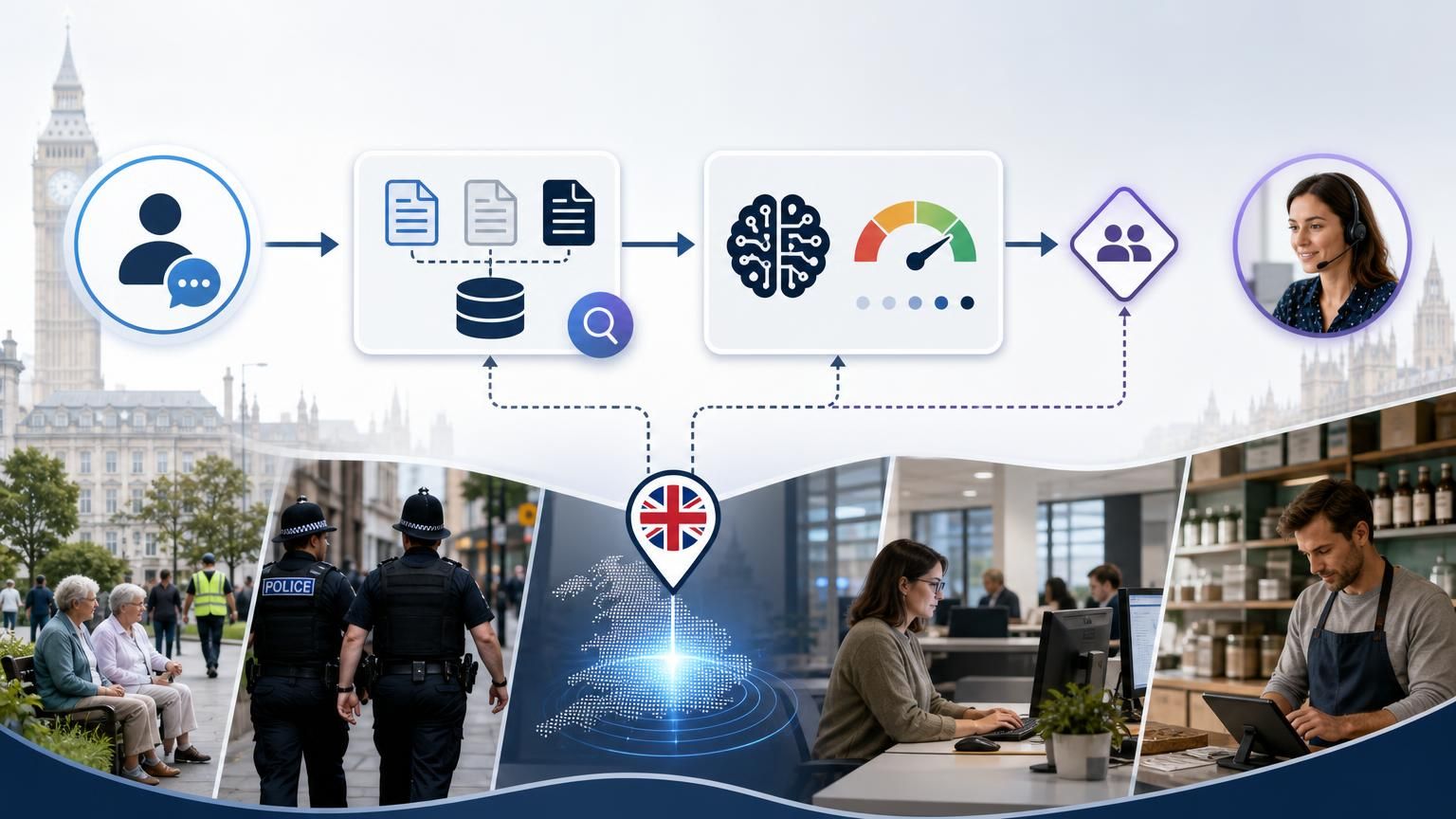
A composable approach: RAG or knowledge‑base retrieval feeds an LLM (or deterministic engine) for accurate answers; workflow orchestration applies policies, and a clear, immediate human handoff occurs when required. This is the only model that balances speed, accuracy and auditability for UK regulated teams.
RAG and hybrid orchestration reduce hallucinations by always sourcing answers from controlled corpora, which is why many public and regulated teams select hybrid patterns. ()
The runbook: map intent → outcome → SLA
Follow these stages to turn chat into a contractable service channel.
1) Define outcome buckets, not just intents
Create 4–6 outcome buckets that match procurement/SLA expectations, for example:
- Information-only (no PII/decision required)
- Transactional (payments, bookings)
- Case creation (welfare, housing repair) — needs evidence capture
- Regulated decision (licensing, safeguarding) — human‑only escalation
Each bucket gets a measurable SLA (see step 3).
2) Tag intents to outcomes at the knowledge layer
Use RAG or indexed knowledge so every retrieved document carries metadata: source, sensitivity, revision date, author, and jurisdiction. These tags are how automation decides whether the AI can answer or must escalate. Implement this with a RAG-backed knowledge layer like a UK-hosted, auditable index so resolution claims are traceable. See IMSupporting’s RAG knowledge feature for a practical implementation pattern: https://imsupporting.com/feature-rag-based-ai-agent-knowledge.php.
3) Define SLAs and escalation triggers
Make SLAs numeric and contractual. Examples:
- Information-only: 95% auto‑resolution within 30s.
- Transactional: 98% correct response or confirmed human handoff within 5 minutes.
- Case creation: 100% human validation within 4 hours; ticket created and reference provided within 10 minutes.
- Regulated decision: human agent responds within 60 minutes; AI may only open a draft ticket.
Define measurable KPIs: response time, handoff accuracy, escalation rate, FCR (first contact resolution) and audit completeness.
4) Implement deterministic guardrails
Guardrails prevent scope creep. Examples:
- Confidence threshold: if retrieval confidence < X, auto‑escalate.
- Data sensitivity rule: any PII/health/legal keyword forces human review.
- Policy token: if query matches a GDPR/process token, block automated decisions and attach a human reviewer.
Link these guardrails into the chat workflow so actions are reproducible and auditable. IMSupporting’s hybrid AI workflows show practical orchestration for this pattern: https://imsupporting.com/feature-hybrid-ai-chat-workflows.php.
5) Test with real‑world error budgets
Don't aim for zero exceptions out of the gate. Define an error budget and run a phased rollout on low‑risk buckets. Monitor escalation accuracy, false‑positive escalations and customer satisfaction — then tighten thresholds.
6) Operationalise measurement and continuous review
Make measurements visible to managers and procurement teams. Reports should show:
- Escalation rate by outcome bucket
- Average human time after handoff
- FCR percentage for hybrid sessions
- Evidence completeness score (are transcripts, attachments, and decision metadata stored in UK hosting?)
Public sector teams must ensure data residency and transfer controls align with government cloud guidance and ICO rules on international transfers. That’s not optional for regulated data. (gov.uk)
Practical tech selection checklist (UK‑hosted required)
- UK‑hosted indexing and vector store for sensitive corpora.
- Proven RAG support with metadata tagging and document provenance.
- Deterministic workflow engine that forces human validation on regulated paths.
- Audit logging, exportable and searchable by date/agent/keyword.
- Accessible transcripts that meet public sector accessibility standards.
- Data export and deletion tools aligned with ICO guidance on AI and data protection. (ico.org.uk)
Governance and procurement notes for councils and police
- Build SLAs into your supplier contracts: require UK data residency or a clear lawful transfer mechanism.
- Require evidence-of-proof: ability to export transcripts, retrieval provenance and the configuration of guardrails.
- Expect to iterate: many organisations set up a hybrid AI Centre of Excellence to manage models, RAG indexes and SLAs — roughly half of data leaders are formalising hybrid AI governance today. ()
Risk realities to plan for
- Hallucination risk remains if retrieval is incomplete; always pair generation with source citations.
- Over‑automation can harm satisfaction — monitor FCR and CSAT, not just speed. KPMG and sector reports recommend measuring AI FCR separately and expecting to tighten escalation policies until parity with human decisions is achieved. ()
Quick checklist to launch a compliant pilot (30–60 days)
- Select 1–2 low‑risk outcome buckets.
- Build UK-hosted RAG index for relevant documentation.
- Configure guardrails and confidence thresholds.
- Train 10 agents on handoff protocols and audit expectations.
- Run pilot, measure escalation rate, FCR and CSAT — iterate weekly.
Final commercial argument
Hybrid AI live chat is no longer an experiment — it’s a strategic channel you can contract against. If you define outcomes (not features), enforce UK hosting and instrument SLAs with deterministic guardrails, you convert chat from a cost centre into a measurable service channel that keeps regulated decisions where they belong: in trained human hands.
Ready to build an operational runbook and deploy UK‑hosted hybrid AI with RAG and deterministic workflows? Start with a vendor that supports UK hosting, RAG‑based agent knowledge and hybrid orchestration to meet public sector SLAs. Explore IMSupporting’s approach and get a pilot set up today: https://imsupporting.com/ and see specific features at https://imsupporting.com/feature-rag-based-ai-agent-knowledge.php and https://imsupporting.com/feature-hybrid-ai-chat-workflows.php.
Call to action: arrange a pilot with IMSupporting to map your intents to auditable SLAs and prove compliance on UK‑hosted infrastructure — book a consultation at https://imsupporting.com/.