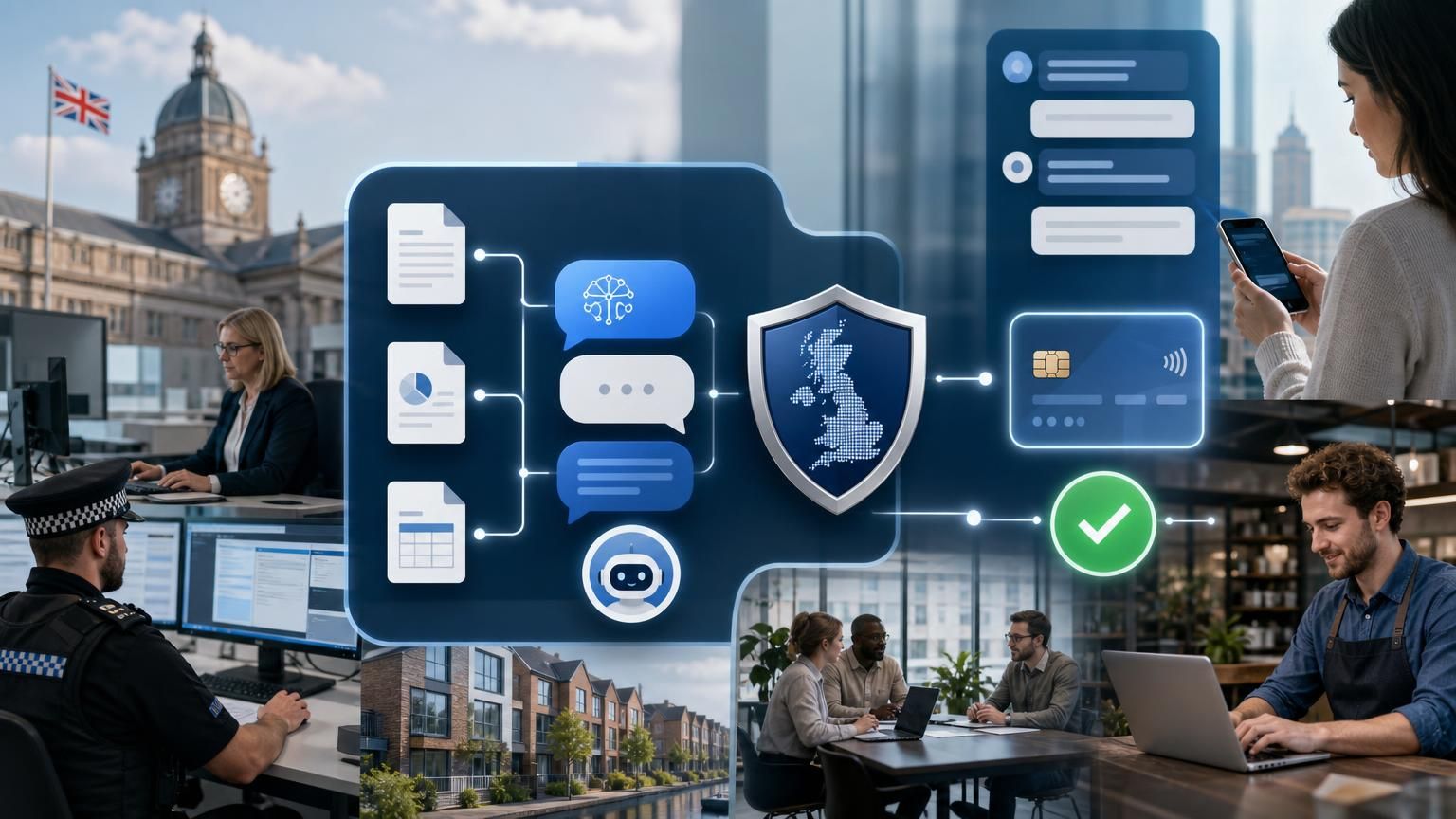
Why councils and regulated teams should treat chat as a transactional channel
Live chat is no longer just a front‑door FAQ. For UK councils, housing associations, police and other regulated teams, it can become a secure, auditable channel for payments, e‑signatures and low‑risk authorisations — if designed correctly.

Digital contact volumes are rising and councils are under pressure to move residents to online services while keeping control of data, audit trails and accessibility. The Local Government Association highlights the push for unified digital front doors and joined‑up customer records to reduce phone demand and improve resident experience. (local.gov.uk)
A pragmatic transactional live chat reduces back‑office work: when a resident can pay a parking fine, authorise a tenancy request or sign a simple consent form inside the same chat, downstream casework is shorter and error rates fall. Live chat also retains the conversion benefits of real‑time support — research shows live chat can lift conversions by as much as 20% when used to answer high‑intent questions quickly. ()
The three chat architectures and why only one fits regulated transactions
Before you design payments-in-chat, pick the right AI model. They are not interchangeable.
Rule‑based chatbots
- Deterministic flows, good for form filling and simple menus.
- Pros: predictable, easy to audit; cons: brittle for natural language and exceptions.
Pure LLM bots (large language models)
- Powerful natural language understanding and freeform answers.
- Pros: fast, flexible; cons: hallucinations, weak provenance, data residency risks unless tightly controlled.
Hybrid AI live chat (recommended for UK regulated use)
- Hybrid = RAG (retrieval‑augmented generation) knowledge + LLM for language + deterministic workflows + human handoff.
- Pros: instant, context‑aware answers with a verifiable source, automatic triage and secure handoffs to agents when needed.
Hybrid AI gives you the UX of an LLM with the auditability and control of rule‑based systems — essential when money or legal consent is involved.
Transaction types you can safely enable in chat (and when to stop)
Enable inside chat
- Small payments (parking, fines, immediate fees) processed via a hosted payment integration.
- Consent capture (simple e‑signatures or checkboxes) with timestamped records.
- Identity light‑checks (confirm name, DOB, last 4 digits) for low‑risk actions.
Hold for human verification
- High‑value payments or legally sensitive signatures.
- Complex welfare decisions, safeguarding or anything requiring professional judgement.
Design rule: if the action could materially disadvantage a resident, route to a human agent with an auditable briefing produced by the hybrid AI.
Architecture checklist: how to build a compliant UK-hosted transactional chat
- UK hosting and data sovereignty: keep chat transcripts, PII and audit logs on UK infrastructure to meet public‑sector procurement expectations and data‑sovereignty policies. (This is non‑negotiable for many councils and police forces.)
- Use RAG for knowledge accuracy: bind the AI to curated, versioned documents (policy pages, service FAQs, payment terms). RAG gives answers a source pointer so every automated suggestion is provably linked to a document. See how RAG‑based agent knowledge works in practice. https://imsupporting.com/feature-rag-based-ai-agent-knowledge.php
- Hosted payments (do not collect raw card data unless you are PCI‑ready): where possible, use a hosted payment solution or API designed for public bodies. GOV.UK Pay is the government‑approved option for many local authorities and provides a PCI‑compliant path for card handling; councils can integrate without direct card storage. (payments.service.gov.uk)
- Encryption and data security: apply strong encryption to session state and logs, and follow ICO guidance on technical controls for personal data. Keep keys, logs and redaction controls in the UK. (ico.org.uk)
- Audit trails and immutable records: capture a full transcript, the RAG source links used to generate each AI suggestion, timestamps for consent, and a signed human handoff note when agents take over.
- Policy‑as‑workflow: bake compliance checks into chat workflows — e.g. a pre‑payment consent step, a check for vulnerable‑person flags, or an automatic escalation trigger for high‑risk keywords.
- Minimise scope of LLM access to PII: treat the LLM as a stateless language layer and keep PII in a controlled context store that can be redacted or purged on demand.
For practical hybrid workflows that do exactly this, examine IMSupporting’s hybrid AI chat workflow features. https://imsupporting.com/feature-hybrid-ai-chat-workflows.php
Technical patterns that reduce risk and procurement friction
- Tokenised payments: use one‑time payment tokens or hosted iframes so your chat UI never touches card numbers. GOV.UK Pay supports telephone and online payments without merchants needing to store cards. (payments.service.gov.uk)
- Ephemeral session context: persist minimal session state for the duration of transaction and archive a redacted audit log for long‑term record keeping.
- Explainability UI: show the resident which documents the AI used to answer their question (policy link, council page, receipt number). That reduces complaints and provides quick FOI‑style traceability.
- Automated receipts + case IDs: once a payment or authorisation completes, issue a stamped receipt and create a case record with the chat transcript and the RAG source list.
UX and accessibility — what residents expect
- Make it obvious when a chat is transactional: label buttons “Make a payment” or “Sign consent”.
- Offer assisted digital fallbacks: phone payments, in‑person options and language support are still required under public‑sector accessibility duties.
- Keep sessions short and mobile optimised — most residents will complete transactions on phones.
Compliance quick wins for procurement and security reviewers
- Show a UK‑hosted deployment topology and key management plan.
- Demonstrate use of hosted payment pages or third‑party PCI providers rather than card collection inside chat.
- Publish an audit schema: what you log, retention periods and redaction rules aligned to ICO guidance. (ico.org.uk)
Three tactical project phases (90–120 days)
- Pilot: enable tokenised micro‑payments in chat for one transactional flow (parking fines or licence fees). Collect KPIs: completion rate, average time, drop‑off points.
- Harden: add RAG source linking, encrypted UK logs and an auditable human‑handoff. Run a basic security assessment against ICO guidance and PCI requirements. (ico.org.uk)
- Scale: extend to wider transactional set and integrate receipts into case management, plus staff training and SLA monitoring.
Bottom line: commercial upside and risk management
A UK‑hosted hybrid AI live chat that handles low‑risk payments and authorisations cuts friction, reduces call centre volumes and speeds up resident outcomes — but only if you combine RAG knowledge, hosted payment flows and clear audit trails. Public bodies can safely adopt transactional chat by following GOV.UK Pay integration patterns and ICO security guidance while keeping data in the UK. (docs.payments.service.gov.uk)
If you want a practical implementation that pairs RAG‑backed answers with secure workflow handoffs and UK hosting, review IMSupporting’s RAG and workflow capabilities and then talk to their team: https://imsupporting.com/feature-rag-based-ai-agent-knowledge.php and https://imsupporting.com/feature-hybrid-ai-chat-workflows.php
For a fast, compliant rollout that keeps payments off your estate and audit trails unambiguous, see how IMSupporting can help and request a demo. https://imsupporting.com/