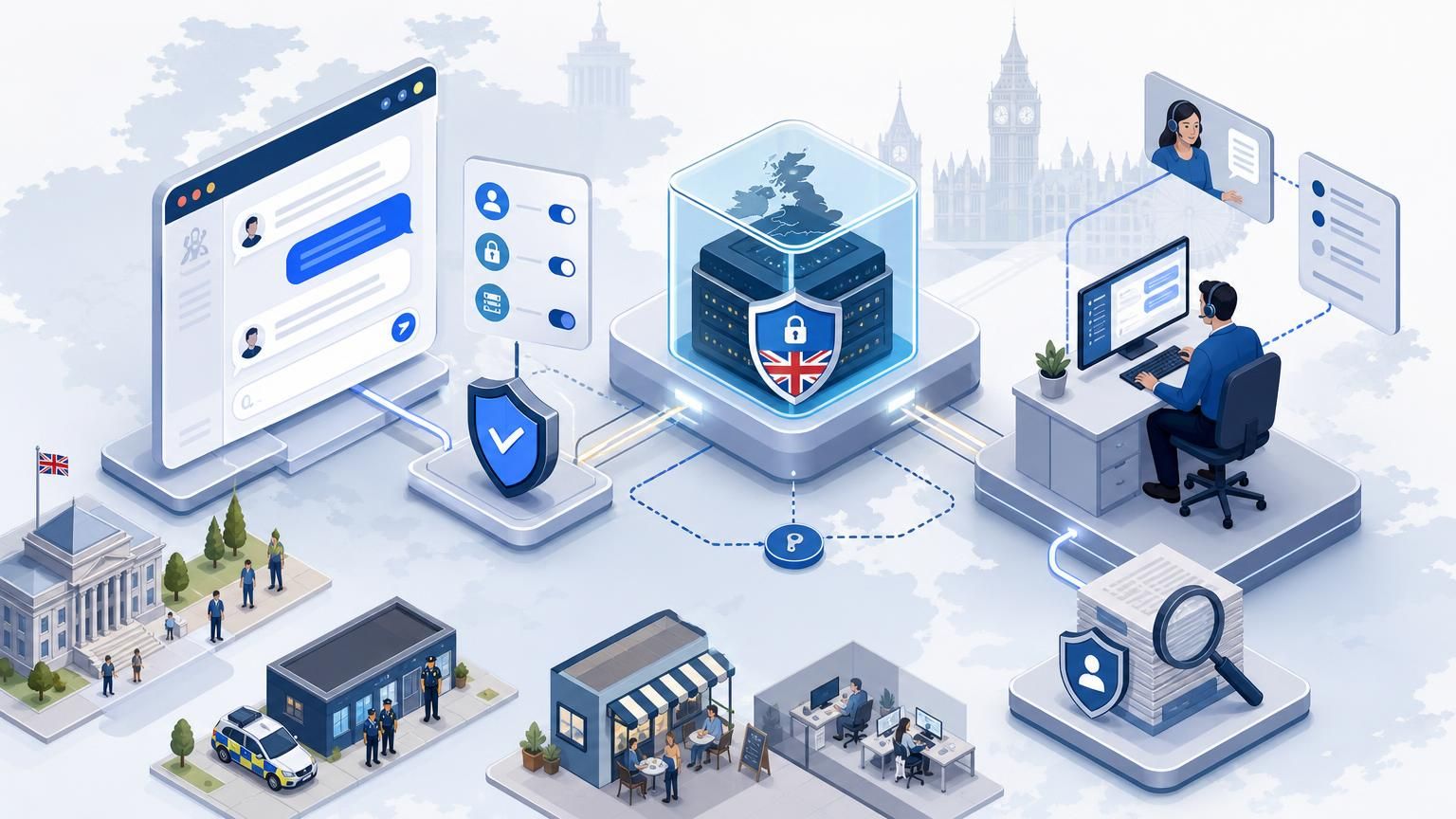
Problem statement: sloppy handoffs cost trust, time and compliance
Hybrid AI live chat promises instant answers and reduced queues — but the handoff from AI to human is where most organisations fail. Leaky, verbose transcripts and ad‑hoc context dumps create GDPR exposure, long agent on‑ramp times, poor SLAs and unverifiable audit trails for police, councils and regulated teams.

Integrating live chat can lift conversion and self‑service impact by around 20% — but only when handoffs are predictable, auditable and data‑minimised. ()
This post shows a practical, UK‑first architecture pattern for session‑safe handoffs: deterministic tokens, redaction-aware snapshots, a policy engine and reliable fallback rules that keep all production data inside UK hosting boundaries.
Three chat models and why the handoff matters
- Rule‑based chatbots: deterministic, low‑risk flows built from decision trees. Handoffs are simply URL redirects or queue placements; but context is explicit and small.
- Pure LLM bots: probabilistic, open‑ended responses. They can surface hallucinations, leak training data or retain unexpected PII unless tightly controlled.
- Hybrid AI live chat: best practice blends both — lightweight rule engines for intent and triage, an LLM for instant answers, and an engineered, auditable human handoff when confidence or complexity thresholds are hit.
Hybrid is the target architecture for UK public sector and regulated organisations. It preserves speed while giving you a deterministic handoff surface to audit.
Core design: the session‑safe handoff token
Build the handoff around a single ephemeral object: the session snapshot token.
What the token contains (data‑minimised):
- session_id and short hash of user_id (no raw identifiers)
- last N user messages (N = 2–4), with PII redaction flags, not full history
- detected intent, confidence score and classifier metadata
- list of knowledge documents referenced (IDs, not full text)
- handoff reason code (escalation, low confidence, user request)
- timestamp and TTL
What never lives in the token: full identifiers, full raw PII (nats, full address strings unless explicitly permitted), or long text blobs. Store those server‑side in an encrypted, UK‑hosted snapshot store and map them by session_id; the token is only the pointer.
Why a token works
- Minimises data sent to agents and external integrations.
- Creates a single, auditable handoff event for logs and FOI requests.
- Enables repeatable, deterministic replays for quality checks and court‑ready transcripts when needed.
Policy engine: enforce redaction, retention and provenance
Place a lightweight policy engine between the chat layer and agent UI. Responsibilities:
- Apply redaction rules (names, NI numbers, account numbers) before snapshot creation.
- Decide retention windows per data category (e.g., sensitive PII < 30 days) and auto‑prune.
- Add provenance metadata so every answer includes origin (AI suggestion, rule ID, document ID).
Align these policies with ICO expectations on purpose limitation and generative AI lifecycle controls — evidence shows regulators are focused on how generative AI uses data and purpose drift. Implement DPIAs and provenance fields accordingly. (ico.org.uk)
Fallback & escalation logic: deterministic, auditable rules
Design fallback rules as clear, testable automata rather than freeform triggers.
Key patterns:
- Confidence threshold: if LLM intent confidence < X%, create handoff token and route to human queue.
- Intent ambiguity: if two intents have similar scores, prompt a clarifying question; after two fails, escalate.
- Circuit breaker: if average AI response confidence drops across N sessions, enter degraded mode (rule‑only) and notify ops.
- SLA compensator: where public‑sector SLAs apply, auto‑open an incident ticket if human handoff waits > Y seconds, and surface fallback actions to users.
These rules keep behaviour reproducible and simplify post‑incident reviews.
Integrations: map, not duplicate
Avoid dumping token payloads into every downstream system. Instead:
- Use the token pointer to fetch curated snapshot data for CRM or case management systems on demand.
- Push only the handoff event and a small provenance bundle to audit logs and evidence stores.
- For RAG/knowledge retrieval, send document IDs (not documents) to agents and allow controlled re‑fetch with redaction applied.
ILM and connectors should be UK‑hosted or have contractual data residency guarantees for councils, police and housing associations.
Refer to practical hybrid AI workflows and tool integration patterns at IMSupporting for implementation details. (local.gov.uk) See IMSupporting’s guide to Hybrid AI Chat Workflows and API integrations for secure connector patterns: https://imsupporting.com/feature-hybrid-ai-chat-workflows.php and https://imsupporting.com/feature-ai-tool-integrations.php
Operational reliability: test, monitor, rehearse
- Canary releases for model updates with shadow traffic and rollout gating.
- Synthetic monitoring for handoff latency and token creation success rate.
- Regular privacy‑preserving replay tests: replay redacted snapshots to validate agent on‑ramp time and transcript quality.
- Incident playbook: if a snapshot contains unexpected PII, trigger a fast purge and DPIA escalation.
The ICO disclosure log shows real incidents where chatbot usage led to reported data breaches — treat that as proof that operational practices matter. (ico.org.uk)
Public‑sector considerations: FOI, evidence and retention
Police, councils and regulated teams need court‑ready chains of custody and defensible retention. Use these controls:
- Immutable handoff event records with hash‑based tamper evidence.
- Data‑minimised transcript exports that include provenance metadata for each suggested answer.
- Separate evidence vaults for long‑term case attachments (UK‑hosted) and short‑lived session snapshots.
Local council case studies show live chat significantly boosts self‑service conversion when implemented with careful governance — which is why data residency and retention policies matter in the UK. (local.gov.uk)
Quick checklist to implement session‑safe handoffs (practical)
- [ ] Build ephemeral session tokens and server‑side snapshot store (UK region).
- [ ] Implement a policy engine for redaction, retention and provenance.
- [ ] Define deterministic fallback rules and SLA compensators.
- [ ] Route only pointers and provenance to downstream systems.
- [ ] Canary model changes and run privacy‑preserving replay tests.
- ] Document DPIA and align with ICO guidance on generative AI lifecycle. ([ico.org.uk)
Final tradeoffs and recommendations
- Performance vs. privacy: store minimal context in the token; fetch expanded context on demand to preserve agent speed.
- Automation vs. control: prefer hybrid triage — automate first contact, but escalate deterministically when confidence or regulatory risk rises.
- Procurement: specify UK hosting, encryption at rest, and auditable handoff tokens in contracts for councils and regulated buyers.
For a practical, UK‑hosted hybrid AI live chat platform that already supports policy‑driven handoffs and secure tool integrations, review IMSupporting’s hybrid workflow and integrations pages and examine their privacy commitments. https://imsupporting.com/feature-hybrid-ai-chat-workflows.php https://imsupporting.com/feature-ai-tool-integrations.php
If you want a concise implementation plan and an audit checklist tailored to councils, housing associations or police teams, contact IMSupporting for a technical review and proof‑of‑concept. Start the conversation at https://imsupporting.com/ — get a UK‑hosted, auditable handoff plan that preserves SLAs and privacy.